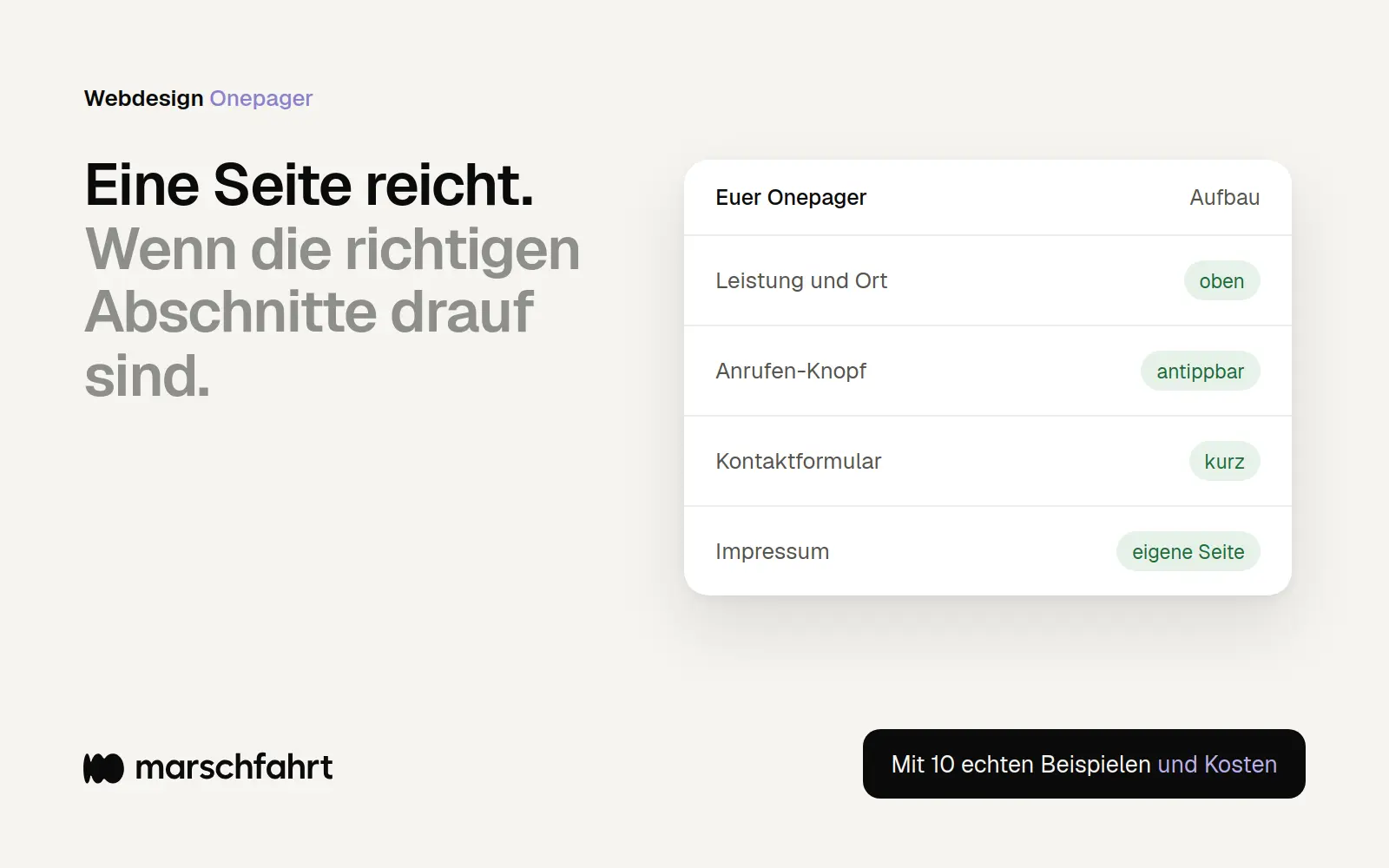
Get a Website Built at an Affordable Price: An Honest Comparison of Website Builders, Subscription Plans, and Fixed Prices
Website builders advertise “one euro a month,” and hosting plans tout “zero setup fees,” but over five years, “affordable” often looks very different. We compare all the options using real prices and show why a well-built website works like a sales representative for a small business.
Date
Category
Author

"We really need a website, but it can't cost much. Wouldn't Wix or Jimdo be enough? Or do you know anyone who could do it for a few hundred euros?"
Many inquiries we receive from small businesses start off like this, or something similar. It’s a valid question. Anyone who runs a small business—whether it’s a craft shop, a medical practice, or a small restaurant—doesn’t have a marketing budget of several thousand euros lying around. And the options are endless: website builders for one euro a month, hosting providers offering “we’ll build it for you” services, website subscriptions, freelancers, fixed-price packages, and agencies.
The problem isn't that there aren't enough affordable options. The problem is that the price on the ad banner is almost never the price you end up paying. And just because a website exists online doesn't mean it will generate any inquiries.
In this article, we walk you through all the options, using actual prices from providers as of October 23, 2026. We name the companies, calculate the costs over five years, and openly point out the pitfalls—even with our own offering. And we show what a well-designed website can do for a small business when it’s built to handle inquiries.
In a nutshell (as of October 23, 2026)
There are six ways to have a website created affordably: using a website builder yourself, through a hosting provider’s website-building service, via a website rental agreement, through a freelancer, with a fixed-price package, or through an agency. The key figures:
According to Stiftung Warentest, website builders cost between €43 and €257 in the first year. The testers warn: “In the second year, it often becomes significantly more expensive.” STRATO Plus, for example, costs €1 for 12 months and then €12 per month.
You can't transfer a finished website from Wix, Jimdo, or IONOS. If you switch platforms, you'll have to start from scratch.
According to our calculations, IONOS and STRATO's website-building services cost between €2,000 and €5,500 gross over five years, and the site will only remain active through the service.
According to our calculations based on the rates set in the 2010 and 2011 court rulings, website lease agreements with a 48-month term cost approximately €6,400 to €9,800 net.
Our fixed-price package costs €999 (net) as a one-time fee, or €1,269 (net) with hosting for five years.
The key factor is whether the site generates inquiries. In our analysis of 734 Cologne-based tradespeople’s websites, only 2.2% were fast, easily accessible, and featured a clickable phone number.
Six Ways to Create an Affordable Website
Every path has its merits, but each comes at a different cost: sometimes money, sometimes your time, sometimes your freedom to change course later on.
1. Build it yourself with a website builder
Sign up with Wix, Jimdo, IONOS, STRATO, Squarespace, or Hostinger, choose a template, and fill it out yourself. This is the cheapest option, but you’re responsible for the layout, text, photos, and legal notices.
2. Book a web hosting provider's website development service
IONOS, STRATO, and directory providers will build your website for a setup fee and a monthly payment. It's convenient, but the site will only stay up as long as you keep paying.
3. Sign a website lease agreement
A provider builds the website, and you pay a fixed monthly amount over 24 or 48 months. At first, this seems like a good deal, but over the course of the term, it often ends up being the most expensive option, and the website usually belongs to the provider.
4. Hire a freelancer
Freelancers usually charge by the hour. So the cost of the website depends primarily on the amount of work involved. On top of that, there are platforms like Fiverr or Upwork, where the quality varies widely.
5. Purchase a fixed-price package
A clearly defined scope at a fixed price. Our website for €999 falls into this category: predictable, but with a limited scope.
6. Hire an agency
The agency plans, writes, designs, and builds custom solutions. This isn't "inexpensive" in the sense of a cost-saving measure, but it's the right approach for some businesses.
The table shows how this breaks down over five years. You can find a more detailed breakdown with a calculator tailored to your specific situation on our page about website costs.

The costs for the six options in the first year and after five years, based on our calculations using the providers’ pricing pages (as of October 23, 2026), the rates from rulings by the Düsseldorf Regional Court (2010/11), the 2026 Freelancer Compass, and Sellwerk’s Cost Guide. The website builder and hosting service are listed at gross prices; the remaining options are listed at net prices.
Here's how we did the math
Website Builder: STRATO Plus costs €12 in the first year and €144 per year thereafter, totaling €12 + 4 × 144 = €588 over five years. Wix Light costs €199.92 per year, totaling €999.60 over five years, plus the domain fee starting in the second year. Hostinger Premium costs about 142 € gross for 48 months in advance, about 143 € in the fifth year, for a total of about 285 € plus the domain. This results in a range of about 290 to 1,000 € gross, not including your labor costs.
Web Hosting Service: The most affordable package is STRATO Basic, with a one-time setup fee of 200 € and a monthly fee of 30 €; over five years, that comes to 200 + 60 × 30 = 2,000 €. The most expensive is the IONOS Package 3, with a €399 setup fee and €85 per month; over five years, that comes to €399 + 60 × 85 = €5,499, gross in each case.
Lease Agreement: In the Düsseldorf court rulings, the monthly payments ranged from €130 to €200 plus sales tax, over 48 months, plus a €199 connection fee. Based on these payments, our calculation comes to €6,439 to €9,799 net—after just four years.
Freelancers: Here we’ve made an assumption that isn’t based on a specific source: 25 to 40 hours for a small company website at 90 to 110 € per hour, for a total of 2,250 to 4,400 € net. For ongoing costs, we used the range from the Sellwerk guide (€20 to €60 per month). Over five years, this amounts to approximately €3,450 to €8,000 net.
Fixed price of €999: A one-time fee of €999 plus €5 per month for hosting. If you register a new domain, the first six months are free: €999 + 6 × 5 = €1,029 net for the first year; €999 + 54 × 5 = €1,269 net over five years. If you use an existing domain, the total over five years is €1,299 net.
Small agency: €2,500 to €8,000 one-time fee plus €40 to €120 per month, according to the Sellwerk range. Over five years, approximately €4,900 to €15,200 net.
What none of these figures take into account: your own hours, subsequent renovations, a new build after switching providers, and the value of the inquiries a website does or does not generate.
Website Builders Compared: Prices and Catch-22s of the Major Providers
For many people, website builders are the first option that comes to mind when looking for an affordable solution. We’ll take a closer look at each one, including the minimum plan required for a business with its own domain. All prices are taken from the providers’ pricing pages, as accessed on October 23, 2026, from a server in Germany. Promotional prices change frequently, so always check the current page before making a purchase.
Wix
Wix is the world's largest website builder. According to W3Techs, it powers 4.2% of all websites. The pricing plans are: Light at €16.66, Core at €29.75, Business at €40.46, and Business Elite at €177.31 per month, each including VAT and when paid for a full year in advance. The website does not list the cost for monthly payments.
The catch: The domain is free only for the first year, as are the “legal texts that protect against cease-and-desist letters.” The Light plan allows for four forms for inquiries. According to the Terms of Service, Israeli law applies, with Tel Aviv as the venue for legal proceedings, unless mandatory law provides otherwise. And according to Wix Help, a Wix site must run on Wix’s servers. You can only take the domain with you.
Jimdo
Jimdo is based in Hamburg. The website plans cost €12 for Start, €20 for Grow, €29 for Grow Legal, and €50 for Unlimited per month, each with a 12-month term and including VAT. The free plan isn't suitable for businesses: it only includes a jimdosite.com address, no custom domain, Jimdo ads, five pages, and no advanced SEO settings—that is, settings for Google.
The catch: The domain is free only “for the first contract term.” Legal documents are only available with the Grow Legal plan, which costs €9 more per month than the Grow plan. File uploads via forms—for example, photos of damage—are only available starting with the Grow plan. And according to Jimdo Help: “Jimdo also does not offer a feature for creating a backup on your own.” (This help article is from the section for the older Jimdo Creator; we couldn’t find a separate export page for the current website builder.)
IONOS MyWebsite Now
The IONOS website builder is offering promotional prices: Starter for €6 for six months (instead of €12), Plus for €1 for twelve months (instead of €18), and Pro for €18 for six months (instead of €33), all per month and including VAT.
The catch: The page doesn’t explicitly state what applies after the promotion ends. The crossed-out price seems to be the obvious indication, but this hasn’t been confirmed. There’s also no specific minimum term listed for each plan. Regarding the domain, the page contradicts itself: at the top it says “Free domain of your choice,” while the plan comparison states “Domain free for one year.” According to IONOS Help, website builder projects cannot be used outside the IONOS infrastructure, and licenses for images from the IONOS image pool cannot be transferred.
STRATO Website Builder
The STRATO website builder has one of the widest price ranges in this comparison. For a 12-month term, the Plus plan costs €1 per month for the first 12 months and €12 per month thereafter. The Basic and Pro plans are free for the first month; after that, they cost €7 and €18 per month, respectively. For a one-month term, the cost is €9, €15, or €20 per month, plus a €15 setup fee.
The catch: After the promotional year, Plus costs twelve times as much. On the plus side: STRATO is the only provider in our comparison that includes the domain “permanently.” We haven’t found an official statement on whether a STRATO site can be exported.
Squarespace
Squarespace is known for its elegant templates. With annual billing, Basic costs €14.28, Core €21.42, Plus €38.08, and Advanced €82.11 per month; with monthly billing, the prices are €20.23, €28.56, €49.98, and €94.01. You can cancel your subscription at any time, and a cookie banner is built in.
The catch: The free domain is only available with an annual subscription and only for the first year. Google Workspace for email is free only with select subscriptions and only for the first year. The export only works partially—as a WordPress file containing layout pages, text blocks, and image blocks. According to Squarespace Help: “Only one blog page is exported.” Style settings, custom design rules (Custom CSS), store pages, and calendar pages are left behind.
Webflow
Webflow is geared more toward designers than toward businesses that want to build their own sites. The Basic plan costs $15 per month when paid annually ($25 per month); the Premium plan, which includes a CMS (content management system) for blog posts and the like, costs $25 or $39. Taxes are added, and a domain is not included.
The catch: It's more difficult to use than Wix or Jimdo. On the other hand, Webflow offers the best way to export your work: With the Core Workspace subscription ($19 per month when billed annually), you can export the code as HTML and CSS. However, you cannot export content from the CMS.
Hostinger Website Builder
On October 23, 2026, the Hostinger Website Builder featured a Black Friday promotion: Premium for €2.49 per month, Unlimited for €3.49.
The catch: There are three. First, these are net prices; Hostinger is the only provider in this comparison that advertises prices without VAT. The gross price for the Premium plan is around €2.96. Second, the price applies only if you pay 48 months in advance—that is, €119.52 net or around €142 gross in a single payment. Third, the Premium plan automatically renews at €9.99 net per month. The domain and email accounts are free only for the first year. According to Hostinger support, if you want to switch providers, you’ll have to copy text, save images individually, and rebuild the layout from scratch.
On the Sidelines: Framer, Google Sites, and Shopify
We build our own websites using Framer, a tool similar to a website builder, with plans starting at $10 per month when paid annually. We’ll explain what this means for this comparison later on. Google Sites is free with a Google account, but it’s very limited for a business website. Shopify is an e-commerce platform starting at €27 per month when paid annually, and it’s too robust for a simple business website.

Starting prices, post-promotion prices, and export options for the most popular website builders. Sources: Pricing pages and help centers of Wix, Jimdo, IONOS, STRATO, Squarespace, and Hostinger, accessed on October 23, 2026. Webflow is mentioned only in the text because its prices are in U.S. dollars.
The Real Drawbacks of Building Blocks
Building sets aren't bad. But they have drawbacks that aren't mentioned on the product pages. First, let's dispel a common misconception found in many guidebooks.
No downside: the charging time
"Website builders are slow" is something you often hear. The data tells a different story. The HTTP Archive's Technology Report analyzes real-world measurement data from the Chrome browser. In September 2026, 98% of Jimdo sites and 91% of Wix sites in Germany met all three Core Web Vitals—Google’s metrics for load time, responsiveness, and layout stability—when viewed on mobile devices. For WordPress, the figure was only 63%. Squarespace scored 80%, while Webflow and Framer each scored 81%.
Our own findings in the Cologne Crafts Website Report dated September 11, 2026, do not contradict this. There, we used Google PageSpeed Insights to measure performance—specifically, a loading time score on a scale of 0 to 100. The median score was 70 for 32 Wix sites, 69 for 26 Jimdo sites, and 64 for 310 WordPress sites. Squarespace scored 54, though this was based on only 12 sites. In the case of WordPress, this is likely due less to the system itself than to many poorly maintained installations. You can find the detailed comparison in our article “WordPress, Wix, Jimdo, TYPO3: Which System Loads the Fastest in Cologne?” So using load time as an argument against website builders misses the point.
1. The introductory price is valid only for the first year
Almost every web hosting package advertises a price that jumps after twelve months or sooner: STRATO Plus from €1 to €12, IONOS Plus from €1 to presumably €18, and Hostinger to €9.99 net after four years of prepayment. Stiftung Warentest compared 16 website builders (test 02/2024) and found costs ranging from 43 to 257 € in the first year, adding: “In the second year, it often becomes significantly more expensive.” All of this is clearly stated. Yet people who focus only on the large number still plan based on a price they’ll pay for just one year.
2. The free domain is usually only free for one year
Wix, Squarespace, Hostinger, and IONOS explicitly state “1 year,” while Jimdo refers to the “initial contract term.” Only STRATO lists the domain as “included indefinitely.” More important than the price, however, is who the domain is registered to and how you can transfer it when switching providers. With Wix, for example, a domain registered through Wix remains active even after the Premium package is canceled and must be canceled separately. We show you how to transfer a domain without any downtime in our guide, “Transferring a Domain Without Downtime.”
3. No export: If you switch, you have to start over
That’s the biggest drawback for us. Wix, Jimdo, and IONOS don’t offer a website export feature. Squarespace only allows a partial export, while Hostinger requires rebuilding the site manually. Only Webflow allows a code export—but even that comes at an additional cost and excludes CMS content.
In practical terms, this means: The time you invest in your website builder page stays with the website builder. If you need more in three years or the provider raises its prices, you can copy your text and save your images. You’ll have to rebuild the rest from scratch.
4. You'll be responsible for the text, photos, layout, and legal notices yourselves
A website builder provides the technology and a template. It doesn't determine what goes on the page. You decide which sections to include, what the headings say, which services to list, which photos to display, and what goes in the legal notice. That's the bulk of the work involved in creating a website.
Almost all website builders now have AI assistants. Jimdo promises that you’ll be “online with the right content in less than 5 minutes.” IONOS creates a website—with five pages by default—based on your industry and keywords. What these assistants can’t provide: real photos of your business, your testimonials, your prices, and what sets you apart from the local competition. The AI fills the template with generic industry text. We put this to the test in our own experiment: Website Builder or AI Website?
When it comes to legal texts, you are personally liable—even on a website builder. Here’s an example that has affected many businesses: On January 20, 2022, the Munich I Regional Court ruled (Case No. 3 O 17493/20) that embedding Google Fonts without consent unlawfully transmits visitors’ IP addresses to Google. The court awarded €100 in damages. This was followed by a wave of cease-and-desist letters, which later became the subject of an investigation into cease-and-desist letter fraud. We have not verified whether individual website builders still load fonts from Google servers today. The point is a different one: The operator remains responsible for the site, not the website builder.
5. It takes up your time, and time isn't free
Stiftung Warentest titled its press release about the test “Website Design in One Hour.” It’s true that a rough draft can be put together quickly. But a website that clearly explains your services, looks good on a cell phone, is legally sound, and appears in Google search results for the right keywords takes significantly longer to create. Be honest with yourself about how many evenings you’ll need to set aside for this and what an hour of your time is worth to your business.
6. The Template Look
If you choose a popular template, your business will look just like many others. For a café, that’s no big deal. But for a business that has to compete against five rivals in the same town, it’s a different story. Templates are designed for the average business, not for yours.
7. Limitations of Forms and Functions
The affordable plans are limited precisely where inquiries arise. Wix Light allows four forms. Jimdo Free includes one form; file uploads aren’t available until the Grow plan, which costs €20 per month. Webflow Starter allows 50 form submissions and two pages. Anyone who later wants a multi-step inquiry form, an appointment booking feature, or integration with their office software will quickly hit the limits.
8. U.S. Providers, Foreign Law, and Data Protection
From a factual standpoint: Wix is based in Israel, Webflow in the U.S., Squarespace enters into contracts with EU customers through Squarespace Ireland Ltd., and Hostinger through Hostinger International Ltd. Wix, Squarespace, and Webflow rely on the EU-U.S. Data Privacy Framework for data transfers, while Hostinger relies on standard contractual clauses. Framer, which we use, also transfers data to the U.S., relying on either the Data Privacy Framework or Standard Contractual Clauses. This is a legally viable approach. However, Stiftung Warentest rated the basic protection of personal data as only “satisfactory” or “adequate” for 10 out of 16 providers and notes that Wix “missed out on a better grade due to shortcomings in its privacy policy and terms of service.” Jimdo, IONOS, and STRATO are German providers. None of this is a reason to rule them out, but it’s something you should be aware of.
9. Built does not mean sold
The biggest drawback has nothing to do with the tool itself. Just because a website is online doesn’t automatically mean it will generate inquiries. A website builder ensures that the site works. It doesn’t ensure that a visitor will understand within ten seconds what you do, for whom, and in what area—and then call you with a single tap. In Cologne, only 31% of the accessible tradespeople’s websites even had a contact form, and this applied to WordPress sites just as much as it did to website builders. It’s a planning problem.
That’s why we’re open about it—even when it comes to our own work: The tool isn’t the problem. We build our own sites using Framer, which is more like a modular system than classic WordPress. Even a Framer site can’t be exported as finished code. Anyone who leaves our package will have their project transferred to their own Framer account and will then pay Framer directly (plans start at around $10 per month). So the difference between this and building it yourself isn’t in the technology. It lies in who plans the site, writes the text, tailors each section to specific requests, and sets out in writing who owns the domain, the content, and access rights.
When a Building Set Is All You Need
Let's be fair: There are cases where a modular system is the right choice, and hiring an agency would be overkill.
You're just starting out and have no budget. A simple website with your name, services, phone number, and legal notice is better than nothing at all. Choose a plan that includes your own domain—don't go with a free plan.
You enjoy writing and have some free time. If you enjoy writing and taking photos, you can put together a nice website in just a few weekends using Jimdo or Wix.
The website doesn't have to generate leads. It could be for a club, a hobby project, or a way to stay in touch with existing customers.
You know that you'll be building a new one in a year or two anyway. So the lack of an export feature doesn't matter.
Then keep three things in mind: the price starting in the second year, a domain registered in your name, and a phone number that customers can tap at the top of the page. If you do that, you’ll already be better positioned than more than half of the Cologne-based trades businesses in our survey.
When the Hosting Provider Builds: IONOS, STRATO, and Directory Publishers
Those who don’t have time to build a website themselves often end up using the website-building services offered by major hosting providers—that is, companies that offer storage space and website hosting on their servers. They appear at the top of Google’s search results when you search for “affordable website creation,” and they sound reasonable: a manageable setup fee, monthly payments, and maintenance included.
IONOS Website Design Service
On the “Create a Website” page , IONOS offers three packages, all inclusive of VAT: Package 1 with three pages for a one-time setup fee of €199 and €45 per month; Package 2 with five pages for €299 and €65 per month; and Package 3 with seven pages for €399 and €85 per month. Each package includes a domain and five email accounts, and the website is built using WordPress. The minimum term is twelve months; after that, the contract can be canceled with one month’s notice.
The key point is stated in the Terms and Conditions (as of July 2023): “The website can only be used in combination with the Website Design Service.” And: “IONOS has exclusive administrative access to the website and its content.” The Terms and Conditions do not specify what happens to the website after the contract ends. For stock photos that IONOS incorporates, you are responsible for the license after acceptance. According to our calculations, Package 2 costs €299 + 24 × 65 = €1,859 gross over two years, and €4,199 gross over five years.
STRATO Website Design & Maintenance
STRATO offers three packages, including VAT: Basic with one page for €30 per month (listed at €200 for setup in one place, and €0 for setup in another), Plus with seven pages for €50, and Pro with seven pages and SEO services for €70 per month. Each package includes two hours of maintenance per month, three domains, and three email accounts. Content creation costs an additional one-time fee of €100.
The website does not specify a minimum term, nor does it say whether you can transfer the site. Since it is based on the STRATO website builder, it is unclear whether a transfer is possible. According to our calculations, Pro costs €4,200 gross over five years.
Directory Publishers via Sellwerk
Regional directory publishers, which also publish the Yellow Pages and Das Örtliche, sell websites under the Sellwerk brand: starting at €54.90 per month according to the Sellwerk website, with up to three pages designed by a personal web designer, including a legal notice and privacy policy. Setup costs and the minimum contract term are not listed on the shop page. According to their product descriptions, other Sellwerk products have a minimum contract term of twelve months and renew automatically. We were unable to determine whether this also applies to the website. Based on our calculations, the total cost over two years—excluding setup fees—comes to at least €1,317.60.
These services aren't unreliable. They're convenient and a good fit for some businesses. But they're a subscription, not a one-time purchase. If you cancel, you usually no longer have a website.
Website Lease Agreements: How They Work and What the Federal Court of Justice (BGH) Has to Say About Them
Website rental agreements—sometimes also called website subscriptions, Internet system contracts, or all-inclusive packages—are the option most likely to lead to regret later on. Not because the model is illegal, but because people rarely consider the total cost when they sign the contract.
Here's How a Lease Expires
This typical pattern is well documented by rulings of the Düsseldorf Regional Court from 2010 and 2011: a minimum term of 48 months, with the monthly fee due annually in advance, plus €199 in connection or sign-up fees, plus sales tax. The monthly payments were €130 (22 S 64/10), €135 (22 S 12/10, “Type A Premium” contract), and €200 (23 S 27/10, “Euroweb Premium Shop 5000” contract), each plus sales tax. We were unable to find reliable current average prices for such contracts. However, offers with monthly fees still appear in search results today; for example, in our search on October 23, 2026, we found results such as “starting at €49” or “starting at €199” per month.
Sample Calculation Over 48 Months
Let’s take the contract from the ruling of August 27, 2010 (22 S 12/10): €135 net per month, 48 months, €199 connection fee. Our calculation: 48 × €135 = €6,480; plus €199 equals €6,679 net, which comes to €7,948.01 gross with 19% VAT. With annual prepayment, €1,620 net is due for the first year alone.
By comparison, here’s a provider that’s transparent: The agency XICTRON calls its website subscription plan “Basic,” with a €490 setup fee and €129 net per month for a 24-month term, and openly states that the rights to the website’s implementation remain with the agency under the subscription. If you want to buy it outright, you can do so for €1,990 net. So a subscription isn’t automatically a trap. The key is that you know what you’re signing up for.
What the Federal Court of Justice Ruled
In 2010, the Federal Court of Justice classified such an Internet system contract as a contract for work and services because the focus is on the end result—that is, the completed and accessible website (BGH, judgment of March 4, 2010, III ZR 79/09). This is important because, as the client, you can terminate a contract for work and services at any time. The Federal Court of Justice did not object to the annual advance payment.
The 2011 rulings state: “The customer may terminate a contract for work and services—under which the contractor has undertaken to provide, design, and maintain a website for a minimum contract term of 48 months—at any time in accordance with Section 649, sentence 1, of the German Civil Code (BGB).” The customer—in this case, you as the client (Federal Court of Justice [BGH], judgments of January 27, 2011, VII ZR 133/10, and of March 24, 2011, VII ZR 111/10, among others). Following termination, the provider must specifically detail what services have already been rendered and what costs have been saved. A lump-sum invoice based on installments is not sufficient. Today, the right of termination is set forth in § 648 BGB. The provider retains the remuneration minus any expenses saved; for the portion not performed, 5% is presumed.
There are two caveats. First, this applies to contracts that qualify as contracts for work and services. If a contract is structured as a lease or a service contract, the situation may be different. Second, as a business, you are not considered a consumer. The rules that protect consumers from long contract terms do not apply to you. If you have a specific contract, consult a lawyer.
How to Recognize a Lease Agreement
A lower setup fee—or none at all—in exchange for a fixed monthly payment over 24 or 48 months.
The website does not belong to you. Watch out for phrases such as “We retain the rights to the implementation” or “May only be used in conjunction with the service.”
Advance payment for an entire year, often shortly after signing the contract.
There's no rule regarding the end of the contract. What happens to the website, text, images, and domain if you cancel?
Pressure to Sign. The Lübeck Chamber of Crafts issues a general warning against sales representatives who pressure local businesses into signing contracts: verbal promises not included in the contract, advance payments, and time pressure. Their warning applies to contract brokers, but the same pattern holds true for website contracts.
The domain is registered with the provider. Find out who the owner is according to the registration.
If you're unsure whether a document on your desk is a lease agreement, send it to us via our contact form. We'll calculate the total cost over the term of the lease for you—free of charge—and let you know what questions regarding ownership and termination you should ask the provider or a lawyer.
Freelancers and Platforms: The Pros and Cons
A good freelancer can be an excellent choice: a direct point of contact, no agency overhead costs, and often greater flexibility. According to the Freelancer Compass 2026 by freelancermap, the average hourly rate is €103, based on a survey of 5,412 freelancers conducted between November 2025 and February 2026. By country: Germany €103, Austria €101, Switzerland €133 per hour.
Here’s a sample calculation based on our estimate of the number of hours: For a small company website requiring 25 to 40 hours at a rate of 90 to 110 €, the total comes to 2,250 to 4,400 € net. That’s an honest estimate of the work time, but it’s not cost-effective in terms of search engine optimization.
What's Good
You'll get a custom page instead of a template.
The site usually belongs to you if that's what the contract says.
A local freelancer often knows your market.
What's Risky
Dependence on a single person. If the freelancer gets sick, changes jobs, or is unavailable, you’ll be on your own. Make sure to clarify in advance who has access and where that information is documented.
Maintenance. Many freelancers build their sites using WordPress. That’s not a problem as long as someone maintains the site. Patchstack identified 11,334 new security vulnerabilities in the WordPress ecosystem for 2025—42% more than the previous year. Ninety-one percent of these were found in plugins, or extensions. For the most dangerous vulnerabilities, it took attackers an average of just five hours to exploit them. A WordPress site without a maintenance contract is therefore a real risk. Depending on the provider, maintenance costs roughly €30 to over €200 per month; the Austrian agency VCAT lists prices ranging from about €72 to €238 per month in its 2026 price list.
Platforms like Fiverr or Upwork. You can find very affordable offers there, often from abroad. User reviews on OMR Reviews mention inconsistent quality, language barriers, misunderstandings during the briefing, and fees that can add up significantly for small jobs. You’ll need to verify for yourself whether the legal notice and privacy policy comply with German law and whether the rights to the code and images are properly transferred.
The Wix Marketplace connects you with designers who can build your Wix site. You pay the designer as well as your Wix subscription, and the site remains on Wix.
Three questions you should ask any freelancer: Do I own the website and all the files? Who handles the technical maintenance, and how much does that cost per month? What happens if you’re no longer available? For other points that should be included in a contract—whether with a freelancer or an agency—check out our article “Hiring Someone to Build a Website: Process, Contract, and How to Spot a Good Agency.”
What an Affordable Website Still Needs to Be Able to Do
No matter which path you choose, there are a few things every company website must be able to do; otherwise, it’s not worth the money—even if it didn’t cost much. We’ve evaluated four of these in Cologne, where you can see very clearly what goes wrong in practice.

The minimum requirements for a company website designed to generate inquiries. Metrics: Our own Cologne Crafts Website Report, 734 and 752 websites, respectively, measured on September 11, 2026, using Google PageSpeed Insights and our own crawl.
You should be able to tap the phone number
According to Statcounter, about six out of ten page views in Germany in September 2026 came from smartphones (59.85%; monthly figures fluctuate significantly). Anyone who wants to make a call on their cell phone taps the number. If the number isn’t set up as a link, tapping it often doesn’t work reliably. In our analysis, the number was set up as a link on only 43% of Cologne-based tradespeople’s websites, and only 37% displayed it in the top third of the page. Roofers performed best at 58%, while florists and bakeries performed worst at 23% and 24%, respectively.
We need a short contact form
Not everyone wants to call; many people prefer to send a quick inquiry in the evening. Only 31% of the websites we analyzed had a contact form. A good form asks only for the essentials and tells visitors when you’ll respond. To find out why many forms still don’t get results, read our article “Why You’re Not Getting Inquiries Through Your Contact Form.”
The page needs to load quickly on a cell phone
Google considers 2.5 seconds to be a good value for the most important loading metric (Largest Contentful Paint, or LCP for short—the time it takes for the largest piece of content to become visible). In Cologne, the median time in a lab test using a simulated mobile network was 6.0 seconds. Only 12.5% of pages met the 2.5-second benchmark, while 36.1% took longer than eight seconds. You can measure how fast your own page is using our free speed check.
The texts must answer the questions customers have before they call
What exactly do you do? In what area? How does a job work? How soon can you start? These questions come up anyway, either on the website or over the phone. A page that answers them saves you phone calls and attracts inquiries that are a better fit.
The legal notice and privacy policy must be correct
Since May 14, 2024, Section 5 of the DDG has governed legal notices (previously Section 5 of the TMG), with no changes to the content. In Cologne, 88% of websites had a recognizable legal notice and 83% had a privacy policy. This means that more than one in ten websites did not have a legal notice that we could identify.
Regarding accessibility: The Accessibility Enhancement Act has been in effect since June 28, 2025, for certain services in e-commerce. According to the Cologne Chamber of Industry and Commerce (IHK Köln), micro-enterprises with fewer than ten employees and an annual turnover or balance sheet total of no more than €2 million are exempt as service providers. Purely informational websites are generally not affected under current interpretation. However, anyone offering an online appointment booking service, for example, may fall under this law, according to the *Deutsche Handwerks Zeitung *. We explain what this means in practice in our article “Accessible Websites According to the BFSG.” Good contrast ratios are worthwhile in any case: Insufficient contrast was the most common error in Cologne, found on 62.4% of the pages.
The page must be linked to the Google Business Profile
Many customers first see you on Google Maps and click “Website” from there. According to Google, businesses with a complete profile are 2.7 times more likely to be viewed as reputable, though Google does not specify the methodology behind this. The profile and website should display the same services, hours, and contact information and link to each other. The basics for Google are also important: In Cologne, 36.1% of pages were missing the meta description—the text that Google displays below the title.
The domain must be registered in your name
No visitor will see this, but it’s the most important factor for your future. Whoever owns the domain decides where it points. Make sure to verify that you’re listed as the owner.
All in all, it’s not a long list. Nevertheless, in Cologne, only 16 out of 734 pages—or 2.2%—were fast on mobile devices (loading time score of 90 or higher), easily accessible (accessibility score of 90 or higher), and included a clickable phone number. To put this into perspective: Our sample comes from OpenStreetMap entries with associated websites, so it is not representative of all businesses, and the detection of phone links and forms via source code is an approximation. Nevertheless, the trend is clear.
A good website works like a salesperson
Almost all guidebooks on the subject discuss the cost of a website. Hardly any of them talk about what it can do. Yet a well-designed website can take over some of the work for a small business that would otherwise be done by a sales employee.
Imagine someone who does exactly four things: is available around the clock, answers the same questions to every prospective customer, filters out unsuitable inquiries, and makes a good first impression. That’s exactly what a website does when it’s built right.
Available when you're not
If you’re on a construction site, with a patient, or in the kitchen, you can’t answer the phone. Customers call anyway, often in the evening. A statistic from doctors’ offices shows just how important this is: According to Bitkom, 64% of Germans have booked a doctor’s appointment online at least once (in 2023, the figure was 36%). The most commonly cited advantage (84%): You’re not dependent on whether the office can be reached by phone. Of those who booked online, 25% used the office’s website.
The same principle applies to a small business. If someone discovers a leaky gutter at 10 p.m., they rarely call anymore. But they’ll submit a request if the form takes just a minute to fill out. The next morning, it’ll be in your inbox.
Checked before anyone calls
Most customers find a tradesperson through a recommendation, not through a website. This is clearly shown by the 2025 Bitkom survey “Finding a Tradesperson: Word of Mouth Beats the Internet”: 83% ask people they know, while 26% look at companies’ websites. However, the same survey also shows that for 40% of respondents, the lack of a website is a reason to rule out a company. And 55% find tradespeople with digital offerings more appealing.
So the website doesn’t replace the recommendation. It’s the test after that. A neighbor says, “Give Müller a call,” and before the prospective customer does that, they check to see who this Müller is. If they find nothing—or a page from 2014 with broken images—they might call someone else instead. A survey from the U.S. shows the same pattern for reviews: According to BrightLocal 2026, 54% of respondents visit a business’s website after seeing positive reviews. While this figure applies only to the U.S., the principle holds true elsewhere.
Answer questions and pre-sort inquiries
Every business is familiar with those calls that go nowhere: “Do you also do tile work?” “Do you come all the way to Bergheim?” “How much does that cost, roughly?” A webpage that answers these questions saves you from having to handle these conversations. If you clearly state which jobs you handle and which you don’t, you’ll receive fewer inquiries that you have to turn down. A form that asks for the type of job, location, and desired timeframe provides the information needed for a callback. For some jobs, a photo upload can even eliminate the need for an initial site visit. That’s exactly the kind of work an inside sales team does every day.
Be quick—because waiting costs you leads
We need to be precise here, because many articles make claims that go beyond what the studies actually show. The best-known study is “Milliseconds Make Millions” by Deloitte, commissioned by Google (data from late 2019, covering 37 brands in Europe and the U.S.). When mobile page load times were 0.1 seconds faster, the conversion rate in e-commerce—that is, the percentage of visitors who make a purchase—rose by 8.4%. According to the study, pages that collect inquiries showed consistently positive effects. The most significant results: 21.6% more visitors reached the page where the form is submitted, and there were 7% more page views. The measurements were taken across multiple load times simultaneously. It does not follow from this that every tenth of a second yields exactly the same benefit.
A more reliable example is an A/B test conducted by Vodafone in Italy, in which two versions of the page were simultaneously shown to visitors randomly assigned to each group. The version with a 31% improvement in LCP generated 8% more sales and 15% more inquiries per visit. And in 2022, the agency Portent analyzed data from 20 websites: For sites that collect inquiries from business customers, the conversion rate was three times higher with a one-second load time than with a five-second load time. It’s a small sample size, but the trend is clear.
Take Cologne, for example: There, the median time in the lab test was six seconds until the largest visible item appeared. A sales representative who stares silently at a customer for six seconds before saying “Hello” wouldn’t last long.
How much a sales representative costs, and how much the website costs
According to Stepstone, an in-house sales representative in Germany earns a median gross annual salary of €38,800 (range: €32,800 to €46,300). On top of that are non-wage labor costs: According to the Federal Statistical Office, employers pay an average of €29 in non-wage labor costs for every €100 in gross earnings (estimated figure for 2025).
Our calculation: 38,800 € × 1.29 = about 50,050 € per year, or about 4,170 € per month. Based on 220 working days per year (our assumption), that works out to about €228 per working day. The €999 for our website package thus corresponds to about 4.4 working days of an in-office employee. With hosting over five years—that is, €1,269 net—it amounts to about 5.6 working days. According to Stepstone, the median salary for field sales representatives is €48,800; in that role, €999 corresponds to about 3.5 workdays. This figure does not include the cost of a workspace, a vehicle, commissions, or the time spent recruiting the employee.
What a Website Can't Do
Being honest is part of it. A website is no substitute for a sales representative. It doesn’t conduct sales pitches, negotiate, build relationships over the years, or call existing customers. The comparison applies to the tasks that come before the first conversation: being reachable, answering standard questions, pre-screening leads, and making it easy to get in touch. And it applies only to a website that’s built specifically for that purpose. A site where you have to search for the phone number isn’t a sales representative—it’s a sign in the woods.
Our alternative: the website for €999
Our survey in Cologne shows why we designed the package this way: Many good businesses have websites that don’t work for them, and the usual alternatives are either expensive or tie you to a single provider. The €999 website package is our offering for small businesses: tradespeople, restaurants, medical practices, studios, salons, and the self-employed.
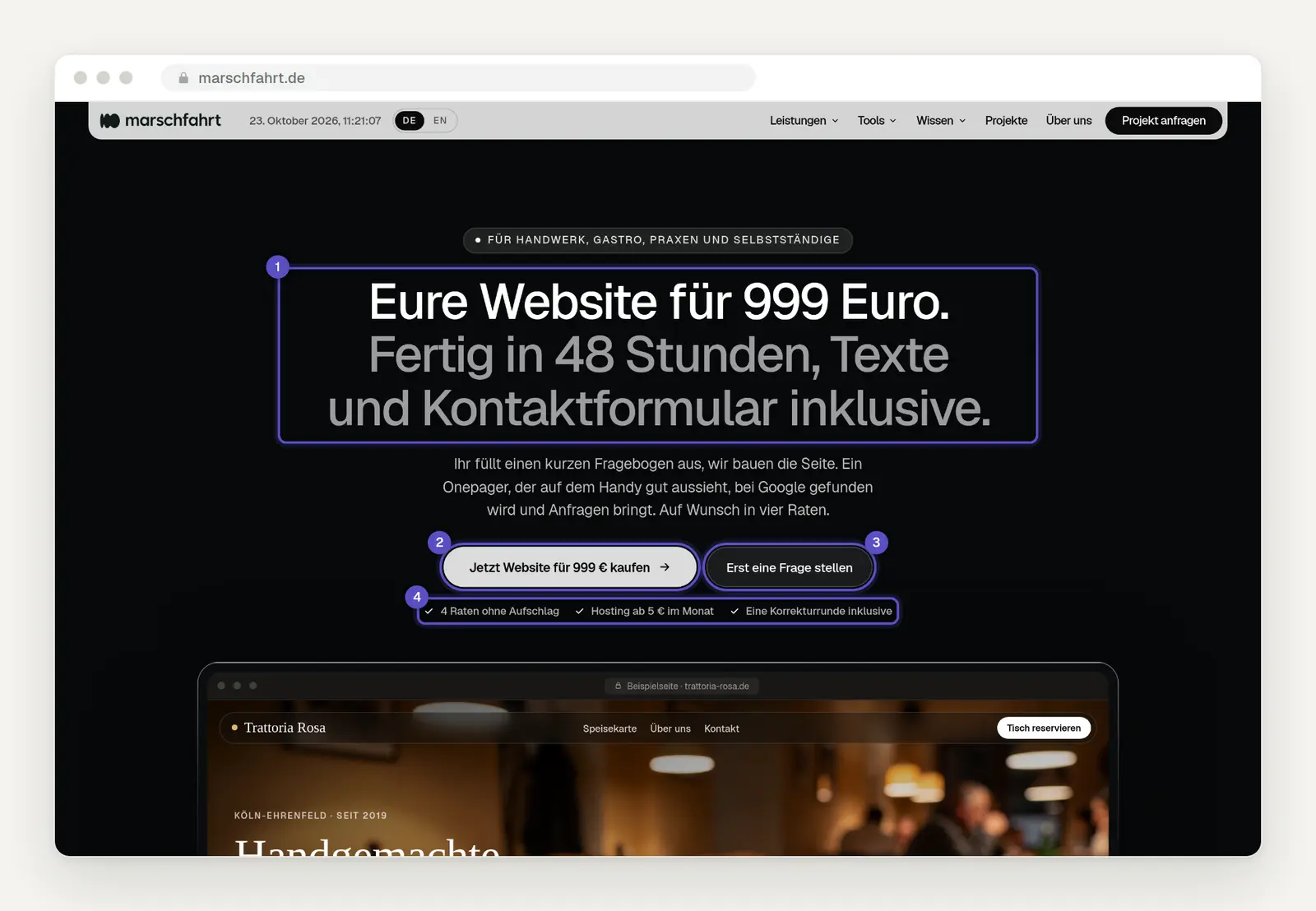
The website: a one-page site, ready in 48 hours, including text and a contact form.
What's Inside
A one-pager with up to six sections—in other words, a single, long page instead of multiple subpages.
We'll write the texts based on your answers in the questionnaire.
A contact form designed to handle inquiries.
Built with a mobile-first approach and optimized for speed so the page loads quickly on a cell phone.
Legal Notice and Privacy Policy based on a template that you fill in with your information. This is not a substitute for legal advice.
Google Basics: Page Title, Description, and Linking to Your Business Profile.
A round of corrections.
Contrast, keyboard navigation, and alt text for images are standard features.
We'll use your photos if you have any. Otherwise, we'll use royalty-free images that fit your business. Your own photos make the site look better, but they're not required.

The "What's Inside" price box: everything included in the package at a glance.
Here's how it works: live, 48 hours after the questionnaire
You purchase the package—it takes about five minutes. You’ll receive the questionnaire by email no later than the next business day. It takes about 15 minutes to fill it out: who you are, what you offer, how to contact you, and what images you have. After that, we’ll build the site within 48 hours, including the layout, text, contact form, legal notice, and basic Google setup. You’ll receive a link to a preview and have one round of revisions. Finally, we’ll connect your domain or set up a new one, go live with the site, and show you in a short video how to edit the text yourself.
Payment, Installments, and Hosting
The package costs a one-time fee of €999 plus VAT, for a total of €1,188.81. You can pay via Stripe, for example, using a credit card or Apple Pay. If you’d like, you can pay in four installments of €249.75 each plus VAT, with no additional fees. If you need more installments, please contact us.
Hosting—that is, running the site on a server—and technical maintenance cost €5 per month plus VAT, with a monthly cancellation option. If you don’t have a domain yet, the domain and web space (the storage space for the site) are free for the first six months. We’ll connect an existing domain for free, and you’ll remain the owner. Over five years, this comes to €1,269 net (€1,510 gross) for a new domain or €1,299 net for an existing one.
And the most important question of all: Do you own the website? Yes. The domain, content, and access rights all belong to you. If you decide to switch to another agency later on, that’s no problem—the project will simply be transferred to your own Framer account. There’s no minimum contract term for the website and no recurring fees that continue for years.
What the package is not intended for
A fixed price is only possible with a fixed scope. That's why we're upfront about when a package isn't the right fit:
Online stores with shopping carts and payment options.
Companies with multiple locations or more than ten employees.
Websites with many subpages, a customer portal, or a booking system.
Relaunches—that is, revamps of large existing websites that require a lot of redirects.
Projects that require many rounds of coordination and workshops.
Multilingual pages, ongoing SEO work, a photo shoot, or our ongoing maintenance of your content.
A one-pager with six sections isn’t the kind of page that will get you found on Google for twenty individual services. After the proofreading round, you can make minor text changes yourself; we offer more extensive revisions at an hourly rate, which we’ll quote upfront. If you need more than that, our regular web design service is a better fit—but not at this price.
Why the price is going up
The most expensive hours in a web project aren’t the ones spent building it. They’re the meetings: the kickoff meeting, the coordination meeting, the presentation, and the follow-up coordination meeting. For us, the questionnaire replaces these rounds. We’ve tested the structure, technology, and form in many projects and adapt them to your business instead of reinventing them from scratch every time. So the structure is fixed; it’s your text and images that make the difference. And there’s one round of revisions instead of ten.
We make our money from larger projects. The package is fairly priced—it’s not subsidized. It’s our way of ensuring that good websites don’t fail because of budget constraints.
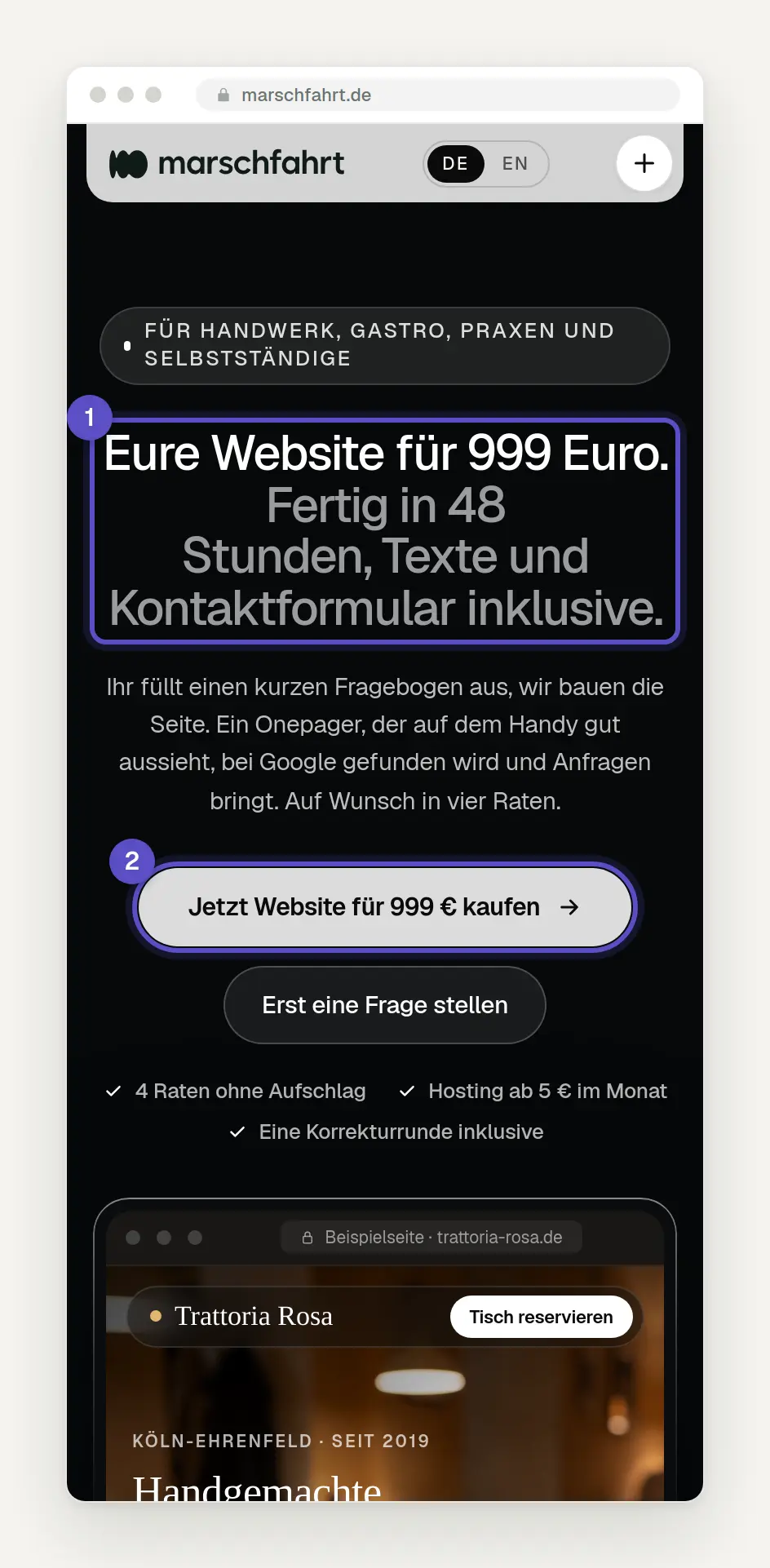
This is what the page looks like on a cell phone, which is where most of your visitors will view it.
If you have a question before making a purchase—such as whether your business qualifies—just click “Ask a Question First” on the offer page. We’ll give you an honest answer about whether the package is right for you or not.
Funding in 2026: There Are Hardly Any Grants Available for a Standard Website
Many hope that the government will help cover the cost of the website. For a standard website, this will hardly be the case in 2026. According to the Bonn Chamber of Industry and Commerce (IHK), the federal “Digital Jetzt” program expired on December 31, 2023, while “go-digital” ran until the end of 2024. We have not found any current federal programs for websites.
Although the Bavarian Digital Bonus covers up to 50% of expenses, according to Bayernportal, it expressly excludes “standard websites and online stores, as well as standard online marketing measures.” The BAFA grant for management consulting services runs through December 31, 2026, but it funds consulting services, not website development.
Ask your chamber of commerce about state programs. You can find a detailed overview in our article “Getting Funding for Your Website in 2026.” Be wary of providers who advertise “up to 80% grants” for website development without specifying the actual program.
Which approach is right for which business?
Founders with Zero Budget
Start with a website builder in a plan that includes your own domain—STRATO Plus or Jimdo Start will suffice. Make sure the price is right starting in the second year, that the domain is registered in your name, and that there’s a clickable phone number right at the top. Once you start getting your first orders, plan to switch.
A small business with a full order book
You don't have time to build a website yourself, but you need a site that makes the right impression with its recommendations, filters inquiries, and saves you from having to make phone calls. We created the €999 package specifically for this situation. Learn more on our page for trades businesses.
Practice
Many patients now prefer to book appointments online; according to Bitkom, 64% have already done so. For a practice that accepts appointment requests via a form, a one-page website is often sufficient. If you need a full-fledged online appointment booking system integrated with your practice software or multiple subpages, a custom website is the better option.
Dining
A menu, hours of operation, location, and reservations—that’s usually all a restaurant or café needs. The menu should be included on the page as text, not as a PDF, and visitors should be able to call or request a table with just a click. A one-pager is ideal for this.
A Growing Business
More than ten employees, multiple locations, and a wide range of services? In that case, a budget one-pager won’t be enough, and a website that you’ll have to rebuild in two years will end up costing you more in the long run. For situations like this, we offer our standard web design service with a customized quote.
Frequently Asked Questions
How much does an affordable website really cost?
Based on our calculations, over a five-year period, website builders cost around €290 to €1,000 gross plus your labor time; hosting services cost €2,000 to €5,500 gross; and lease agreements—based on the Düsseldorf court rulings—amount to €6,439 to €9,799 net after just four years. Our fixed-price package, including hosting, comes to €1,269 net. You can calculate the costs for your specific situation on our cost page.
Can I transfer my Wix or Jimdo site to another provider?
The site itself, no. According to Wix Help, Wix sites must run on Wix servers; Jimdo does not offer an export feature. You can take your domain, text, and images with you, but you'll have to rebuild the structure and design from scratch.
Is a website that costs €500 legitimate?
That could be the case. Check what the second year costs, whether you own the domain, whether it includes content and legal texts, and whether there’s a minimum contract term. A low price isn’t a red flag, but a lack of pricing information for subsequent years is.
How can I identify a website lease agreement?
A fixed monthly payment over 24 or 48 months, a clause stipulating that the website remains the property of the provider, and often an upfront payment for an entire year. Calculate the payment amount based on the term and compare it to a purchase price. If in doubt, consult a lawyer.
Do I own the website if I've paid for it?
Not automatically. With website builders, hosting services, and rental agreements, the site runs only on the provider’s servers; with freelancers and agencies, it belongs to you if the contract specifies so. Make sure to get written confirmation that the domain, content, and access belong to you.
Is a one-pager worth it for a business?
For many small businesses, yes. It shows on a single page what you do, who you serve, where you’re located, and how to reach you—and it’s viewed on a cell phone exactly the way customers scroll anyway. It’s not enough if you want to be found on Google for a wide range of services individually.
Are website builders slower than WordPress sites?
According to the HTTP Archive, probably not: In September 2026, 98% of Jimdo sites and 91% of Wix sites in Germany met the Core Web Vitals standards on mobile devices, compared to 63% for WordPress. The downsides of website builders include pricing starting in the second year, a lack of export options, and the extra work that falls on you.
How quickly can an affordable website go live?
According to Stiftung Warentest, you can have a template-based design in an hour, but a finished website with well-written content takes significantly longer. With our €999 package, the site goes live 48 hours after you fill out the questionnaire; with freelancers and agencies, you should expect it to take weeks.
Conclusion: Affordable is what pays off
The lowest price advertised on a banner is rarely the most cost-effective option. Website builders tie you to the provider and leave you with the work; hosting services and rental agreements end up costing many times more over the years—and they don’t belong to you.
For every quote, check four things: How much will it cost over five years? Who owns the domain and the website? Who writes the content? And is the website designed to encourage customers to call or email? If the answers are right, you’ll have not only an affordable website, but one that works for you.
If you want to know whether the €999 package is right for your business, or if you have a quote you’re not sure how to evaluate, please reach out to us via the contact form. We’ll respond personally and give you our honest opinion on which option is best for you—even if it’s not ours.
More Articles
© Marschfahrt Studio
Practical knowledge on web design, SEO, AI, and conversion optimization. Based on real projects, without any marketing spin.