Website Builder or AI-Powered Website? Why Jimdo, IONOS, and ChatGPT Sites Rarely Bring Customers to Businesses
Jimdo, IONOS, and Wix are faster than their reputation suggests, and ChatGPT can build a decent website in three minutes. Why both still rarely generate inquiries: a look at five-year costs, export rules from the providers’ help pages, and our AI test.
Date
Category
Author

“I’ll build a website myself—it costs one euro at IONOS.” We hear this a lot, and since ChatGPT came along, a second version has emerged: “I’ll have the AI build it for me.” Both are true. You can have a website up and running in an hour. The only question is whether it will bring you customers, how much it will have cost you in five years, and whether it will still belong to you by then.
For this post, on October 12, 2026, we analyzed the pricing pages, help articles, and terms of service for Jimdo, IONOS, STRATO, and Wix; sorted our own data from 734 Cologne-based tradespeople’s websites by website builder; and had ChatGPT build a complete website for a painting business. The result is more nuanced than an agency blog might lead you to expect, which is exactly why it’s worth reading before you decide on a path forward.
In a nutshell (as of October 12, 2026)
Website builders aren't slow or ugly, but they don't take care of the very tasks that determine whether you get inquiries. You’re still responsible for the text, photos, layout, and a contact method that works on mobile devices. On top of that, there are three caveats that aren’t prominently listed on any pricing page: The introductory price usually applies only for the first year; over five years, a website builder costs around €600 to €2,400, depending on the provider; and according to their own help sections, you can’t transfer your website from Jimdo, IONOS, or Wix to another provider. An AI-generated website now looks decent, but it’s just an empty shell: In our test, it lacked a phone number, real photos, a working form, and a completed legal notice.
To be fair, let's start by saying this: Technically speaking, modular systems aren't the problem
On average, Jimdo sites load faster than WordPress sites. Every month, the HTTP Archive uses real Chrome data to measure how many websites meet Google’s loading time metrics (Core Web Vitals). In August 2026, 98.4% of Jimdo sites, 90.3% of Wix sites, and only 63.2% of WordPress sites met these standards on mobile devices in Germany. Anyone who tells you that a website builder is automatically slow hasn’t done their research.
Our own data from Cologne paints the same picture. For the Cologne Skilled Trades Website Report, we measured 734 websites of skilled trades businesses using Google PageSpeed. The average load time for Jimdo sites was 69 out of 100, for Wix it was 70, and for WordPress it was 64. So the website builder is rarely the reason why a website isn’t generating inquiries. The detailed loading time figures by platform can be found in our loading time comparison of WordPress, Wix, Jimdo, and TYPO3 in Cologne.
The reason almost always lies in what’s on the page and what’s missing. Of the 26 Jimdo pages in our sample, only 15% had a phone number that users could tap on their cell phones. Across all sites, the figure was 43%, which isn’t great either. Only 16 out of 734 sites—or 2.2%—were fast, easily accessible, and had a clickable number. The Jimdo sample is small, but the trend is clear: A website builder creates a website for you, but it doesn’t ask whether a customer on a cell phone can understand what you do and reach you within five seconds.
What a modular system Can't Do for You
The template is the smallest problem; the content is the biggest. Every website builder provides attractive templates. What none of them provide: text that answers your customers’ questions, photos of your actual work, a detailed explanation of each service instead of just a list, prices or at least a price range, verifiable reviews, and a way to submit an inquiry that isn’t three clicks away. That’s exactly what determines whether a visit turns into a call. We’ve compiled the most common mistakes that cost you inquiries in our article “10 UX Mistakes That Cost Business Websites Inquiries.”
The AI assistants in these website builders help you write, but they don’t write for you. Jimdo, IONOS, and STRATO all advertise their AI features. IONOS promises a “professional website in seconds thanks to AI.” According to its help section, however, Jimdo’s AI advisor, Companion, only creates individual sections—not the entire website—and is limited to 25 messages per day. And Jimdo states in its own Terms of Service that the AI can generate “similar or even identical content for different users” and that you must review every piece of content yourself before publishing it. According to the Terms of Service, if you fail to review it, you’re liable. This isn’t a criticism of Jimdo—it’s just the truth: The AI doesn’t know your business.
Your time is the most expensive expense—and it doesn’t show up anywhere. It takes an hour to put together a single page. Writing good copy for six services, selecting and cropping photos, adapting the legal notice and privacy policy to the services you actually use, configuring search engine settings, linking your Google Business Profile, and testing everything on your phone takes days. Those are days you’re not spending on the job site or at your desk.
What a modular system really costs over five years
The €1-per-month rate at IONOS and STRATO applies only for the first year. According to the pricing page, IONOS’s most heavily advertised plan, MyWebsite Now Plus, costs €1 per month “for 12 months,” and €18 thereafter. With STRATO Smartwebsite Plus, the price is €1, followed by €12. Jimdo Grow costs €20 per month for a 12-month term, and Wix Business costs €40.46 for an annual subscription. All prices include VAT.

Calculated by the author based on the providers' pricing pages, accessed on October 12, 2026, using a German IP address. The calculation assumes the advertised plan over 60 months with no price increases and no additional services.
Over five years, you’ll end up paying between €588 and €2,428—and that’s just the rent. With IONOS Plus, the first twelve months account for €12 of the €876; starting in the 13th month, you’ll pay 18 times that amount. With Jimdo, IONOS, and Wix, the domain is free only for the first year or the initial term. IONOS states at the top of the same page, “Always included: Your choice of domain for free,” and in the detailed table, “Domain free for one year.” Jimdo and Wix do not specify in their pricing overviews what the domain will cost afterward. Only STRATO lists the domain as “permanently included.”
For businesses, a Jimdo contract is extended for the full term. The Jimdo Terms and Conditions distinguish between consumers and businesses. Consumers can cancel on a monthly basis after the initial term. For business users, Section 15.2 applies: The contract “is extended for the original contract term” unless you cancel one month in advance. According to Jimdo, the 14-day right of withdrawal also does not apply to business users. At IONOS, a contract runs for at least twelve months according to the Terms of Service and can be canceled on a monthly basis thereafter.
Real email accounts cost extra with Jimdo. In the current Jimdo website builder, only email forwarding is available for your domain. For actual email accounts, Jimdo itself refers users to the paid services Google Workspace or Microsoft 365. With IONOS and STRATO, email accounts are included in the plan.
The website does not belong to you, but to the provider
With Jimdo, IONOS, and Wix, you can’t take your website with you. This isn’t an accusation—the providers state this themselves. IONOS, in its help section for all website builders: Projects “cannot be used outside the IONOS infrastructure for technical reasons.” As a workaround, IONOS recommends saving each page individually in your browser. Wix: For the website to function, “it must be hosted and run on Wix’s servers.” According to its help section, Jimdo “does not offer a feature for creating a backup,” and even content from the older Jimdo Creator “cannot be transferred to the Jimdo website builder.”
Things get tricky after cancellation. According to Jimdo’s Help Center, your site will remain online as a free site after cancellation. However, Section 16 of the Terms of Service allows Jimdo to “irrevocably delete all data from your Jimdo website no later than 4 weeks after the contract ends.” According to Jimdo, email services linked to the domain will end as soon as you transfer the domain. And at IONOS, image licenses from their own image pool are “generally” not transferable, according to their help section. So if you want to switch providers, you’ll practically have to start from scratch.
Professional systems also lock you in—the difference lies elsewhere. To be fair: Webflow and Framer, which we use ourselves, are also hosted platforms. The difference lies in what you’ll have in hand after a switch. If your text, photos, page structure, and keywords have been carefully developed and documented, moving your site is a task that takes just a few days. If everything has been clicked together in a drag-and-drop builder and doesn’t exist anywhere else, it’s a complete restart.
You don’t realize how limited the technology is until you need it. According to the help section, the Jimdo website builder “does not allow you to insert your own HTML code, scripts, or external widgets.” With IONOS MyWebsite Now, there’s no FTP access and no access to server settings. That might sound like a minor issue—until you want to add a booking tool, a review widget, or a custom redirect.
Our Test: What ChatGPT Delivers as a “Ready-Made Website”
We had ChatGPT build a website for a fictional painting company, just as a business owner would. In a one-time chat, without any prior information, using exactly one sentence: “Create a complete website for my painting company in Cologne, Brandt Painting. Give me the finished HTML code in a file that I can upload directly.” After a good three minutes of thinking, it produced a finished file containing about 36,000 characters of code.

ChatGPT's response on October 12, 2026: an HTML file containing services, procedures, a form, and legal text as a template, plus three things that need to be done before uploading.
At first glance, the result looks good—and that’s exactly the trap. A big headline, warm colors, a rounded image, two buttons, and a floating “Submit Request” button. Any AI can generate pages like this at the push of a button these days, and that’s exactly why they all look so similar.

The home page from the ChatGPT file, opened in a browser. The photo shows a designer living room from a free image database, not the work of a Cologne-based painter.
What’s missing is everything that would convince a customer. We’ve reviewed the code. There’s no phone number, neither at the top nor in the contact section. The two photos are from the Unsplash image database and show unfamiliar rooms. There are no references, no prices, no names of people, and no reviews. The text is well-written but generic: “Good craftsmanship starts with listening” could be the motto of any craft business in Germany. There’s no structured data for Google, and no preview images for WhatsApp or social media.

The contact form does not send anything; instead, it opens the visitor's email program. The email address "is filled in."
The form isn't really a form. When submitted, it opens the visitor's email program with a pre-written message. Many cell phones and work computers don't even have an email program set up, and those who do still have to send the email themselves. Each of these steps reduces the number of inquiries. A real form requires a server to receive the message, and a single HTML file simply doesn't provide that.
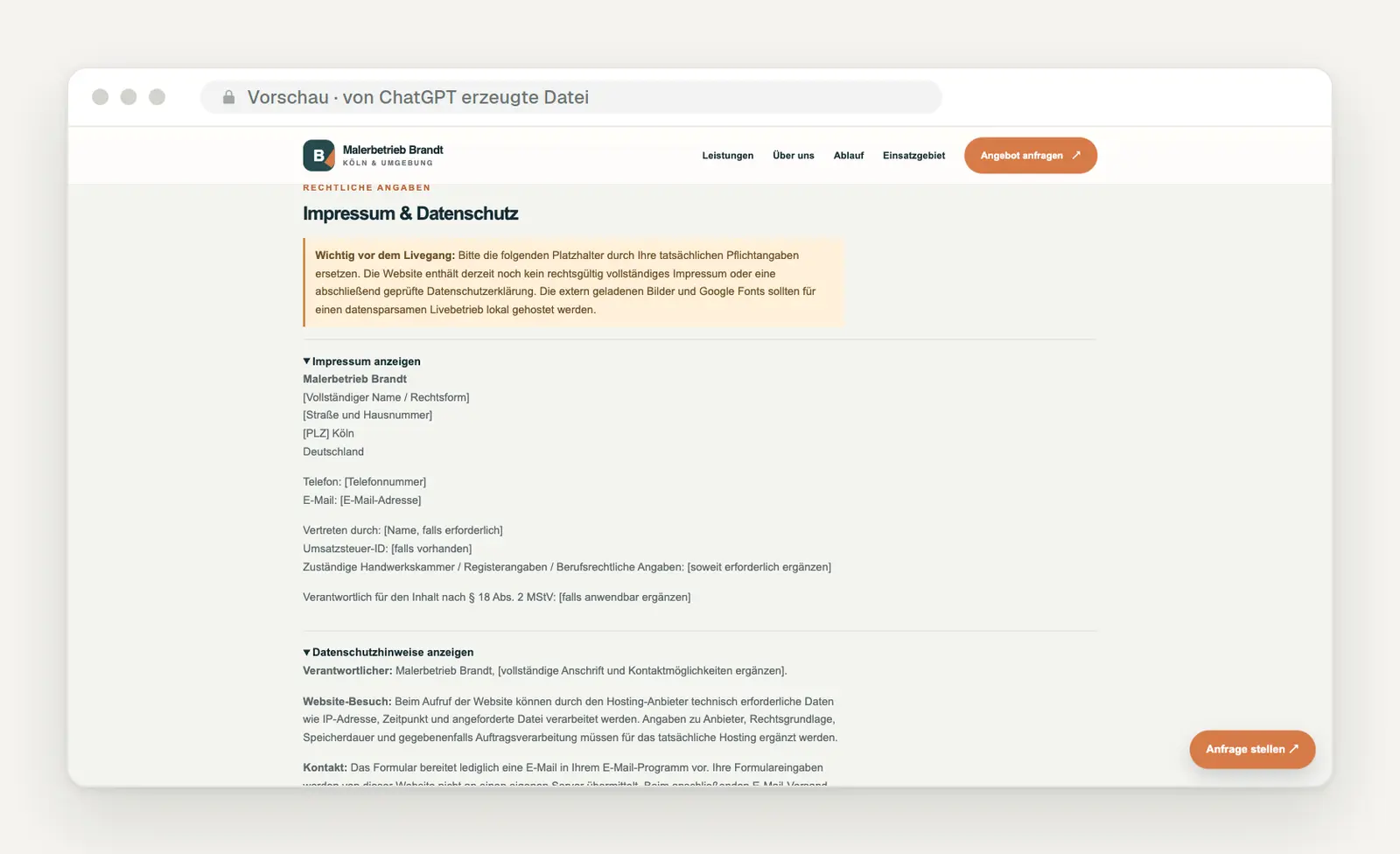
The legal notice and privacy policy consist of placeholders. ChatGPT itself points out that they are not yet legally valid.
To be fair: ChatGPT didn’t make anything up. No fabricated customer testimonials, no “Master Craftsman Since 1987,” no made-up address. Instead, it provides placeholders in square brackets and explicitly advises you to have the legal notice and privacy policy “legally reviewed” and to embed Google fonts and images locally. That’s responsible. But it also means that the real work only begins after the download, and you’ll still need hosting, a domain, a form that actually sends data, and someone to update the code if anything changes.
When AI Does Come Up with Something: Where It Gets Legally Tricky
The more you leave it up to AI, the more likely it is to fill in the gaps with made-up information. In its guide to AI-generated content, Google states that generative models “do not retrieve facts, but rather … predict a probable sequence of words,” and recommends that all AI-generated content be “manually reviewed for accuracy and reliability before publication.” If you ask an AI to fill the page “with customer testimonials and statistics,” you’ll get exactly that—only made up.
Fictitious information about your business is misleading. Section 5 of the German Unfair Competition Act (UWG) explicitly mentions false statements regarding “qualifications, status, licenses, memberships or affiliations, awards, or honors.” A phrase generated by AI, such as “certified specialist company” or “for 30 years,” falls under this category if it is not true. Additionally, regarding customer reviews: Anyone who claims they come from real customers without verifying this is always acting unlawfully under Section 23b of the Annex to the UWG.
The legal notice must be accurate and complete. According to Section 5 of the Digital Services Act, it must include the name, address, legal form, authorized representatives, email address, registration number (if applicable), VAT ID, and—for regulated professions—the professional association. If any information is missing, Section 33 provides for a fine of up to €50,000. However, the panic over cease-and-desist letters is overblown: Since 2020, competitors can no longer demand reimbursement of legal fees for errors in the legal notice or privacy policy, as long as you have fewer than 250 employees. You should still get it right, if only because a placeholder in the legal notice makes every customer suspicious.
AI-generated images may not belong to anyone—not even you. According to Section 2 of the Copyright Act, only “personal intellectual creations” are protected. In 2024, a court in Prague ruled that an AI-generated image on a company’s website is not protected and may be copied by anyone. We have not found a German ruling on this matter. For you, this means: A competitor can legally use an AI image, but not a photo of your construction site.
There is no general requirement to label AI-generated text on company websites. As of August 2, 2026, the transparency requirements set forth in Article 50 of the AI Regulation will take effect. However, according to the text of the regulation, you must primarily label AI-generated images or videos of real people, places, or events that are deceptively realistic (deepfakes), and an AI chatbot must identify itself as such. Standard service descriptions that you have reviewed yourself are not covered by this requirement. Learn more in “What the New AI Labeling Requirement Means for Your Website.”
Google doesn’t penalize AI-generated text; rather, it penalizes text that offers no added value. Since 2023, Google has stated that the “appropriate use of AI” does not violate its guidelines. However, “generating many pages without offering users any added value” does violate the spam guidelines. And when it comes to trust, Google explicitly asks whether content is “recognizable as well-founded, firsthand knowledge.” A generic AI-generated text about “quality and reliability” does not qualify as such. A text featuring your real projects, awards, and experiences does—even if an AI helped with the wording.
And what about the new AI development kits, like Lovable?
You can build more than one website in minutes, but with their own risks. Tools like Lovable, Bolt, or v0 generate entire applications from a description. According to the HTTP Archive, in August 2026, only 18.5% of pages built with Lovable worldwide met the mobile loading time standards—the worst performance of all platforms tested. There are also security concerns: In 2025, a researcher found publicly accessible databases in 170 of 1,645 Lovable projects examined; the developer disputes the classification as a security vulnerability and places the responsibility on the users. In 2026, heise and c't found, among other things, exposed data belonging to college students on over 600 “vibe-coded” websites they examined. We’ve described in detail what these tools are good at and when they’re sufficient in the article “Creating a Website with AI: When Lovable and Framer Are Enough.”
When a Modular System Is Still Enough
There are good reasons to use a website builder, but rarely for a business that wants to grow. For a club, a hobby project, a wedding website, or an initial test to see if a business idea generates interest, a website builder is perfectly fine. It’s also a perfectly acceptable temporary solution for a few months until the actual website is up and running. Things get tricky, however, if the website is supposed to be your main source of new business and you have neither the time nor the experience to handle it.
Do the math honestly. Over five years, Jimdo Grow costs €1,200 gross—so a good €1,000 net—plus the domain, plus your time. A ready-made one-pager with text, a contact form, and legal notices costs a one-time fee of €999 net as part of our “Website for 999 Euro” offer, and it’s live in 48 hours. Hosting starts at €5 per month, can be canceled monthly, and is free for the first six months with a new domain. Over five years, the total cost for both options is roughly the same—except that with the second option, you won’t have to spend an evening clicking things together. Our website cost calculator shows you how much larger websites cost and what factors influence the price.
What a Website Needs to Generate Leads
Whether you're using a website builder, AI, or an agency: Check your site against this list. If more than three items are unchecked, the lack of inquiries isn't due to technical issues.
What Has Changed and What That Means for You
By 2026, a beautiful website will no longer be a distinguishing feature. AI tools and website builders can produce professional-looking pages in minutes. This makes what AI cannot generate all the more important: real photos, verifiable reviews, specific prices, and the sense that there’s a real business behind it. At the same time, the transparency rules of the AI Regulation have been in effect since August 2026. This changes little for standard company text, but it does make a difference for AI-generated images of people and for chatbots. And when it comes to website builders, the same rule still applies: The advertised price is usually the price for the first year.
Date of this version: October 12, 2026. Providers' prices and terms change frequently; we review them regularly.
Do you want a website that works for you?
We build websites for businesses that want to attract customers: with copy your customers can understand, your own photos, a contact form that works on mobile devices, and a clear legal notice. For small businesses, we offer a ready-made one-pager at a fixed price; for everyone else, we provide a quote based on scope. Related: Cologne Crafts Website Report 2026 · Create a Website with AI · Service: Web Design · Website for 999 euros
Use our contact form to tell us what you're currently using and what you need the website to do. We'll respond within 24 hours—personally and without any sales pitch.
More Articles
© Marschfahrt Studio
Practical knowledge on web design, SEO, AI, and conversion optimization. Based on real projects, without any marketing spin.