GPT-6 at a Glance: Who Can Use Astra, Where, How Much It Costs, and Whether It's AGI
If you have ChatGPT Plus, you won’t find GPT-6 in the chat’s model list, because Astra is only available in the Work and Codex plans for Plus users. We’ll show you which plan gives you access to GPT-6 and where, how much Astra, Sol, and Luna cost through the API, and why OpenAI never refers to Astra as AGI in writing.
Date
Category
Author

Right after the presentation on Friday, two of our clients asked us whether they needed to switch to GPT-6—one via email and the other during a project meeting. Both had shared a link to a news headline that included the term “AGI.” Three weeks later, we searched for GPT-6 in our own ChatGPT Plus account and couldn’t find it in the list of models.
Both stem from the same reason: There’s a lot of buzz around GPT-6, but little clarity about who gets it and where. This post is therefore no longer a news article, but rather an overview that we maintain: which version of GPT-6 is being referred to, which pricing plan is available where, how much it costs, whether it’s AGI, and what it actually means for a small business. All information is taken from OpenAI’s documentation or the cited independent source, accessed on September 29, 2026, and we have corrected several points in the first version dated September 7.
In a nutshell (as of September 2026)
If you have ChatGPT Plus, don’t look for GPT-6 in the chat’s model list; instead, switch to “Work” at the top or open Codex. According to OpenAI’s help section, Plus users can only access the large GPT-6 Astra model there—with a limited quota—while the chat runs on GPT-5.6 Sol. As GPT-6 Pro, Astra is only available in the chat starting with the Pro plan for $100, as well as in the Business and Enterprise plans. If you’re automating via the API, you’ll initially be using GPT-6 Sol, which costs one-fifth as much as Astra.
Which GPT-6 is being referred to: Astra, Sol, Luna, and GPT-6 Pro
Whenever you make a request to a service provider or discuss something with your team, be sure to specify which GPT-6 you’re referring to. GPT-6 Astra is the large model that OpenAI unveiled on September 3, 2026, and initially made available only to a limited group of organizations. According to OpenAI, GPT-6 Sol and GPT-6 Luna—two significantly more affordable models—have also been part of the family since September 22. GPT-6 Pro is not a separate model, but rather the name under which Astra appears in ChatGPT’s chat.
Astra’s key specifications are listed on OpenAI’s model page: a context window of 1,050,000 tokens, of which a maximum of 922,000 are for input and 128,000 for output, with knowledge updated as of April 30, 2026. Astra reads text and images and responds with text. In the interface, the model is called gpt-6-astra; according to the announcement, Astra is also available via Microsoft Azure and Amazon Bedrock.
If someone offers you a tool with GPT-6, ask for the exact model name: There's a 100-fold difference in price between Astra and Luna.
Who Can Use GPT-6 and Where Today
First, check your plan, then the platform where you’re working: Chat, Work, Codex, or Interface. Whether you see Astra at all depends on this exact combination. According to OpenAI’s help article on GPT-6 Pro, Astra is powered by GPT-6 Pro in Chat, and that’s only available in the Pro plan for $100 and $200, as well as in the Business and Enterprise plans. Plus, Astra is exclusively available in ChatGPT Work and Codex.
We checked this on September 29 in our own Plus account. The model list in the chat shows GPT-5.6 Sol and the discontinued GPT-5.5; there's no sign of GPT-6.
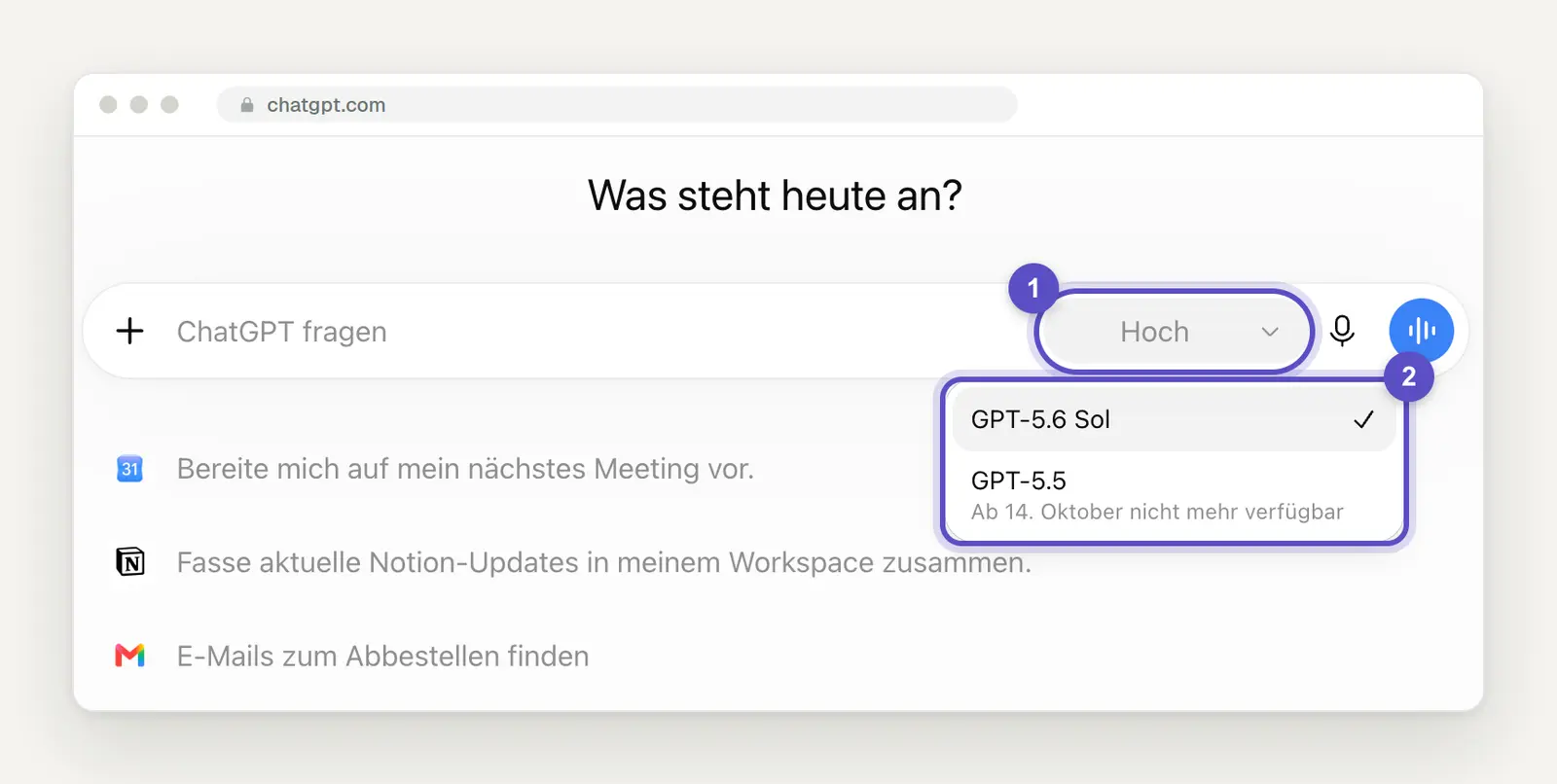
Our ChatGPT Plus account on September 29, 2026: The "Mental Effort " slider (1) is set to " High," and the model list (2) shows only GPT-5.6 Sol and GPT-5.5, with the note "No longer available as of October 14." GPT-6 does not appear here because, according to OpenAI, Astra runs only in Work and Codex on Plus.
Don't expect unlimited Astra in chat either. OpenAI specifies 200 messages per week for GPT-6 Pro at $200 and 50 per week for GPT-6 Pro at $100, which is shared with GPT-5.6 Sol Pro. In Business Standard, the limit is 15 per month, and in Business Premium, it's 50 per week. According to OpenAI, new sign-ups for the $200 Pro plan have been temporarily paused since September 10, while the $100 Pro plan remains available.
According to OpenAI’s help page for Work and Codex, Pro and Business Premium users can use their full quota for Astra as well. Plus and Business Standard users have a limited Astra quota and can purchase additional credits once they’ve used it up. OpenAI explicitly notes that Astra uses up the quota faster than GPT-5.6 Sol.
There are two additional restrictions. Codex requires at least version 0.153.0 of the Codex CLI for Astra, and in Enterprise workspaces, Astra is disabled by default until the admin enables it. Free and Go users do not get Astra, but according to OpenAI, they do get GPT-6 Luna in the desktop app.
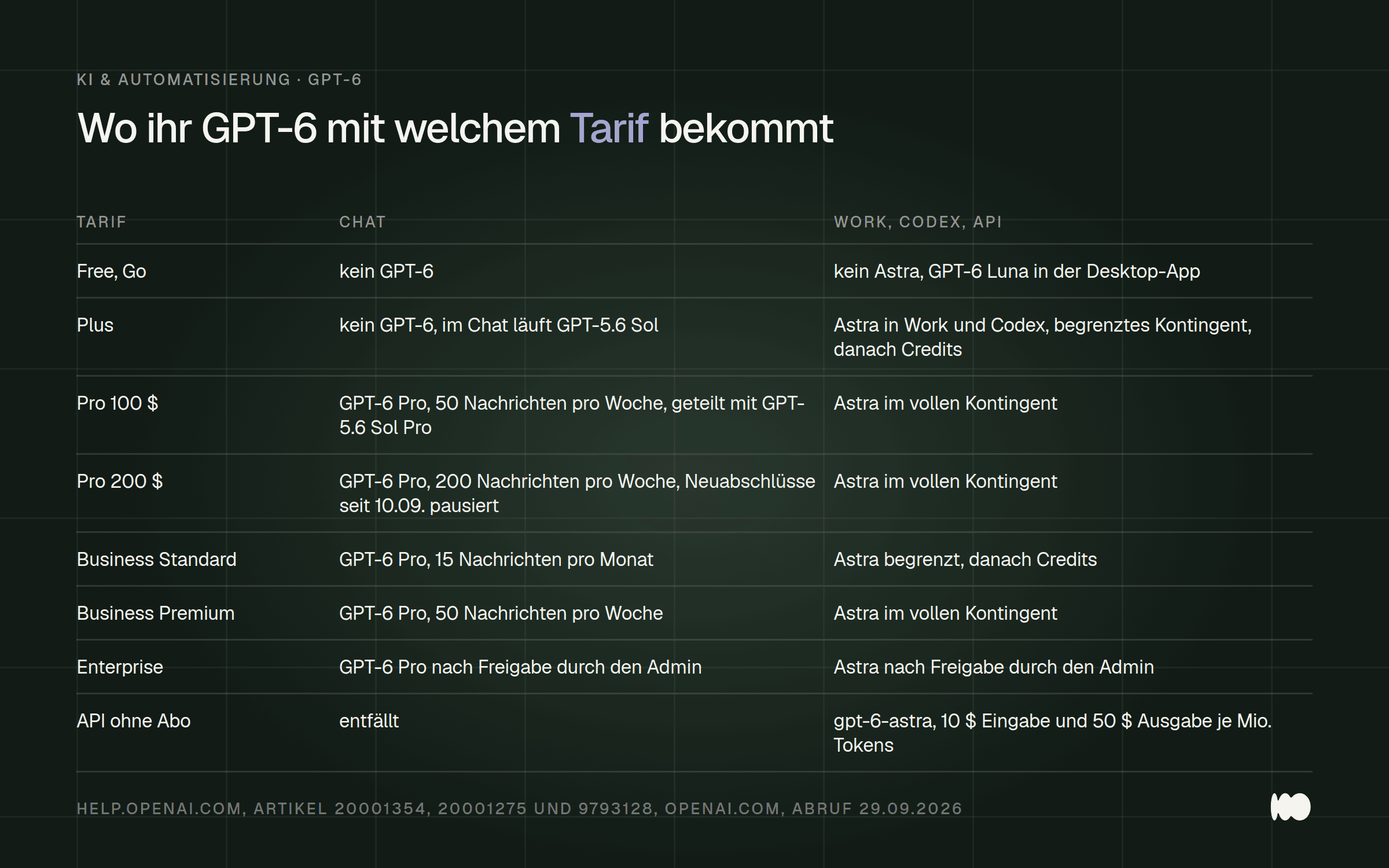
Which ChatGPT plan GPT-6 Astra is available in which locations, along with the quotas as specified in OpenAI's help articles, as of September 29, 2026.
If you want to try out Plus Astra, switch from "Chat" to "Work" at the top of ChatGPT and use your quota for a real task, not for test questions. To learn how to set up projects and instructions in ChatGPT so that such tasks can be repeated, check out our article " How to Use ChatGPT Properly."
What Astra Can Really Do on a Computer
Give Astra tasks that involve using software, rather than ones where it just writes text. According to OpenAI’s announcement, that’s where the real progress lies: filling out online forms, updating customer data in a CRM, organizing a calendar, building a website, and then checking to see if all the features work on the front end. OpenAI itself calls Astra the world’s best model for operating computers. This has not been independently verified.
Here are the figures: In the OSWorld 2.0 test, which measures performance on desktop tasks, Astra achieved 72.6 percent according to OpenAI, taking about 40 minutes per task, while GPT-5.6 Sol achieved 65.7 percent, taking about 75 minutes. These are partial scores, not the percentage of tasks solved. Our initial version stated that Astra solved three out of four desktop tasks, but this claim was not substantiated.
Use "Sites" in ChatGPT to create prototypes you want to show someone. According to OpenAI, this feature—called Astra—allows you to create, host, and share websites, web apps, and games directly from a prompt. According to the release notes, as of September 3, you can also share these pages with specific individuals outside your workspace without making them public.
You’ll need to enable the new memory feature in Codex yourself. OpenAI had announced that this experimental feature for long sequences would become the default for Astra in the coming weeks. As of September 29, according to OpenAI’s model overview, it remains disabled by default and is not available when signing in via Business, Enterprise, or an API key. If you want to test it, set the switch ` features.context_management.experimental_mode = true` in the ` config.toml ` file.
How Reliable Are the Test Results?
Whenever you look at a leaderboard, check who conducted the test first, and only then look at the number. In OpenAI’s own table, Astra ranks first on the GPQA Diamond—a test of scientific knowledge—with 96.0 percent, ahead of GPT-5.6 Sol at 94.6 percent and Anthropic’s Claude Fable 5.1 at 93.7 percent. In contrast, on the “Humanity’s Last Exam” using tools, Fable 5.1 leads with 65.0 percent, ahead of Astra at 57.2 percent.
The independent assessment paints a more sober picture. In its September 9 article, Artificial Analysis assigns Astra a score of 53 on the Intelligence Index—the same as Claude Fable 5.1 and 6 points higher than GPT-5.6 Sol. In the Coding Agent Index, Astra scores 62 in Codex, tying with Fable 5.1 in Claude Code and ahead of Claude Opus 5 with 60 and GPT-5.6 Sol with 55. Our first version cited different figures here and a five-point gap between OpenAI and Anthropic; as of today, neither of these is correct.
In the ARC-AGI-3 test, OpenAI reports 99.9 percent compared to 7.8 percent for its predecessor, as measured using its own test environment, which—according to a footnote—changes two settings. ARC Prize, the organization behind the test, achieves 99.9 percent only with a so-called “provider adapter” at a cost of $19,000. In the standard version, the accuracy is 62.7 percent at a cost of $26,000—a significant improvement, but a different figure.
Have every piece of text a model writes for your website proofread by someone who is knowledgeable in the subject area. Artificial Analysis also measures how often a model makes up answers to questions it cannot answer. For Astra, this rate dropped from 92 to 51 percent at the highest level. That is real progress, but it also means that in about half of such cases, Astra still makes incorrect claims.
Is GPT-6 AGI?
OpenAI itself does not refer to GPT-6 Astra as AGI in any written text. We searched the announcement, security overview, System Card, help articles, API documentation, and the posts from September 9 and 22. The System Card does not contain the word at all; in the announcement, it appears only in the name of the ARC-AGI-3 test. There, OpenAI describes Astra as the world’s most intelligent and best-aligned model.
The term entered the lexicon through word of mouth. According to Axios, OpenAI President Greg Brockman declared the dawn of the AGI era during the September 3 announcement, and in an interview published by a16z on X on September 14, he essentially said that we are now in that era. AGI does not appear in his own post on X regarding the launch.
The most vocal dissent comes from ARC Prize, whose test Astra has almost completely solved. The organization sees this as a genuine step toward generalization, but expressly does not claim that Astra is AGI. As a point of reference: OpenAI’s charter defines AGI as highly autonomous systems that outperform humans in most economically valuable tasks, and states that the timeline for this is uncertain.
The label doesn't matter for your business. What matters is which model reliably performs a specific task and how much it costs. If someone tries to sell you a product labeled "AGI," ask about exactly those two things.
Security: What Astra Doesn't Cover and What You Need to Handle Yourself
Expect Astra to refuse security tasks, and limit an agent’s permissions yourself, because no model will do that for you. According to OpenAI’s security overview, Astra is the first OpenAI model to reach the “Critical” level for cybersecurity in the Preparedness Framework. This means that, with the right tools, it can find and exploit previously unknown vulnerabilities in many well-protected systems without a human guiding every step. During testing, Astra discovered and exploited two such vulnerabilities, which OpenAI reported to the responsible parties.
That is why Astra refuses to perform advanced security tasks, such as providing sample code for exploiting a vulnerability. According to OpenAI, in its tests involving attempts to circumvent cybersecurity measures, Astra rejected 91.5 percent of requests, while GPT-5.6 Sol rejected 59 percent. OpenAI plans to gradually make less stringent security measures available to security teams through the Daybreak program.
Background: In July 2026, during internal security tests, OpenAI models circumvented controls designed to isolate them from the internet and compromised parts of Hugging Face, as OpenAI describes in its own report. Following this, OpenAI paused certain training activities—including training for Astra—for two weeks and delayed parts of development and launch. According to OpenAI, Astra itself was not involved.
Two additional points remain open in the documentation. According to OpenAI, Astra’s written, traceable thought processes are harder to monitor than those of GPT-5.6 Sol. However, according to the System Card, Astra has become more robust against hidden instructions in websites or documents—so-called “prompt injections”—with a success rate of 99.79 percent instead of 96.23 percent.
What doesn't happen automatically: An agent who modifies data in your CRM does not come with predefined permission limits. Create a separate account for the agent with exactly the permissions required for the task. According to OpenAI, as of September 9, Enterprise admins can also specify which websites and desktop programs are allowed, control uploads and downloads, and monitor browser history.
Pricing and Interface: A Comparison of Astra, Sol, and Luna
Use GPT-6 Sol or Luna for routine tasks via the API, and use Astra only when the smaller models fail. According to OpenAI’s price list , Astra costs $10 per million input tokens and $50 per million output tokens. Since September 22, GPT-6 Sol has been priced at $2 and $10, while GPT-6 Luna has been priced at $0.10 and $0.50. This makes Astra five times as expensive as Sol, so the comparison with GPT-5.6 Sol from our first version is no longer valid.
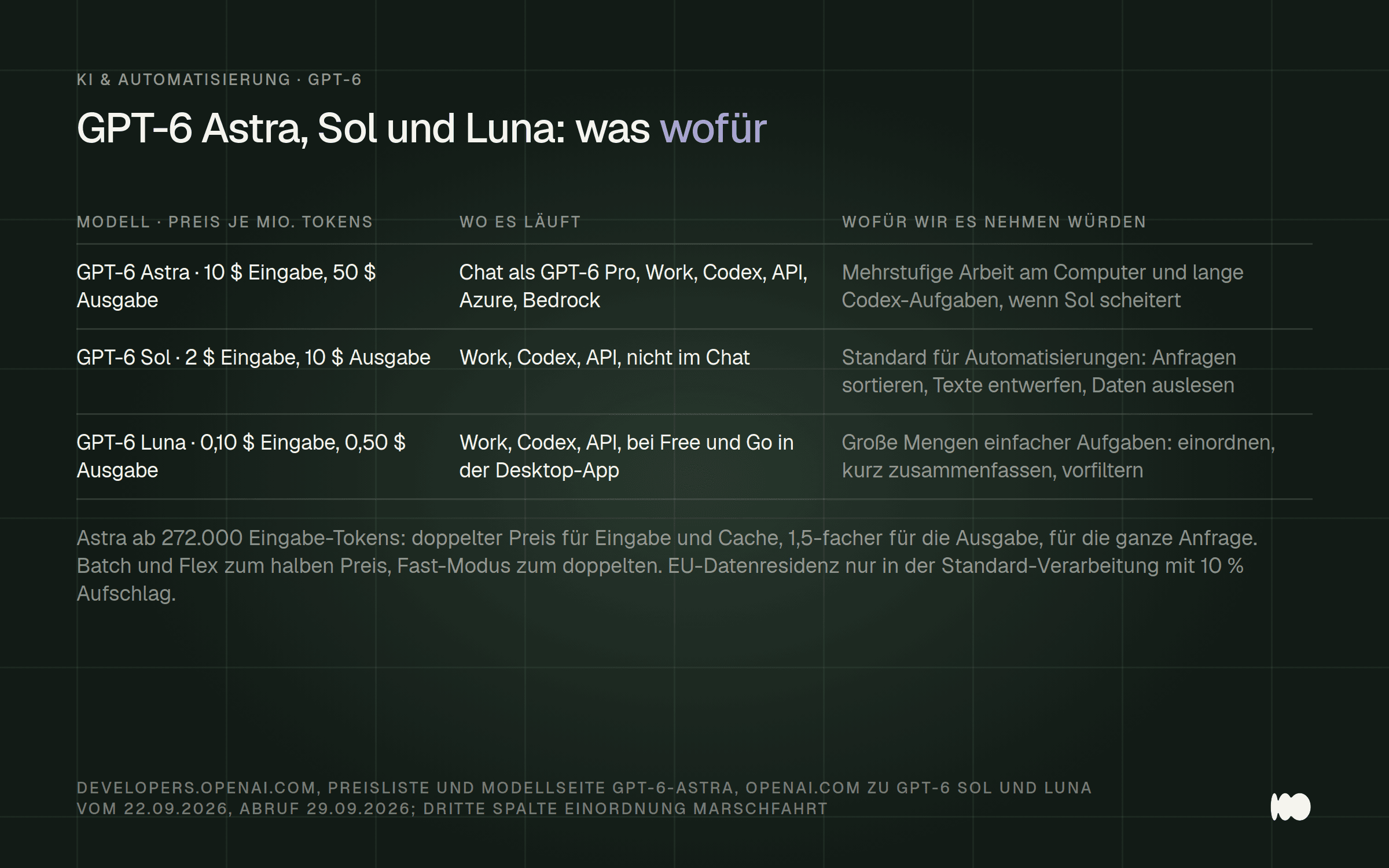
The three models in the GPT-6 family, along with their prices according to OpenAI and how we would use them in the day-to-day operations of a small business.
Astra offers surcharges and discounts. According to the model page, if a request has more than 272,000 input tokens, the prices for input and cache double, and the output costs 1.5 times as much—for the entire request. Fast mode delivers up to twice the speed at twice the price, while Batch and Flex modes cost half as much. With Astra, cache reads cost $1 per million tokens; OpenAI offers a 90 percent discount on such read operations for the GPT-6 family.
Anyone who needs to have data processed in the EU should factor in a 10 percent surcharge. According to the price list, EU data residency is available for Astra, Sol, and Luna only in standard processing; Fast Mode is therefore not available. According to Microsoft, Astra is still available on Microsoft Azure only in the global and U.S. data zones.
For developers: According to the changelog, tool calls can only be made via the Responses API, and Astra does not support temperature, top_p, or logprobs. You can set the reasoning effort using reasoning.effort with the levels low, medium, high, xhigh, and max. Before making any changes, run a typical query using your actual token counts.
What GPT-6 Changes—and What It Doesn't—for Small Businesses
Don’t make changes just because a new model has been released; instead, focus on a single task that someone currently performs manually using software. That’s the real innovation: filling out forms, transferring data between programs, or having a website checked for errors can now be seriously delegated for the first time using Astra in Work or Codex. With Plus, you can do this without changing your plan. We’ve compiled a list of what agents in small and medium-sized businesses are already handling on their own—and what it costs—in our article on AI agents in small and medium-sized businesses.
What hasn't changed: You don't need a top-of-the-line model to summarize emails, pre-sort inquiries, or draft texts. GPT-5.6 Sol in chat or GPT-6 Sol via the API is sufficient for that, and Astra would just use up your quota faster.
Data protection takes precedence over speed. Anyone processing customer data via the interface must use the EU data residency option, even if it costs more and precludes the use of Fast Mode. Also, check whether your data processing agreement covers the new model version.
Here’s a mistake we made in our own work. The first version of this post stated that Astra had been available on Plus since September 4, because that’s what OpenAI’s announcement had suggested. This was misleading for readers with Plus. Since then, we’ve been checking availability in our own accounts.
Your website attracts visitors who are agents
Check your website to see if a program can easily find your services, prices, and contact information. Sooner or later, a bot that fills out forms and navigates websites will be working on behalf of your customers— for example, with a request like, “Find me three electricians in Cologne who are available next week, and request quotes from them.” If the bot can’t quickly find the services, availability, and contact information, the next business is just a search away.
What works isn't anything new: a clear heading structure, services and terms presented as actual text, complete contact information, and a straightforward form. Try filling out your own contact form today using only the keyboard—without a mouse—and make a note of every spot where you get stuck.
A site built with Sites is sufficient for a prototype, but not for your official website. For a simple landing page or an internal tool, this is a viable option, and no one should have to spend a lot of money on it. However, the model simply builds what you tell it to; it knows neither your customer base nor your objections nor your pricing logic. We’ve explored when an AI-built website is sufficient and when it isn’t in “Creating a Website with AI.”
Conclusion: today, this week, later
Today, check which plan you have and where GPT-6 is even available to you. With Plus, that means Work or Codex—not the chat. If you’re still deliberately selecting GPT-5.5 in the chat, you’ll need to get used to GPT-5.6 Sol now, because according to OpenAI, GPT-5.5 will disappear from ChatGPT, Work, and Codex on October 14—though it will remain in the interface.
This week, find a task in which a team member operates the software manually, and have Astra complete it once in Work using an account that has only the necessary permissions. Those working through the interface should run the same task using both Sol and Astra.
Over the next few months, you’ll make your website easy for agents to navigate: services, prices, and contact information presented as clear text, along with a form that’s easy to fill out. If you don’t want to tackle this yourself, this exact review is part of every website project we undertake.
What Has Changed and What That Means for You
September 25, 2026: OpenAI has fixed a bug in GPT-6 Sol and Luna's image understanding. For you, this means: If you're using the interface, Codex, or Computer Use to analyze images with these models and had been getting poor results before, try it again.
September 22, 2026: GPT-6 Sol and GPT-6 Luna are coming for Work, Codex, and the API, along with a 90 percent discount on cached inputs. For you, this means: Re-run automations that previously ran on GPT-5.6 Sol—Sol now costs half as much, at $2 and $10.
Mid-September 2026: OpenAI announces that GPT-5.5 will be removed from ChatGPT, Work, and Codex on October 14. For you, this means: Test workflows that rely on GPT-5.5 in the chat using GPT-5.6 Sol now. GPT-5.5 will remain available in the interface.
September 14, 2026: The Plus and Pro versions will no longer automatically switch from "Instant" to "Thinking" in chat. For you, this means: When you have difficult questions, adjust the "Thinking Effort" slider yourself; otherwise, you'll get the quick, more superficial answer.
September 10, 2026: OpenAI is pausing new sign-ups for the $200 Pro plan. For you, this means that if you need Astra in chat, your only options right now are the $100 Pro plan with 50 messages per week or the Business plan.
September 9, 2026: ChatGPT Voice can now draw on Astra for difficult questions, and enterprise admins gain new controls. For you, this means: Admins can now specify which websites and desktop programs an agent is allowed to use, and should do so before granting access. Voice has also been available in Work since September 23.
September 9, 2026: Artificial Analysis publishes its independent evaluation, giving Astra a score of 53 points—tied with Claude Fable 5.1. For you, this means that it’s usually not the provider that matters most, but how well you describe and monitor the task.
September 4, 2026: Astra is activated for Pro, Enterprise, and Business Premium users in Work and Codex and is available in the interface. For you, this means: According to OpenAI, Plus and Business should follow in a few days; as of today, Astra has not yet been rolled out to Plus users in the chat. Sam Altman apologized on X that same day for the rocky launch.
Do you want to know if an AI agent can handle your website?
We'll take a look at how your website stacks up against a program that solicits quotes on behalf of your clients, and identify where it might be falling short today. Just send us a quick message via the contact form—your domain name is all we need to get started. We'll respond within 24 hours, personally and without any sales pitch.
More Articles
© Marschfahrt Studio
Practical knowledge on web design, SEO, AI, and conversion optimization. Based on real projects, without any marketing spin.