AI Agents for Small and Medium-Sized Businesses in 2026: What Runs Autonously, What Doesn't, and What Ten Seats Cost Per Month
Agents reliably read, sort, and draft emails in 2026, but they need approval for customer emails and payments: In the tau-bench benchmark (2024), the best agents get the same customer case right eight times in a row in fewer than 25 percent of cases. We’ll show you what works in everyday practice, how much a company with ten employees pays per month, and where to start.
Date
Category
Author

“Can’t an agent like that just write our quotes and answer emails?” The question came from the owner of an electrical contracting business with twelve employees, shortly after he had watched a video about AI agents. The short answer, as of September 2026: Agents perform reliably when they read, sort, draft, and assist with tasks. However, they are not reliably autonomous—that is, without human approval—when it comes to customer communication and anything involving financial transactions. And according to Destatis, the biggest obstacle isn’t money, but a lack of knowledge within the company.
We work with Claude and agents every day, both in the studio and on projects with craft businesses, medical practices, and restaurants. This article breaks down what the term actually means, which tasks are included today and which aren’t, how much it costs per month, and how a business with 5 to 100 employees can get started effectively.
Assistant, Automation, Agent: three terms that are constantly confused
An assistant responds to your input, and you carry it out. ChatGPT, Copilot Chat, and Claude in the browser are all part of this process: The assistant writes the draft, you review it, and you send it off.
Workflow automation is an "if-then" chain, like the ones Zapier, Make, or n8n have been building for years: If a form is submitted, then create a contact and send a confirmation. This is predictable and cost-effective, but it lacks the ability to make judgments. If something unexpected happens, the chain comes to a halt.
An agent is given a goal, plans the steps on its own, accesses tools (email, calendar, CRM, browser—often via the Model Context Protocol, which Anthropic released in November 2024), and works toward the result, seeking clarification only when necessary. This freedom makes it both useful and risky. Since 2025, Gartner has been warning against “agent washing”—that is, rebranded chatbots and outdated automation systems. If a provider cannot specify which decisions its agent makes on its own, it usually isn’t one at all.
What Will Actually Be Worn in Everyday Life in 2026
Agents are reliable when they read, organize, and prepare documents, with a human ultimately approving the final version. This aligns with what small and medium-sized businesses are already using: According to KfW Research (Fokus No. 554, July 2026), text generation (14 percent) and text recognition (10 percent) are the most common AI applications in German small and medium-sized businesses—in other words, document processing.
Inbox and documents. Reading inquiries, identifying attachments, entering data into the correct form, drafting a response: That’s all handled. At a plumbing company in the Bergisches Land region, an agent reads each form-based inquiry, assigns photos and addresses to the appropriate job type, and prepares a proposed appointment and a response. The office manager still sends the response with a single click. To find out which tasks are worth tackling first, check out our article on the five processes where AI pays off the most.
Support with a knowledge base. An agent that provides information based on your own documents and doesn’t trigger any actions is the most common type currently in use. In its Copilot Studio documentation (as of August 2026), Microsoft calculates that a support agent with four standard responses and two generated responses consumes 8 credits per customer, while an autonomous order agent with four actions consumes 20. The price difference shows where the provider itself draws the line: providing information is routine; taking action is the exception.
Research, Code, Computer Use. Research involves reading and sorting—areas where agents excel. In programming, according to Anthropic (September 2025), Claude Sonnet 4.5 solved 77.2 percent of the tasks in the SWE-bench Verified benchmark and worked for over 30 hours straight. The biggest leap was seen in agents that operate browsers and desktops on their own: In the OSWorld benchmark, the best score in 2024 was 12.24 percent; Sonnet 4.5 achieved 61.4 percent in September 2025, while humans achieve 72.36 percent. Impressive, but solving six out of ten tasks is not a good enough reason to let a system work unsupervised in accounting.
What Doesn't Hold Up, and Why the Protests Are Deceptive
What matters is not whether an agent solves a task once, but whether it solves it every time. Sierra’s tau-bench benchmark (June 2024) measures exactly that: The best agents solved less than 50 percent of customer service tasks, and after eight runs of the same case (pass^8 metric), the success rate in the retail scenario was below 25 percent. A customer will notice something like that the second time around. The figures are from 2024, and the models have improved since then, but we lack a similarly rigorous measurement using current models.
When it comes to programming, there’s evidence that contradicts the benchmarks. In July 2025, METR had 16 experienced open-source developers work on 246 real-world tasks—some with AI and some without: With AI, they were 19 percent slower, but believed they had been 20 percent faster. The study is small and involves professionals working with code they’ve been familiar with for years. However, it shows that perceived speed is not evidence of actual speed. Since then, here at our studio, we’ve been timing tasks instead of estimating them.
At the corporate level, the figures are sobering. In August 2025, the MIT NANDA project reported—based on 150 interviews, 350 respondents, and 300 implementations analyzed—that only about 5 percent of AI pilot projects contribute to revenue in a quickly measurable way. Off-the-shelf solutions were successful in about 67 percent of cases, while in-house developments succeeded only about one-third as often. Gartner expects (June 2025) that over 40 percent of agentic AI projects will be discontinued by the end of 2027 due to costs, unclear benefits, and a lack of risk control. The MIT figures come primarily from large U.S. companies; the Gartner figure is a forecast; neither of these includes experimental data or data from the DACH region.
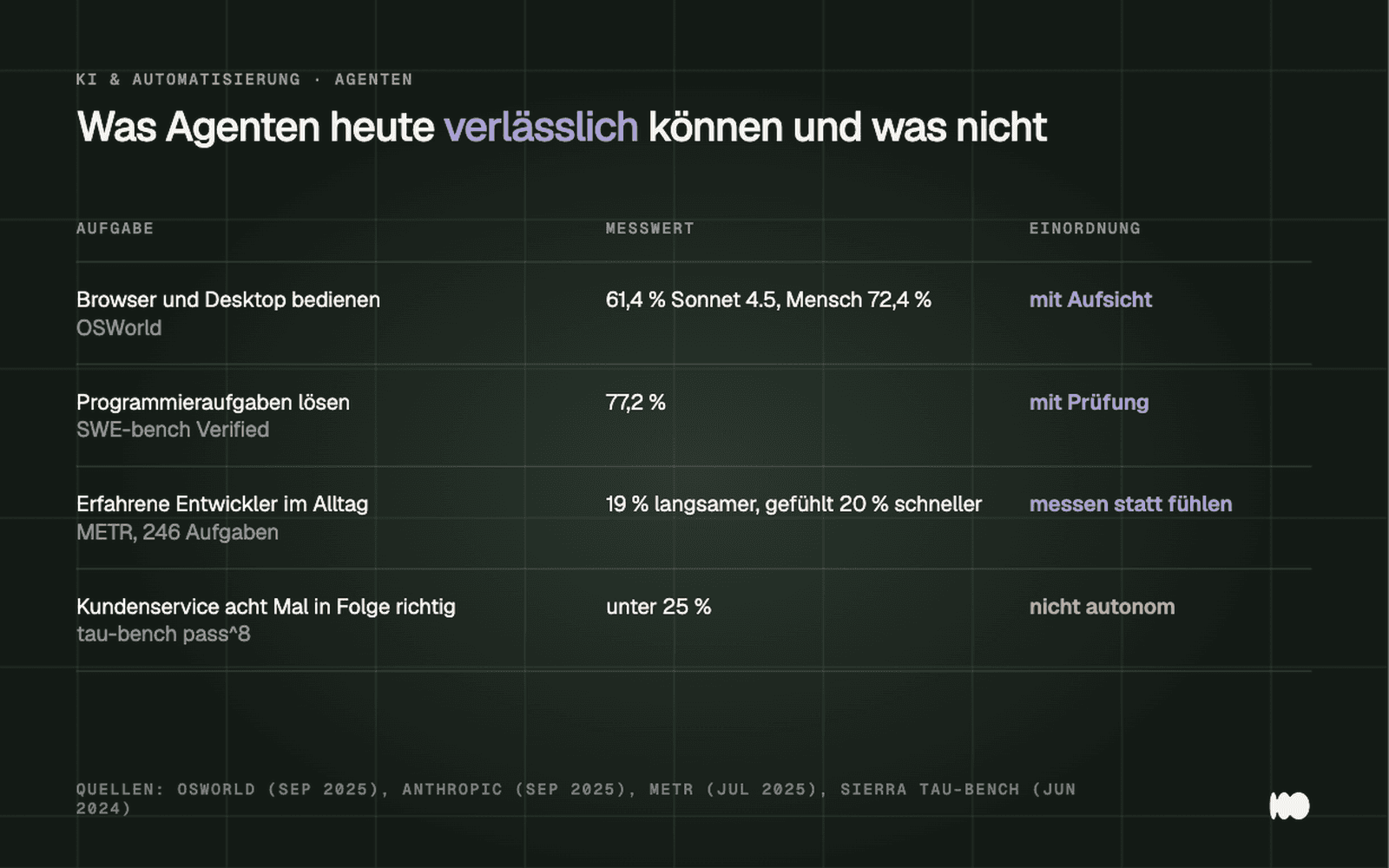
What Works and What Doesn't: Benchmark Results from OSWorld (2025), SWE-bench Verified (Anthropic, 2025), METR (2025), and tau-bench (Sierra, 2024).
Security: Every email an agent reads is a potential point of attack
The biggest risk is called "prompt injection" and ranks first on the OWASP list of LLM risks for 2025. An agent does not clearly distinguish between your instruction and the text it is currently reading. If there is a hidden command in an email, a PDF, or on a website, it may execute it.
Brave demonstrated what this looks like in August 2025 using Perplexity's Comet browser agent: A hidden Reddit comment caused the agent to extract the user's email address and one-time code from their inbox and post them publicly. The user simply wanted a summary of the page.
For a small business, this has three implications. Separate read and write permissions: Anyone who reads the email account does not need permission to send emails or make transfers. Every external action—such as customer emails, orders, or payments—requires approval. And the agent is given their own account with minimal permissions, not the owner’s password. At a dental practice where we pre-sort inquiries, the agent therefore accesses a separate mailbox with read-only access, not the practice’s main account.
The State of German Small and Medium-Sized Businesses
According to Destatis (ICT Survey 2025, published in 2026), 26 percent of German companies with 10 or more employees use AI. Company size is a key factor: 23 percent of companies with 10 to 49 employees, 36 percent of those with 50 to 249 employees, and 57 percent of those with 250 or more employees. Germany thus lies above the EU average of 19.95 percent (Eurostat 2025: small companies 17 percent, medium-sized 30.36 percent, large 55.03 percent), which has risen by 6.47 percentage points compared to 2024. Denmark leads the way with 42.03 percent.
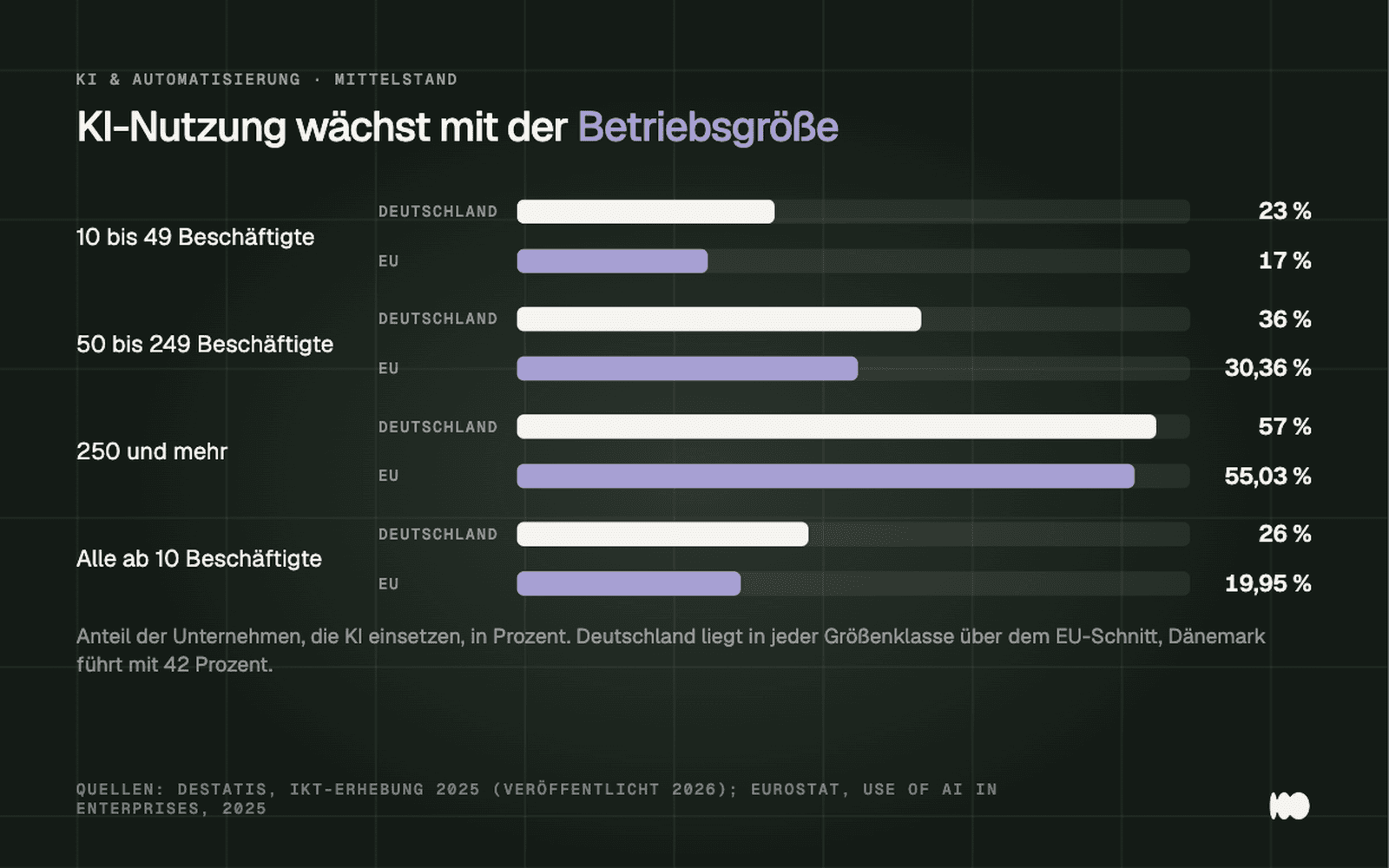
AI Adoption by Company Size in Germany and the EU; figures from Destatis (ICT Survey 2025) and Eurostat (2025).
“Using AI” usually means that someone is using an assistant. According to Bitkom (September 2026, 603 companies with 20 or more employees), 76 percent of AI users use ChatGPT, 35 percent use Copilot, 28 percent use Gemini, and 3 percent use Claude. KfW (July 2026) estimates that 20 percent of small and medium-sized enterprises (SMEs) use AI, totaling approximately 780,000 companies.
No one knows for certain how many German SMEs actually use agents. Startups provide some insight: In a non-representative Bitkom survey of 102 startups (July 2026), 48 percent used autonomous AI agents, and 27 percent had foregone new hires because of AI. However, startups have the fewest legacy systems and the most technical staff.
Law: What Takes Effect on August 2, 2026
The AI Act has been in effect since August 1, 2024, and has been phased in gradually: prohibitions and the requirement for AI literacy (Article 4) have been in effect since February 2, 2025; obligations for foundation models have been in effect since August 2, 2025; and transparency requirements under Article 50 have been in effect since August 2, 2026. The latter requirements apply to nearly every business that uses agents: A chatbot that interacts with customers must be recognizable as AI, and AI-generated content must be labeled in a machine-readable format. For systems that were already in operation before the effective date, a transition period applies until December 2, 2026.
Relief came with the Digital Omnibus, which took effect on July 27, 2026: The high-risk obligations were postponed to December 2, 2027 (Annex III, e.g., staff selection) and August 2, 2028 (Annex I). For most SMEs, this part is thus off the table until the end of 2027. On July 31, 2026, Bitkom criticized that the guidelines on Article 50 had been issued “only recently,” leaving companies with “virtually no time to prepare.” The basics are outlined in our article on the EU AI Act.
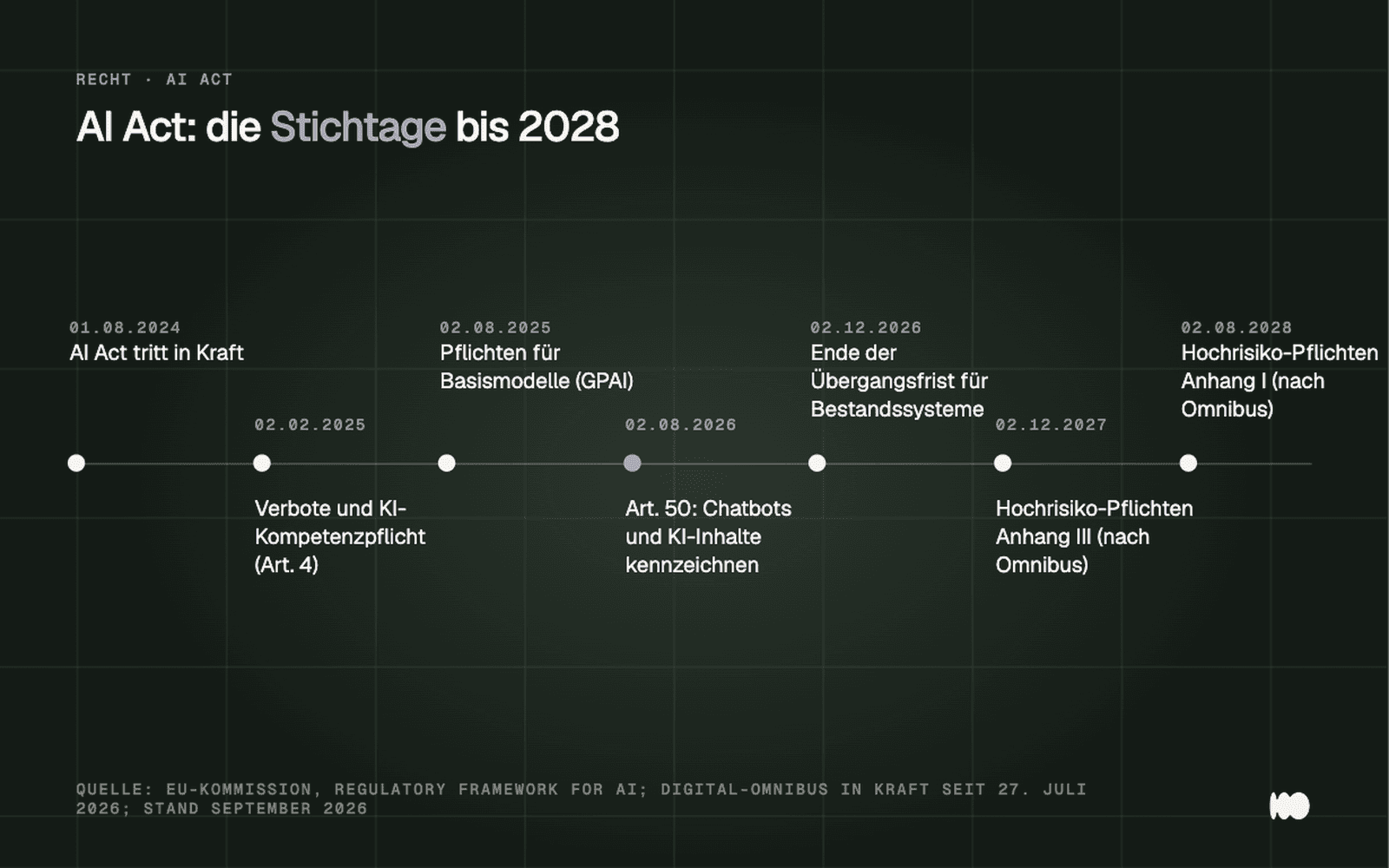
The effective dates of the AI Act from August 2024 to August 2028 under the Digital Omnibus; source: European Commission, as of September 2026.
In everyday practice, the GDPR carries more weight. In Opinion 28/2024 (December 2024), the European Data Protection Board addressed issues related to model anonymity and legitimate interest; for your agents, this means, in practical terms: a data processing agreement with every provider whose model has access to your data. Purpose limitation applies to every tool access—meaning no CRM access if only the calendar is needed. A data protection impact assessment is required as soon as customer data is processed. And employee data must be monitored as soon as an agent reads a mailbox where employees are writing.
How much it costs: a bill for ten people
The list prices aren't the problem. As of September 11, 2026, a spot on Claude Team costs $20 per month with an annual subscription (Premium: $100, Claude Code included). Microsoft 365 Copilot Business costs $18 per user as a promotional price through the end of 2026 (regularly $21), and Google Workspace Standard costs 13.60 euros per user, including Gemini. For the automation layer, n8n charges 20 euros (Starter) or 50 euros (Pro) per month; self-hosted versions are free. Make costs $9, $16, or $29; Zapier Agents start for free with 400 actions per month.
It gets more expensive as soon as an agent speaks with a customer, and that’s where the pricing model shifts from a per-seat to a per-use basis. Salesforce Agentforce charges 2 euros per conversation or 500 euros for 100,000 Flex Credits—about 10 cents per action—plus a $125 add-on per user. HubSpot charges 50 credits per completed conversation at $10 for 1,000 credits, or 50 cents per conversation; the Starter plan includes 500 credits, and the Professional plan includes 3,000. If you don’t set a usage limit, you’ll receive a bill based on your customer volume. Copilot Studio blocks agents at 125 percent of their quota; you should set a similar limit everywhere.
For ten people, that comes to the following per month, all at list prices: ten Copilot or Claude seats for about $180 to $200, n8n Pro or Make Pro for 16 to 50 euros, API usage with about 5 million Sonnet 5 tokens at around $30 to $60, and a support agent for 500 conversations at 250 to 1,000 euros, depending on the provider. Total, with dollars roughly converted to euros: about 500 to 1,300 euros for tools. This does not include setup, which, in our experience, is the larger expense because that’s where the knowledge is generated—the very knowledge that, according to Destatis, is lacking. We have not found a reliable ROI study for SMEs in German-speaking countries.
How to Get Started: Buy Before You Build—A Process, a Approval Step
The main obstacle is not money. According to Destatis (2025), 72 percent of companies without AI cite a lack of knowledge as the reason, 62 percent cite legal uncertainty, 60 percent cite data protection, 45 percent cite incompatibility with existing systems, 44 percent cite data quality, and only 32 percent cite costs. The bottleneck is training, not licensing. We agree: A license can be purchased in ten minutes, but it takes weeks to learn what information you can provide to the agent and how to verify its results.
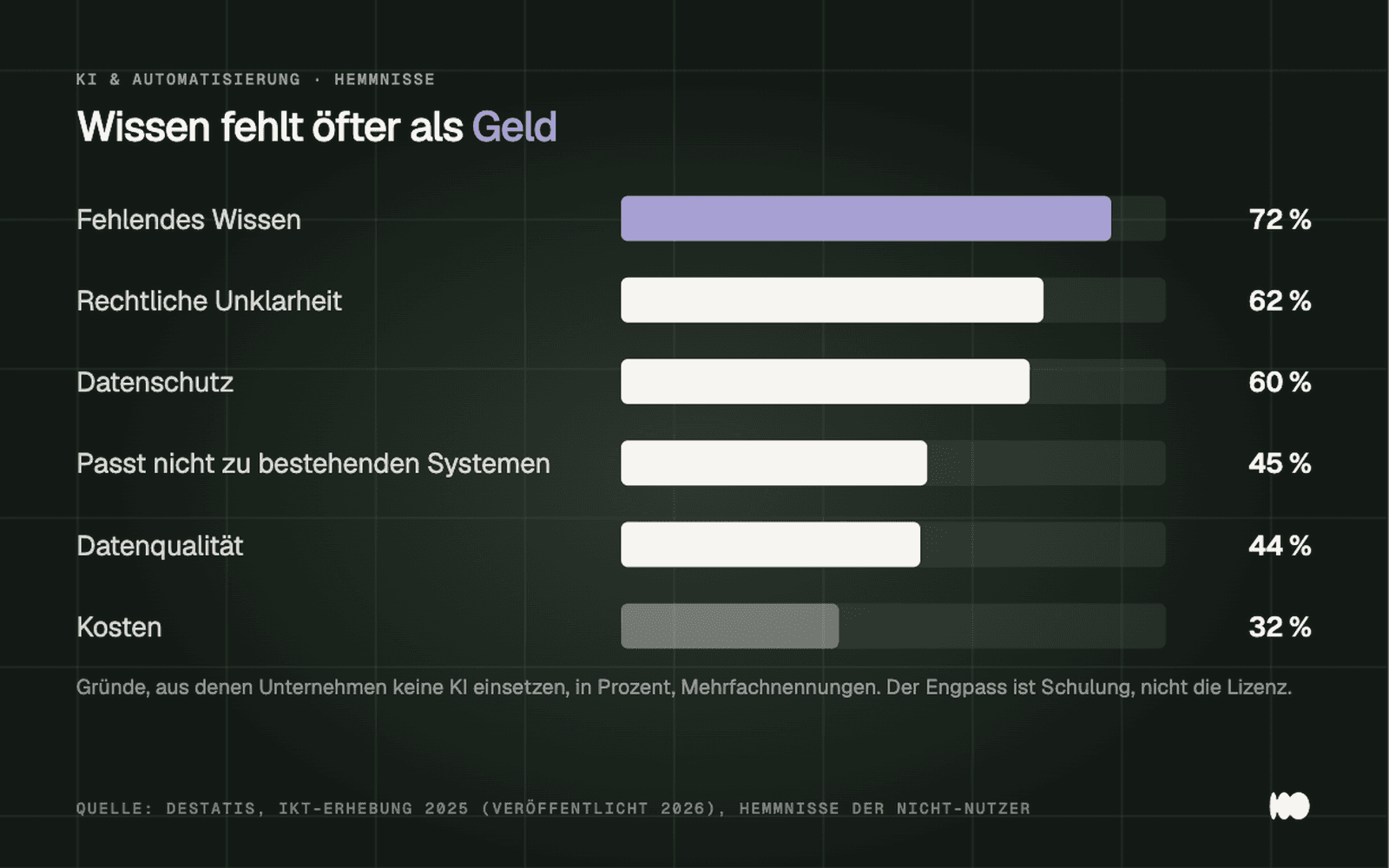
Reasons why companies do not use AI; multiple responses according to Destatis, ICT Survey 2025.
Buy before you build. The MIT figures suggest starting with the agent that’s already integrated into your CRM, office software, or help desk. Building your own solution with n8n or Claude Code is only worth it if you know what you want and have someone in-house who can maintain it.
One process, one approval step, one measurement. Take the process that occurs most frequently and is best documented—usually incoming mail or quote preparation—and document the knowledge base for it: prices, services, standard responses. Everything that goes out to the outside world or involves money is reviewed by a person before it happens. And before you start, note how long the process takes and how many cases occur per week; after four weeks, tally them up, including the time spent on revisions.
Conclusion: The order we recommend
First, determine whether you need an agent or if “if-then” automation is sufficient; if the rules are fixed, automation is usually enough. Second, choose a process with many similar cases and document the knowledge base—that’s the real work. Third, use the agent that’s already built into your software, with dedicated access, read-only permissions, and a cost cap.
Fourth, incorporate the approval step before every customer email and every payment, and label the chatbot as AI, as required by Article 50 starting in August 2026. Fifth, track performance for four weeks and then decide whether to expand the program. If you need someone to help you set up steps two through four and then make themselves redundant afterward, that’s exactly what we offer with our AI solutions for small businesses.
Related: How to Show Up in ChatGPT and Perplexity Responses , and GPT-6 Astra: What the New OpenAI Model Means for Your Business
Do you want to know which process in your organization is the best fit for an agent?
Tell us in three sentences which task takes up the most of your time and what software you use. We’ll give you an honest assessment of whether an agent, automation, or a good assistant is the right solution—and how much it would cost per month. Send us a quick message via the contact form. We’ll respond within 24 hours, personally and without any sales pitch.
More Articles
© Marschfahrt Studio
Practical knowledge on web design, SEO, AI, and conversion optimization. Based on real projects, without any marketing spin.