AI Guidelines for Employees: Customizable Template, Including a Data Traffic Light System and Examples
Which AI tools your employees are allowed to use, what data can be entered into them, and who approves new tools: eight building blocks based on the recommendations of data protection authorities, seven practical guidelines, and three templates, available as Word files.
Date
Category
Author

Are our employees allowed to use ChatGPT, and if so, for what purposes and with what data? In many companies, no one provides a definitive answer, and employees decide for themselves. An AI policy, also known as an AI usage policy, specifies which tools are approved, what data is permitted, what needs to be reviewed and labeled, and who can help with questions. According to Bitkom, by 2025 only 23 percent of companies had established such rules.
For this guide, we reviewed the original recommendations from the Data Protection Conference, the Hamburg Data Protection Commissioner, and the BSI; analyzed seven actual, publicly available AI policies—ranging from the federal administration to the cities of Vienna and Bern, as well as two universities, a research institute, and a software company; and examined the templates provided by Bitkom, the Association of Tax Advisors, and the Swabian Chamber of Commerce and Industry, along with the latest case law on copyright and employee participation. In the end, you’ll receive an AI policy as a template to customize, available as a Word file and a PDF—both blank and as a completed example.
In a nutshell (as of October 2026)
A good AI policy allows more than it prohibits: It authorizes tools linked to company accounts, uses a traffic-light system to specify which data may be used in which tool, and regulates the review, labeling, and approval of new tools. The Data Protection Conference expressly recommends documented internal guidelines with examples of permitted and prohibited uses. According to the German Economic Institute, outright bans are of little help; they would primarily affect dedicated employees. If your company has a works council, consult with it early on—at the latest when company accounts begin collecting usage data. The template for the AI policy contains all the building blocks; you simply need to fill in your tools, points of contact, and examples.
Why Most Companies Need an AI Policy
AI has long been in use, even without rules, and increasingly through personal accounts. According to Bitkom, in 2025 only 23 percent of companies with 20 or more employees had established rules for AI tools; in 2024, that figure was 15 percent. Another 31 percent were planning to establish rules, while 16 percent explicitly intended to do without them. At the same time, the use of private AI tools is widespread in 8 percent of companies, and in another 17 percent, it occurs in isolated cases. Only 29 percent are certain that it does not happen in their companies.
Employees see it similarly. According to a brief report by the German Economic Institute from September 2026, 29.1 percent of respondents who use AI for work rely on tools not provided by their employer. In companies with up to 49 employees, the figure is 33.5 percent, and in companies with 250 or more employees, it is still 25.5 percent.
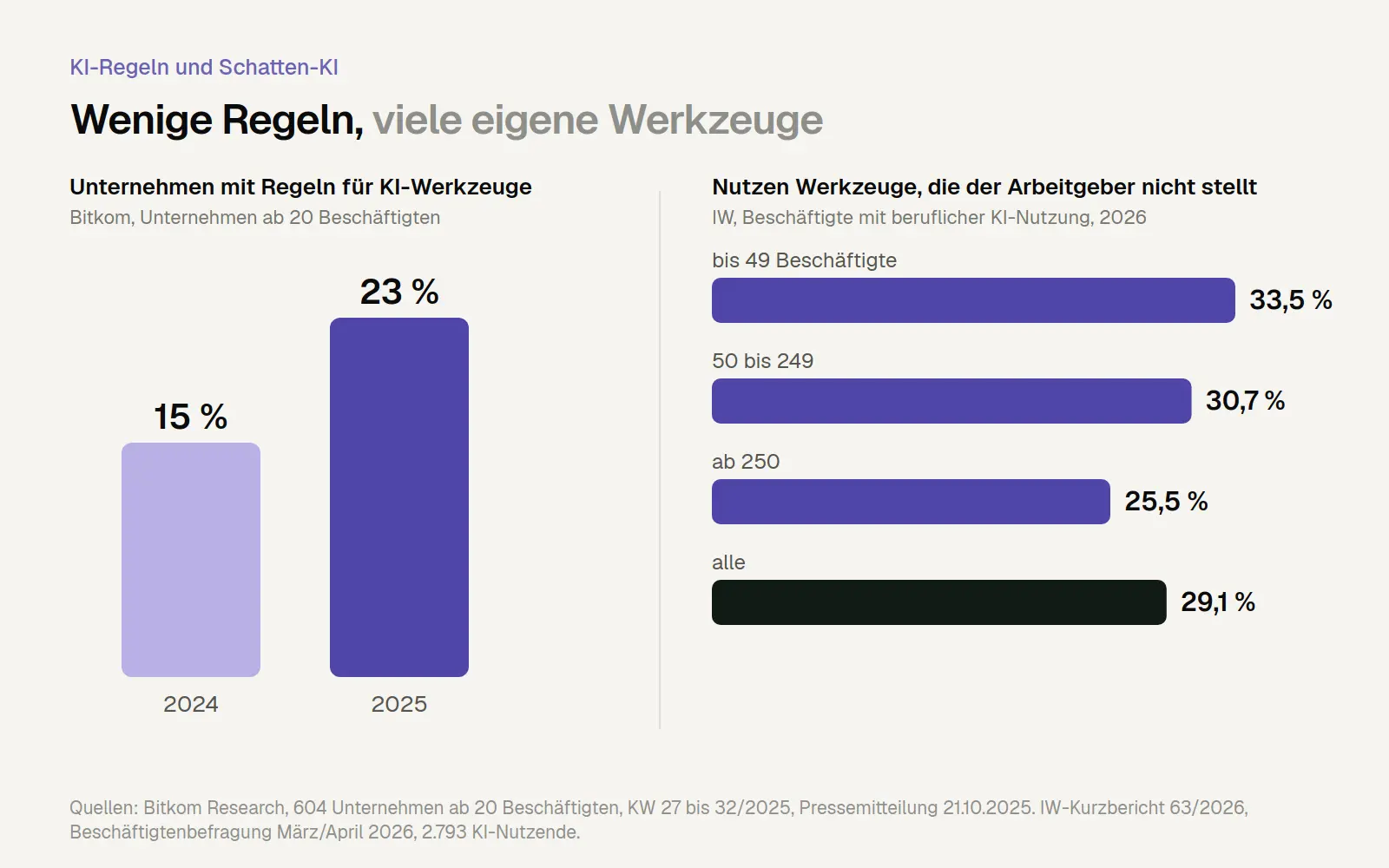
Left: Percentage of companies with policies for AI tools, according to Bitkom. Right: Percentage of professional AI users who do not have access to AI tools, according to the IW, by company size.
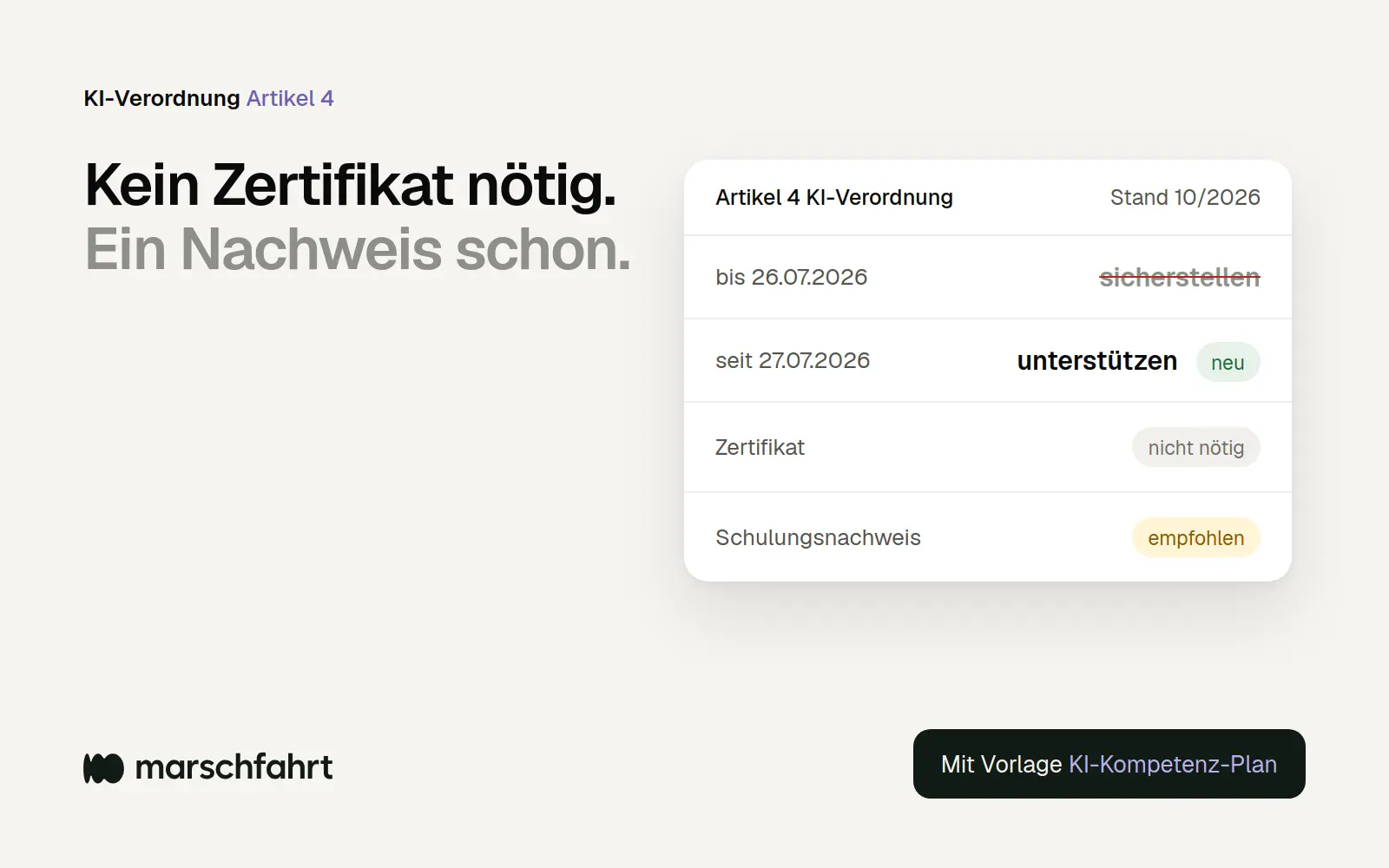
Without a policy, each person decides for themselves whether to copy a customer contract into a free chat tool. The Data Protection Conference therefore recommends in its guidance on AI and data protection: “Clear internal guidelines should therefore be issued and documented specifying which AI applications may be used, under what conditions, and for what specific purposes.” A policy also serves as a practical supplement to the obligation under Article 4 of the AI Regulation to promote AI literacy, which we explain in our guide to the AI literacy requirement: Without rules, you won’t know what to prepare your staff for.
Ban it or allow it?
Allowing and regulating works better than banning, provided you also provide the right tools. The IW writes: “Bans alone would primarily affect dedicated employees and would change little in areas where AI plays no role anyway due to a lack of guidance or visibility.” Instead, it recommends “building expertise, providing tools that comply with data protection regulations, and establishing clear, well-communicated rules for use.” Bitkom President Ralf Wintergerst echoes this sentiment: Companies must “establish clear rules for the use of AI and make AI technologies available to their employees.”
One detail from the IW report is particularly important for the guideline. Where employees report that their employer strongly promotes AI skills, 44.5 percent use tools that are not provided by the employer; without such support, the figure is 21.3 percent. The IW concludes: “Those who promote AI skills without providing the necessary tools make their use uncontrollable.” Training alone is therefore not enough; people also need an approved tool in which they are allowed to apply what they have learned.
There is also a counterpoint to the comprehensive policy. The City of Vienna deliberately states in its AI Compass: “We are refraining from creating a policy with detailed guidelines, as the development of AI is dynamic.” Instead, there are a few basic rules and mandatory training sessions. For a company with several hundred employees, we recommend a middle ground: a few clear basic rules on a single page, followed by appendices that can be easily updated—such as the list of approved tools.
Module 1: Approved Tools and Company Accounts
Specify which tools are permitted with which accounts, and provide company accounts instead of personal ones. The Data Protection Conference states: “Employers should provide devices and accounts for employees’ professional use of AI applications.” Employees should “not be required to work with AI applications on their own using personal accounts and devices, as this can result in the creation of profiles for the respective employees.” The Hamburg Data Protection Commissioner puts it succinctly in his checklist for LLM chatbots: “Provide work-related chatbot accounts.”
The publicly available AI policy from the software provider d.vinci illustrates exactly how this works. It specifies three systems for daily work, including Microsoft 365 Copilot and the team version of ChatGPT. Other tools are permitted only if their servers are located in Europe, no confidential or restricted internal information is entered, and the tool does not use the input for training purposes.
For each approved tool, three settings and a contract must be included in the policy or its appendix:
No Training: The Data Protection Conference recommends default settings “that no input data be processed for training purposes and that no input history be stored beyond the session.”
History: If possible, do not save it beyond the session; when necessary, clearly communicate who can view it.
Sign-up: Company account with sign-up via the company directory, strong passwords, and two-factor authentication.
Contract: Data Processing Agreement pursuant to Article 28 of the GDPR with the provider; review of transfers to third countries.
Module 2: The Data Traffic Light
The most important rule is which data can be used in which tool: Public data can be used anywhere; internal data only in approved company accounts; confidential data only with authorization or on an internal platform; personal data only with authorization; and health, job application, and compensation data, as well as passwords, never. The rule must be simple enough that no one needs to ask for clarification. Most genuine guidelines use data classes for this purpose. The City of Vienna allows only public data in freely available tools, but also restricted and confidential data on its own AI platform. The data class therefore depends on the tool.
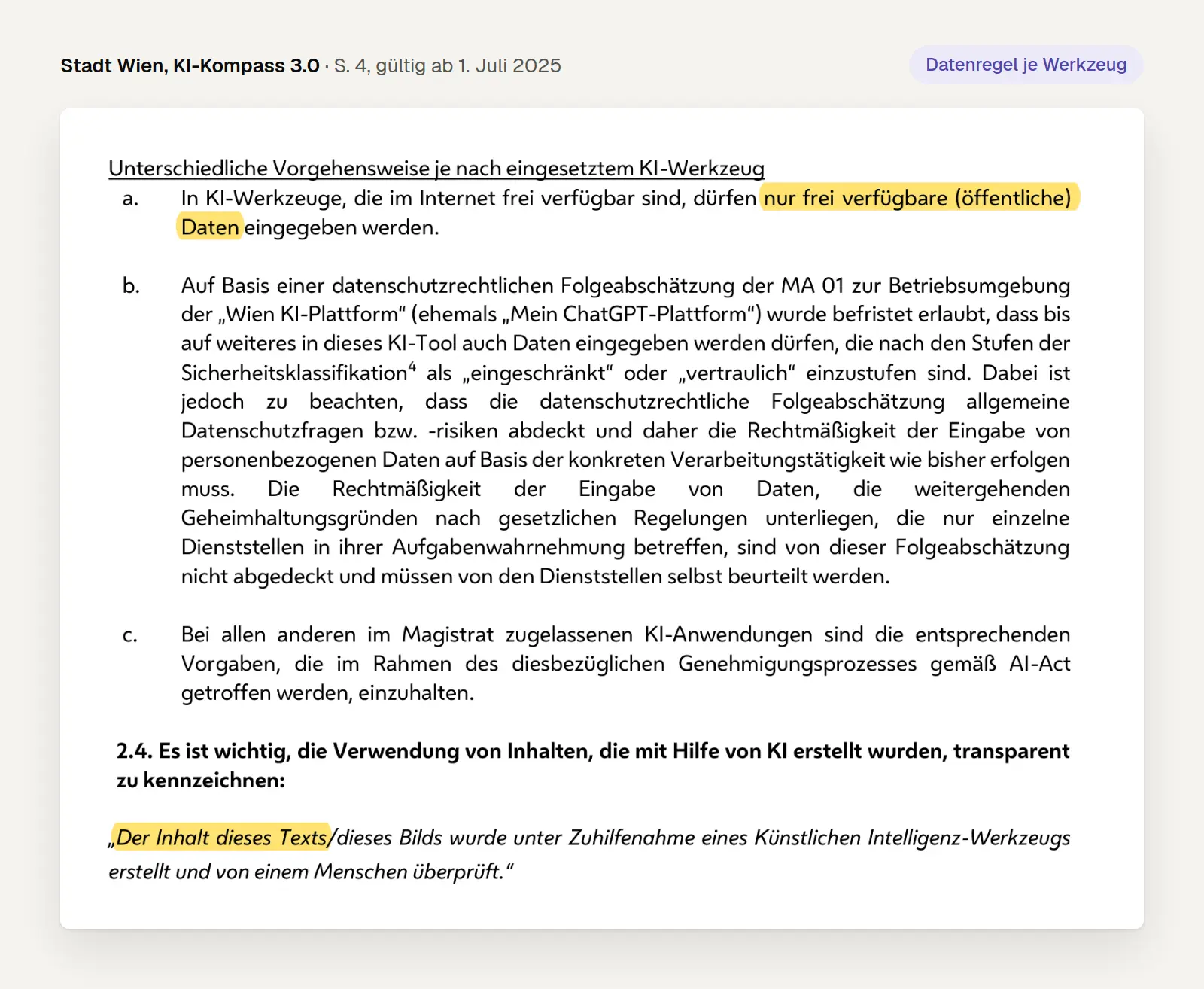
The City of Vienna's AI Compass distinguishes between freely available tools and its own platform (highlighted) and specifies a fixed set of labels.
For companies, we propose a traffic-light system consisting of five data classes and three types of tools. It combines the logic from Vienna with the recommendations of data protection authorities. You can adapt the classes to your existing information classification system, if you have one.

"Data Traffic Light"—a proposal from marschfahrt.de: which data class is permitted in which tool. Yellow means only with documented approval, such as following a data protection impact assessment.
In case of doubt, a fallback rule is needed. The federal administration has summarized it in a single sentence in its AI guidelines: “Unless other information is available, the most restrictive scenario for data entry generally applies to users. In this case, only public data is authorized for entry.” The handout for employees puts it even more succinctly.
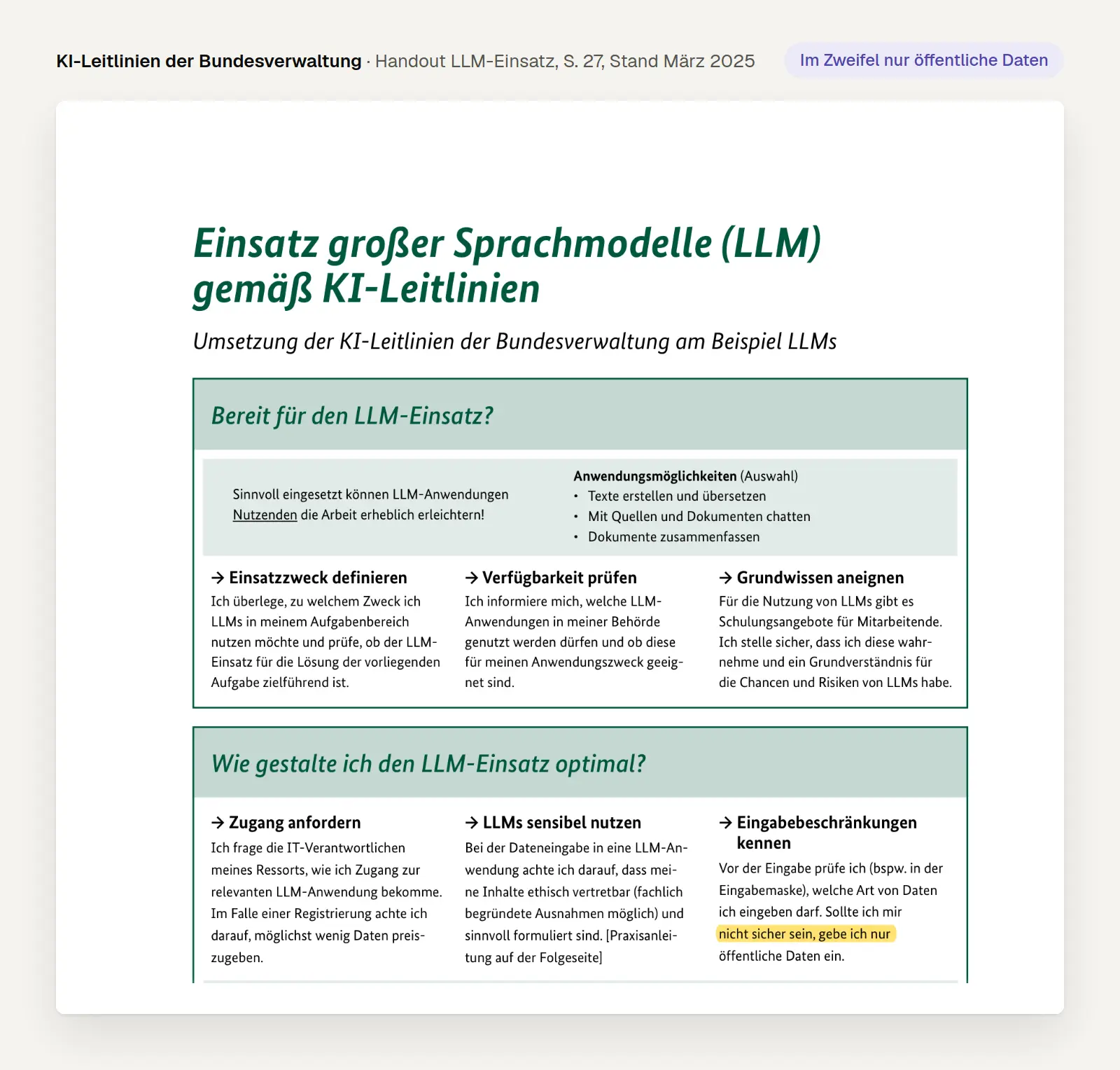
The handout on the federal administration’s AI guidelines: “If I’m not sure, I’ll only enter public data.”
How strict you are with personal data depends on whether the provider uses your input for its own purposes. If that is the case, “no personal data may be transmitted to the AI,” writes the Hamburg Data Protection Commissioner. For corporate accounts, the Data Protection Conference specifies the following requirements: a legal basis, a data processing agreement, disabled training, and, in many cases, a data protection impact assessment. For tools that process the data themselves, the risk level is “red”; for a verified corporate account, it can be “yellow.” The HAW Kiel University of Applied Sciences clarifies what remains “red” in its AI guidelines with a list of data that must not be entered even into approved AI systems.
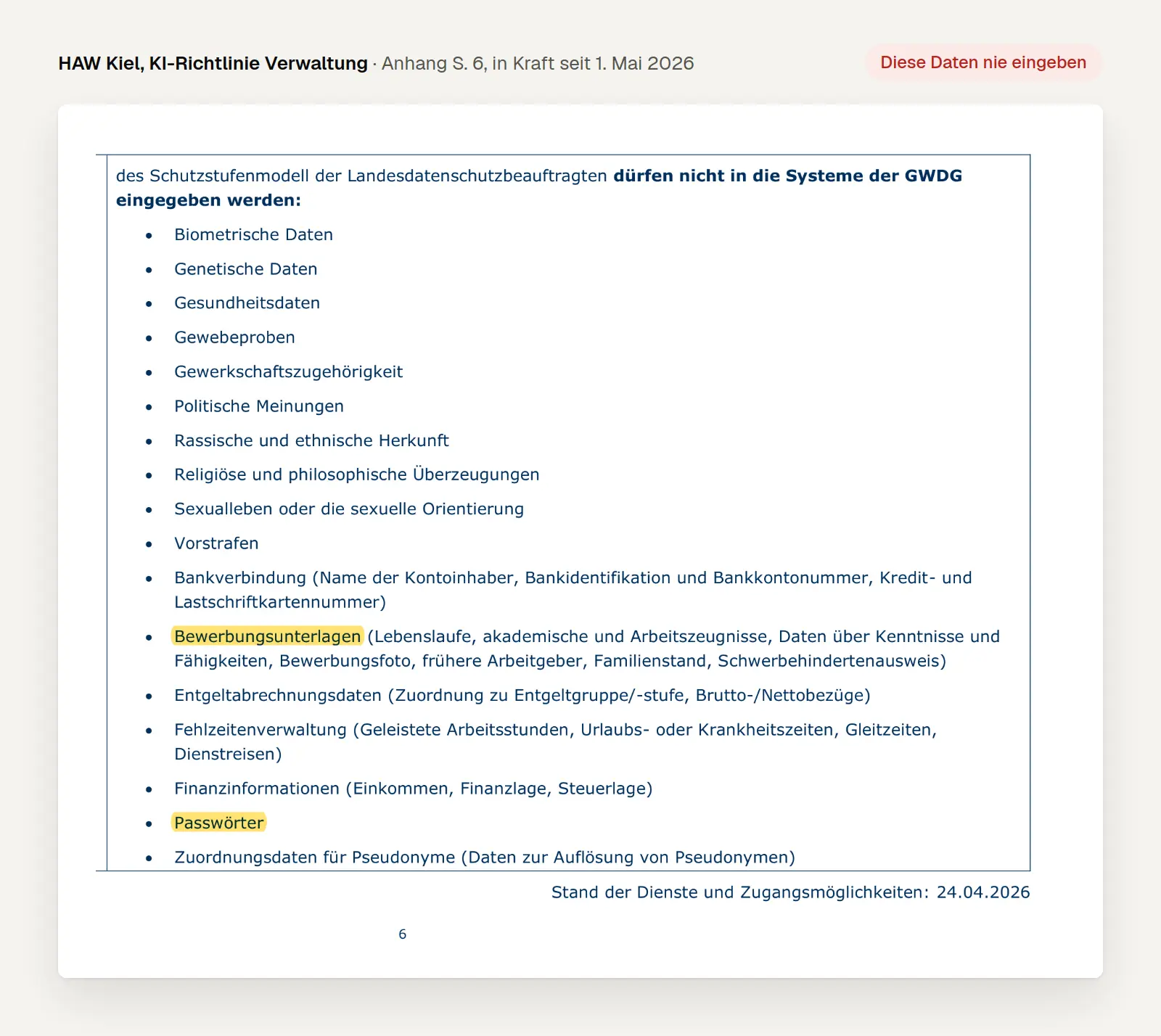
From the appendix to the KI Guidelines of Kiel University of Applied Sciences: Data that must not be entered into the approved KI systems, including job application documents and passwords.
Module 3: Permitted and Prohibited Uses
Use examples from your everyday life to describe when AI is desirable and when it is not. The Data Protection Conference expressly recommends this: “Specific examples of permitted and prohibited use cases can be helpful in clarifying the issue and are therefore recommended.” The Bitkom guide on generative AI also advises that the policy should “ideally address specific, business-relevant use cases.” The City of Bern has implemented this in its AI fact sheet as a two-column table.
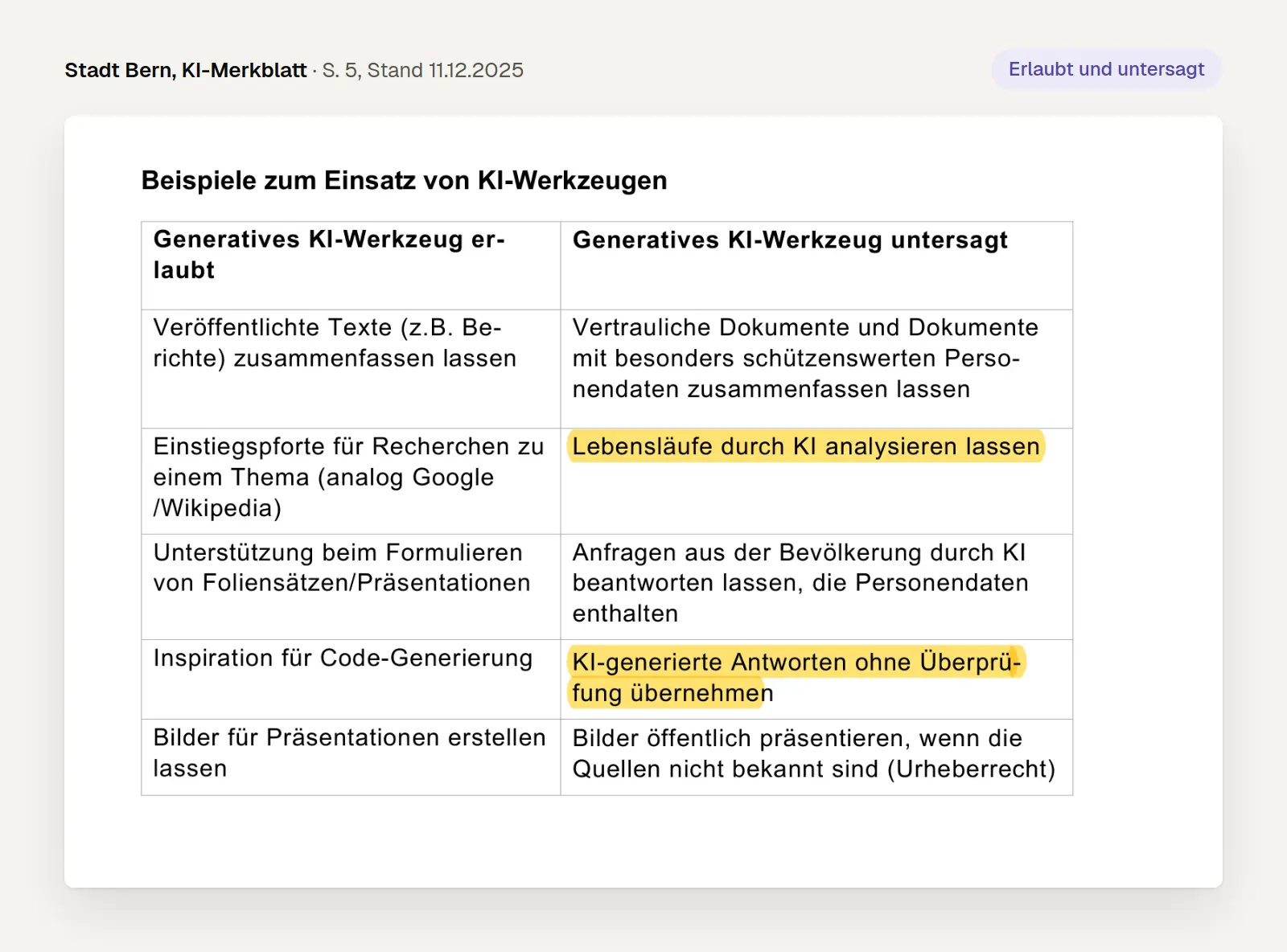
The City of Bern’s AI fact sheet compares permitted and prohibited uses. Two prohibited uses are highlighted: having AI analyze resumes and adopting AI-generated responses without verification.
Certain uses should be prohibited in every company or permitted only subject to special review because the law prohibits or severely restricts them:
Emotion Recognition in the Workplace: Under Article 5(1)(f) of the AI Regulation, AI that infers a person’s emotions “in the workplace and in educational institutions” is prohibited, except for medical or safety reasons. This has been in effect since February 2, 2025.
Decisions About People Made Without People: “Decisions with legal effect may, in principle, only be made by people, in accordance with Article 22(1) of the GDPR,” writes the Data Protection Conference.
Candidate selection and performance evaluation only with special approval: AI used for hiring, selection, or decisions regarding employment relationships is classified as high-risk AI under Annex III of the AI Regulation, with specific obligations taking effect on December 2, 2027. The Wuppertal Institute completely excludes automated performance evaluations by AI from its policy.
Deceptive content: Deepfakes of real people without any labeling; see Module 5 for more information.
Module 4: Reviewing and Taking Responsibility for Results
Anyone who shares an AI-generated result is responsible for it as if it were their own text. This is stated, in this or a similar form, in nearly all of the guidelines reviewed, such as those from the federal government, Bern, and HAW Kiel. The federal administration states: “Users should review AI-generated content from a technical perspective before further use.” The Hamburg Data Protection Commissioner states: “The results of a chatbot query should be treated with caution.” In its paper on generative AI models, the BSI writes that users should be empowered to “critically question the model’s outputs.”
In practical terms, this means that figures, citations, sources, and legal statements are reviewed before being shared. Information intended for clients, government agencies, or the public is reviewed by a second person in cases involving higher risk. In its model for use cases at the second of four risk levels, the German Association of Tax Advisors specifically provides for this “four-eyes principle.”
Module 5: Label where necessary
Above all, deepfakes and certain texts intended for the public must be legally labeled; you are responsible for regulating everything else yourselves. As of August 2, 2026, the transparency requirements set forth in Article 50 of the AI Regulation will take effect. For companies acting as operators, this means, according to Paragraph 4: Anyone who creates deepfakes must disclose this fact. Anyone who publishes AI-generated text to inform the public about matters of public interest must label it, unless it has been reviewed by humans and someone bears editorial responsibility. A chatbot on your website must be recognizable as AI. This obligation applies primarily to the provider, and whoever builds the chatbot is considered the provider.
There is no general labeling requirement for internal documents, emails, or proposals. Many organizations establish guidelines anyway so that colleagues know what they’re dealing with. The federal administration requires labeling when content that has not been fact-checked is shared. The City of Vienna prescribes a standard phrase: “The content of this text/image was generated using an artificial intelligence tool and reviewed by a human.” For more information on labeling on websites, see our article on the AI labeling requirement.
Module 6: Copyright and Trade Secrets
Texts, images, and logos generated solely by AI are often not protected by copyright, and your trade secrets are only protected if you protect them. Copyright law protects only “personal intellectual creations” (Section 2(2) of the German Copyright Act (UrhG)). On February 13, 2026, the Munich Local Court ruled in the first instance (142 C 9786/25) that three AI-generated logos do not enjoy protection: “The mere selection of an AI-generated product from among several ‘suggestions’ is not sufficient in and of itself.” Anyone wishing to rely on copyright protection for a logo, slogan, or product image should therefore design or edit it substantially themselves and document this process.
Trade secrets are about protecting yourselves. According to Section 2(1) of the Trade Secrets Act (GeschGehG), information is considered a trade secret only if it is “subject to confidentiality measures appropriate under the circumstances.” On October 17, 2024 (8 AZR 172/23), the Federal Labor Court ruled that blanket assertions regarding protective measures are insufficient. We are not aware of any ruling specifically addressing AI inputs. In our view, a clear rule specifying which internal information may not be entered into external AI tools is now part of what constitutes appropriate measures. The Hamburg Data Protection Commissioner expressly recommends “establishing rules for the protection of copyrights or trade secrets.”
Module 7: Requesting New Tools
Establish a simple process for reviewing and approving new tools; otherwise, people will use them without asking. The Association of Tax Advisors outlines the basic logic in its template, which is based on three conditions: an approved tool, a documented use case, and compliance with the requirements for the risk level. Only tools listed in the directory are considered approved, and the directory is reviewed at least once a year.

The basic rule from the German Tax Advisors Association’s Model AI Application Guidelines of April 2026.
To ensure that the process does not become an obstacle, it should be brief and based on clear criteria. The BSI recommends establishing “appropriate criteria for selecting the generative AI model and, if applicable, the operators.” Kiel University of Applied Sciences (HAW Kiel) also has an exception clause: In justified exceptional cases, the Chancellor may approve exceptions. In our draft, this is intended for temporary pilot projects.
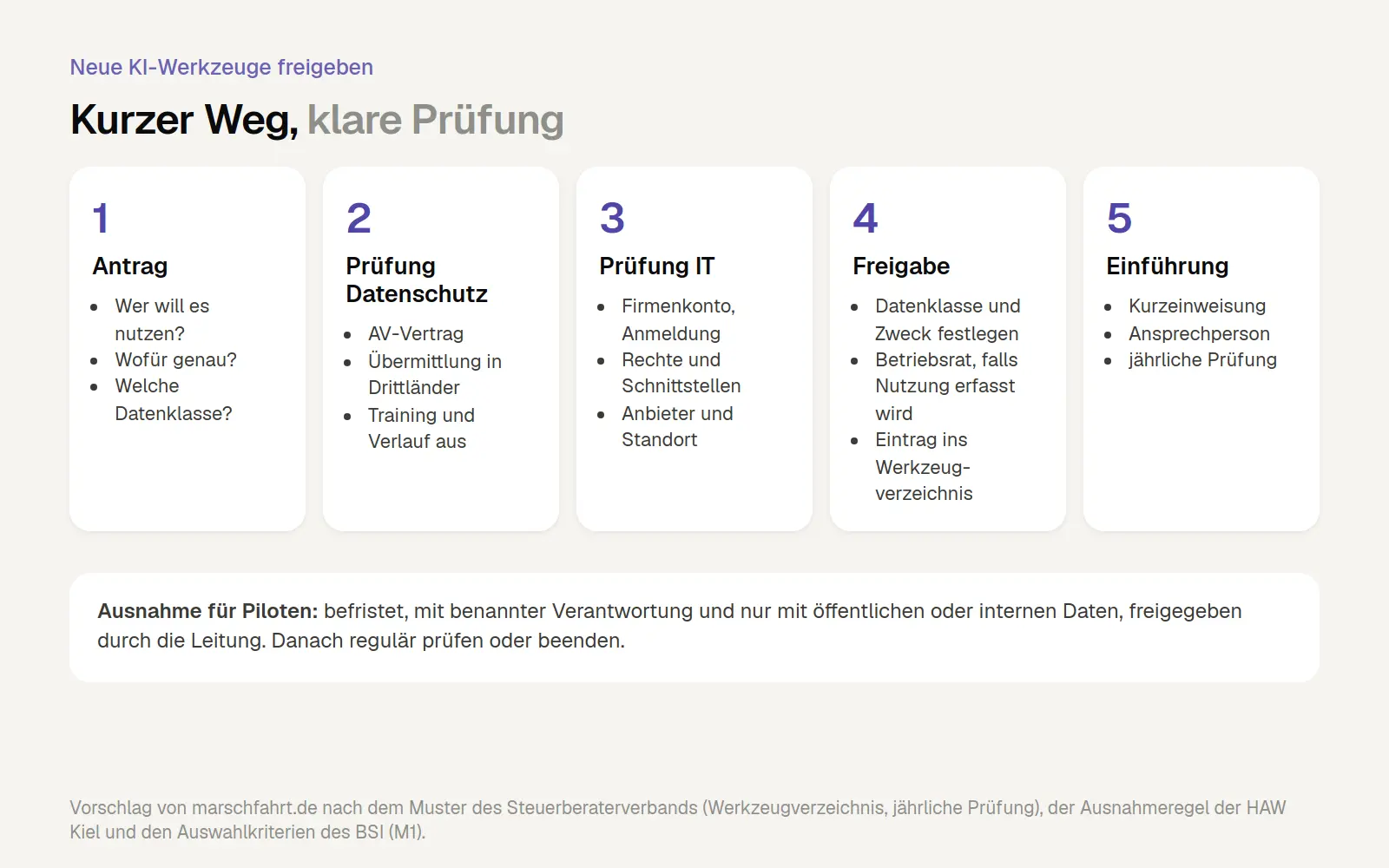
Rolling Out New AI Tools in Five Steps: A Proposal from marschfahrt.de.
Module 8: Training, Points of Contact, and a Culture of Learning from Mistakes
A policy is only effective if people are aware of it, if someone is available to answer questions, and if errors are reported rather than hidden. The BSI states: “If a model is used for professional purposes, employees should be fully informed about it and receive extensive training.” The Bitkom guide suggests making participation in training a prerequisite for access to the tools. The guide on mandatory AI competency —which includes its own template—explains how to plan and document training based on roles.
Designate a department to coordinate approvals, maintain the tool directory, and answer questions. Having a dedicated AI officer is not required; this responsibility can fall to the IT, data protection, or human resources departments. For violations, we—like the Association of Tax Advisors—recommend a learning-oriented culture of error: Anyone who accidentally enters data into the wrong tool should report it immediately, and the team learns from it. Labor law consequences apply only to intentional or grossly negligent violations, not to honest mistakes.
Policy or company agreement?
If there is no works council, you should issue the policy as an instruction; if there is a works council, you should coordinate with it early on; and if company accounts are involved, a works agreement is likely to be required. The basis for a policy is the right to issue instructions under § 106 of the German Trade Regulation Act (GewO), which, according to the law, expressly applies “with regard to order and the conduct of employees in the workplace.” The Bitkom guide takes the position that a unilateral ban on AI tools is not subject to co-determination.
Once you introduce tools, the situation changes. According to Section 90(1)(3) of the Works Constitution Act (BetrVG), the works council must be informed about the planning of work processes “including the use of artificial intelligence,” and if the works council is required to assess the use of AI, the consultation of an expert is deemed necessary under Section 80(3), second sentence, of the BetrVG. Before high-risk AI is deployed in the workplace, employee representatives must be informed in accordance with Article 26(7) of the AI Regulation. Pursuant to Section 87(1) of the BetrVG, rules governing workplace order (No. 1) and technical devices capable of monitoring behavior or performance (No. 6) are subject to co-determination.
In 2024, the Hamburg Labor Court dismissed a works council’s motions in summary proceedings (24 BVGa 1/24) (order dated January 16, 2024). The employer had authorized the use of ChatGPT and published guidelines on the intranet; however, employees used the tool in their browsers via personal accounts to which the employer had no access. In the court’s view, the rules concerned work conduct not subject to co-determination, not workplace order, and, due to the lack of data access, no monitoring had taken place. This cannot be generalized. If you set up company accounts to which you have access to usage data, co-determination under No. 6 is a logical step. However, this is precisely what the data protection authorities recommend. The solution is a works agreement, which the Data Protection Conference also mentions as an option. The policy can then serve as an appendix to that agreement. This is not legal advice; if you are unsure, seek advice on labor law.
Also, involve your data protection officer. The Data Protection Conference states: “Corporate and government data protection officers should always be involved when decisions regarding AI applications are being prepared or made.”
The AI Guidelines as a Template: How to Customize Them
The template follows the sections outlined in this article; you simply need to add your tools, points of contact, and examples. It has twelve sections, ranging from “Purpose and Scope” to “Acknowledgment of Receipt,” and follows the structure of this article. Text highlighted in gray consists of notes; you should fill in the sections enclosed in square brackets.
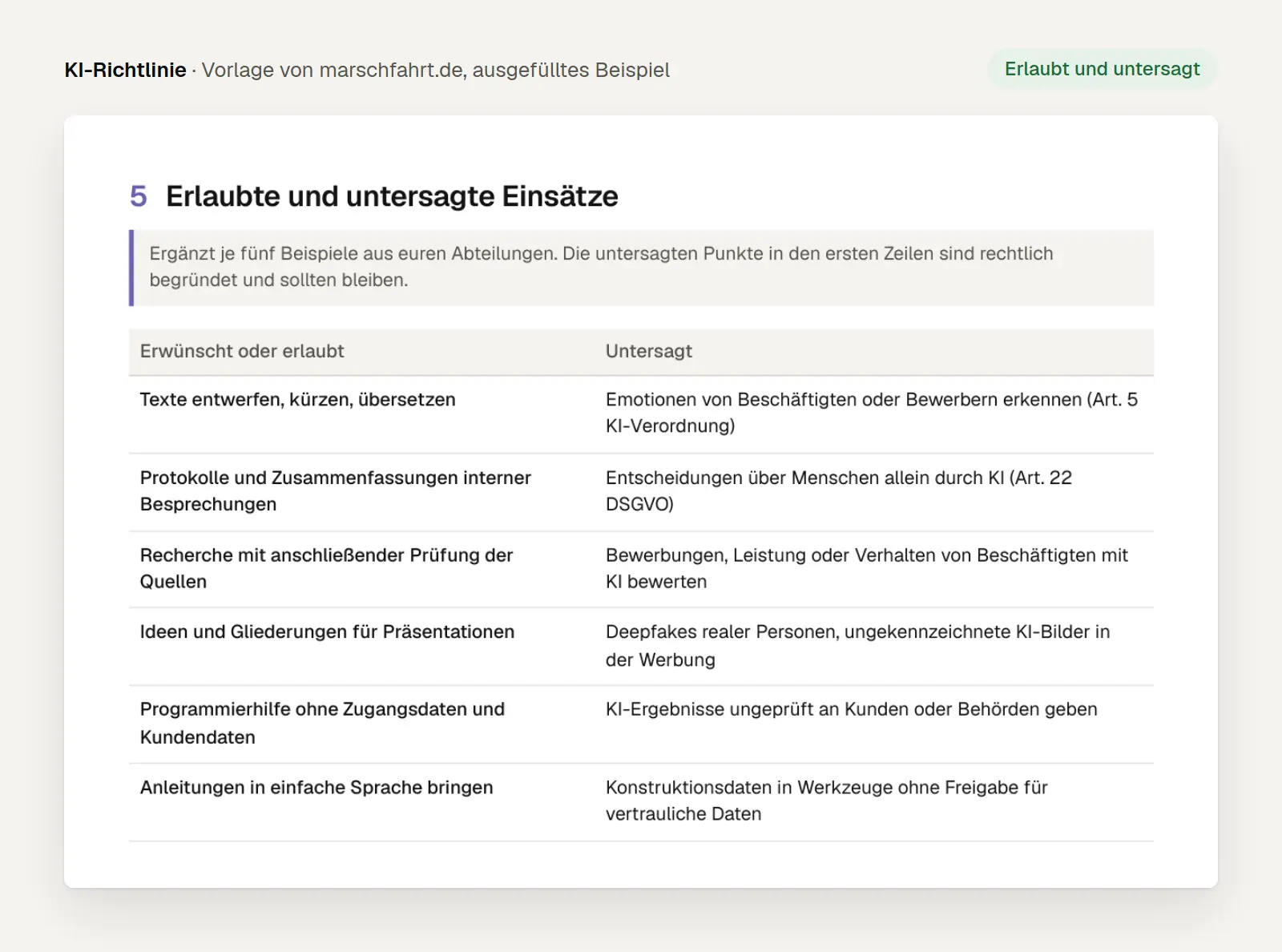
Excerpt from the completed example: permitted and prohibited uses. The first prohibitions are based on legal grounds; the rest are drawn from the day-to-day operations of the fictional company.
Enter tools: all approved tools, including account, permitted data class, and purpose, in Section 3
Customize the traffic light system: Align data classes with your information classification system and add examples from your organization
List examples: five permitted and five prohibited uses from each of your departments in Section 5
Designate points of contact: who approves tools, who answers questions, and where incidents are reported
Coordinate with: the data protection officer, IT security, and, if applicable, the works council
Communicate: Introduce the policy through training and have employees acknowledge that they have received it
The template is available as a Word file and also as a PDF. The completed example shows the policy for a fictional mechanical engineering company with 180 employees.
Frequently Asked Questions
The document is not required by law, but it is recommended by data protection authorities.
Is an AI policy required by law?
No, no law explicitly requires a document with that name. However, the Data Protection Conference recommends documented internal guidelines, and the AI Regulation requires measures to promote AI literacy. A policy covers these guidelines and, together with documented training, serves as good evidence of the measures taken to promote AI literacy.
Are employees allowed to use personal AI accounts for work?
That's up to you. The Data Protection Conference and the Hamburg Data Protection Commissioner advise against it and recommend using company accounts. Most of the policies reviewed prohibit the use of personal accounts for business purposes, such as those of the University of Hohenheim and the template provided by the Association of Tax Advisors.
How long should the policy be?
Short enough to be read. Most of the guidelines we analyzed are three to six pages long; the federal administration’s guidelines, at 32 pages, and the tax advisors’ association’s template, at 16 pages, are significantly longer. We recommend one to two pages of basic rules, with the variable sections—such as the tool list—included as an appendix.
How often does it need to be updated?
At least once a year, and whenever a new tool is added or an existing one is modified. Bitkom states that “it is essential that these developments be monitored on an ongoing basis and that relevant developments be incorporated into the guideline.”
What happens if there is a violation?
Specify this in the policy and distinguish between negligence and intent. In cases of negligence, a prompt report is more helpful than a warning, because only then can you take action—such as asking the provider to delete the data and determining whether the incident must be reported to the data protection authority within 72 hours (Art. 33 GDPR).
What Has Changed and What That Means for You
The rules governing AI in the workplace have become more specific in 2026; today, guidelines can be based on reliable sources.
February 2, 2025: The ban on emotion recognition in the workplace and the requirement to implement measures to promote AI literacy take effect. This should be included in every policy.
February 13, 2026: The Munich Local Court denies copyright protection for AI-generated logos. Anyone who creates trademarks or design elements using AI must specify the extent of human involvement.
April 2026: The German Association of Tax Advisors publishes a model AI application guideline that includes a list of tools and risk levels. A good example for regulated industries.
July 27, 2026: The AI competency requirement is relaxed. Measures to ensure AI competency remain mandatory, but a specific level is no longer required.
August 2, 2026: Transparency requirements under Article 50 take effect. Deepfakes and certain texts must be labeled as such for the public.
December 2, 2027: Requirements for high-risk AI in human resources will take effect. Determine by then whether you use such systems.
Date of this version: October 31, 2026. This article does not constitute legal advice.
Conclusion
An AI policy is not a list of prohibitions, but rather a framework for authorization. It sets up company accounts with training disabled, uses a traffic-light system to determine which data can go where, describes permitted and prohibited uses with examples from your everyday life, establishes procedures for reviewing, labeling, and approving new tools, and identifies who can provide assistance. You should coordinate this with the works council early on.
Download the AI policy template and start with Section 3, which lists the tools you’re already using. If you want to roll out the policy as part of a training session, our AI workshop for teams shows how to make effective use of the approved tools in your day-to-day work.
More Articles
© Marschfahrt Studio
Practical knowledge on web design, SEO, AI, and conversion optimization. Based on real projects, without any marketing spin.