Meta Ads 2026: What Advertising on Facebook and Instagram Really Costs and When It's Worth It
In two of the advertising accounts we manage, traffic campaigns cost €0.16 per click and didn’t generate a single inquiry tracked by Meta, while lead campaigns cost €2.19 per click and generated 59 inquiries worth €53.38 each. This article breaks down the actual cost of an inquiry with follow-up support, explains when Meta Ads are worth it, and details what the learning phase, the EU selection screen, and Tracking 2026 mean for you.
Date
Category
Author

“How much does an inquiry via Instagram cost us?” This is a natural question to ask as soon as a business starts considering Meta Ads, and most articles on the costs of Meta Ads answer it with cost-per-click figures and estimates without citing sources. For a business looking to attract new customers, however, it’s not the cost per click that matters—it’s what a genuine inquiry ultimately costs, including customer support and ad creative. That’s exactly what we’re breaking down here, using data from ad accounts we manage ourselves.
The Data Set: On October 2, 2026, we analyzed the campaigns from four managed advertising accounts in euros via Meta’s marketing interface, covering the period from October 1, 2025, to September 30, 2026—66 campaigns with a total spend of €16,165. This is a small sample, so we’re only showing aggregated values across at least two accounts—anonymized, without names or industry details. These are real-world figures from our work, not a market average, and your results may vary significantly.
This post covers the topics in the order you need them: what clicks and inquiries cost, how Meta sets its prices, what budget the learning phase requires, what a managed inquiry costs, and when it pays off. It also covers the 2026 EU changes, tracking, the Ads Library, and pricing models on the market. We sell our own package for managing Meta Ads—we’re open about that—and we’re just as open about who it isn’t worth it for.
In a nutshell (as of October 2026)
Evaluate your Meta Ads based on cost per inquiry, not cost per click, and set the objective for every campaign designed to generate inquiries to “Leads.” In two of the accounts we manage, traffic campaigns cost €0.16 per click and didn’t generate a single lead as counted by Meta, while lead campaigns cost €2.19 per click and generated 59 leads worth €53.38 each. Open Ads Manager today and calculate how much of your budget went toward campaigns that didn’t generate a single lead last year.
How Much Meta Ads Will Cost in 2026: Prices for Instagram and Facebook Based on Managed Accounts
With Meta Ads, expect two completely different price levels depending on which campaign objective you choose. Across all 66 euro campaigns in the four accounts, the cost per 1,000 impressions—known as CPM—was €3.33, a link click cost €0.31, and 1.06% of impressions resulted in a click. However, this mix doesn’t tell us much because it includes campaigns with very different objectives. The data only becomes meaningful when broken down by objective.
Traffic campaigns, in which Meta optimized for link clicks, ran in two accounts with 14 campaigns and €5,325 in spend. They cost €2.48 per 1,000 impressions and €0.16 per link click, with a link click-through rate of 1.54%. Lead campaigns optimized for inquiries ran across two accounts with three campaigns and €3,150 in spend: €29.81 per 1,000 impressions, €2.19 per link click, a link click-through rate of 1.36%, plus 59 inquiries at €53.38 each.
At Meta, a “lead” is defined as a completed form submitted directly on Meta or a lead event reported by the website’s pixel or Conversions API, as counted by Meta. We do not report campaigns with other objectives individually because they each ran in only one account and cannot be displayed anonymously. When it comes to the costs of Instagram and Facebook advertising, this means that a cost-per-click figure without a campaign objective is meaningless. Whenever someone gives you a number, first ask about the objective, sample size, and time period.
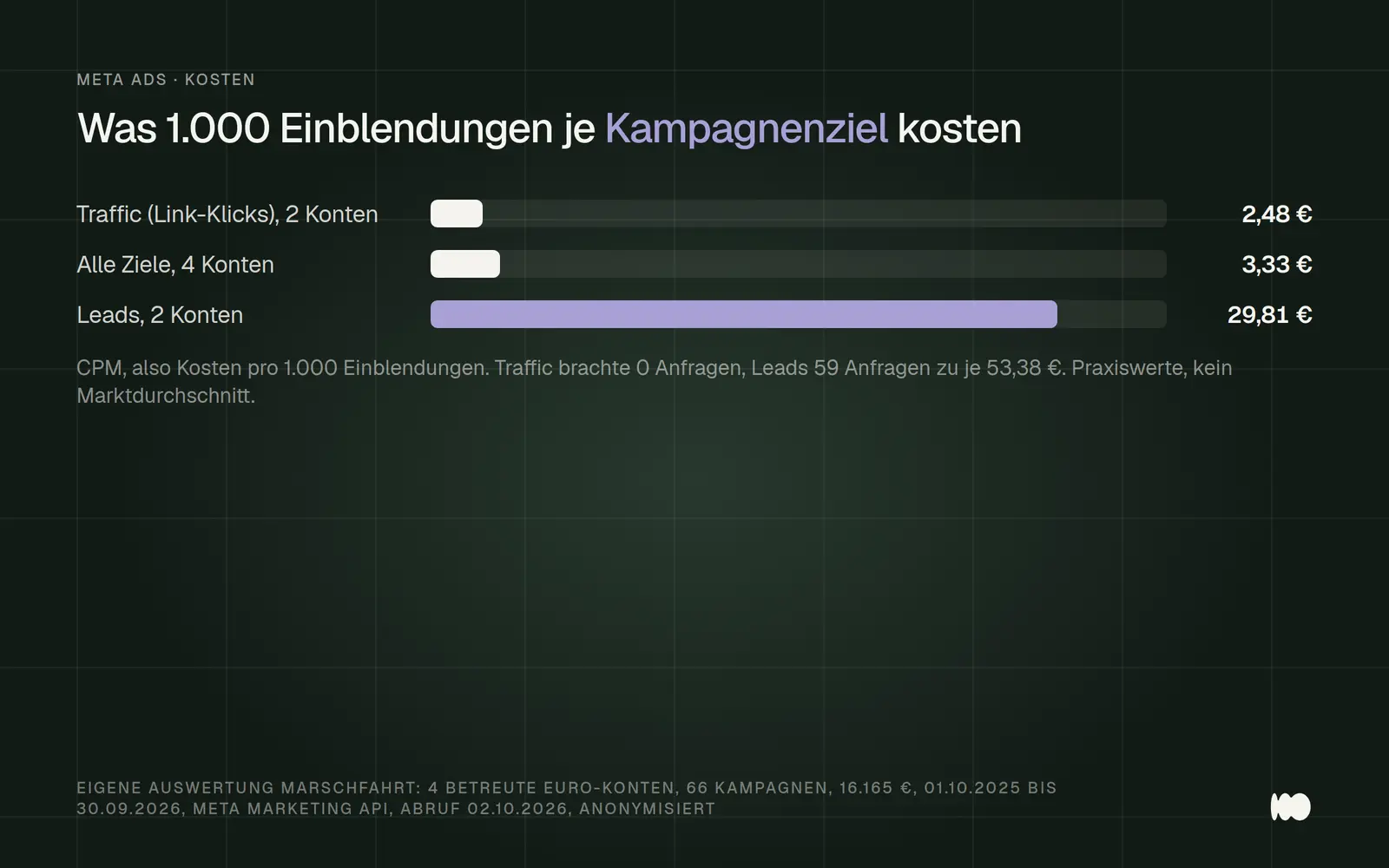
Cost per 1,000 impressions in our managed Euro accounts: Lead campaigns are about twelve times as expensive as traffic campaigns, but they are the only ones that generate inquiries.
Use the current names of the campaign objectives when reading guides or comparing offers. According to Meta’s developer documentation, as of October 2026, there are six objectives: Awareness, Traffic, Engagement, Leads, App Promotion, and Revenue; these replace older objectives such as Conversions or Link Clicks. In our account data, older campaigns still use the old terminology. If someone refers to the objective as “conversions” in 2026, ask how the campaign is actually set up today.
Why Cheap Clicks Don't Generate Leads
Never launch campaigns designed to generate leads with the goal of driving traffic, even if the clicks cost only a fraction of the price. In our accounts, lead campaigns cost about twelve times as much per 1,000 impressions as traffic campaigns—€29.81 versus €2.48—and about fourteen times as much per click—€2.19 versus €0.16. Nevertheless, all 59 inquiries came from the lead campaigns; the cheap clicks in these accounts didn’t generate a single one. Cheap clicks didn’t generate any inquiries in our accounts—that’s the most important takeaway from this post.
The reason for this becomes clear from the auction, which we’ll explain in more detail in the next section. For each ad impression, Meta estimates how likely the desired action is—for traffic, that’s a click; for leads, it’s a completed form. According to our analysis, Meta therefore specifically shows lead ads to people who are more likely to fill out forms, and these ad impressions are more expensive because many advertisers want exactly these people. For traffic, on the other hand, the system finds people who like to click, and in our accounts, these were apparently not the same people who went on to submit an inquiry.
The click-through rate reflects this: At 1.54% for traffic, it was actually higher than the 1.36% for leads. So more clicks don’t necessarily mean more interest in the offer. Our article “Why More Inquiries Rarely Come from More Traffic” explains why this is just as true for websites. Therefore, remove click price and click-through rate from your reports or move them to the bottom, and put cost per lead at the top.
For lead campaigns, check whether the inquiries are actually useful. Forms embedded directly in Meta—so-called “instant forms”—are easier to fill out, which, according to common wisdom, often comes at the expense of quality; Meta also offers a form type with “higher intent.” We cannot provide reliable figures on the difference in quality; our sample size is too small for that. Therefore, before you start, define what constitutes a good inquiry for you—for example, including location, project, and timeframe—and ask for exactly these details in the form.
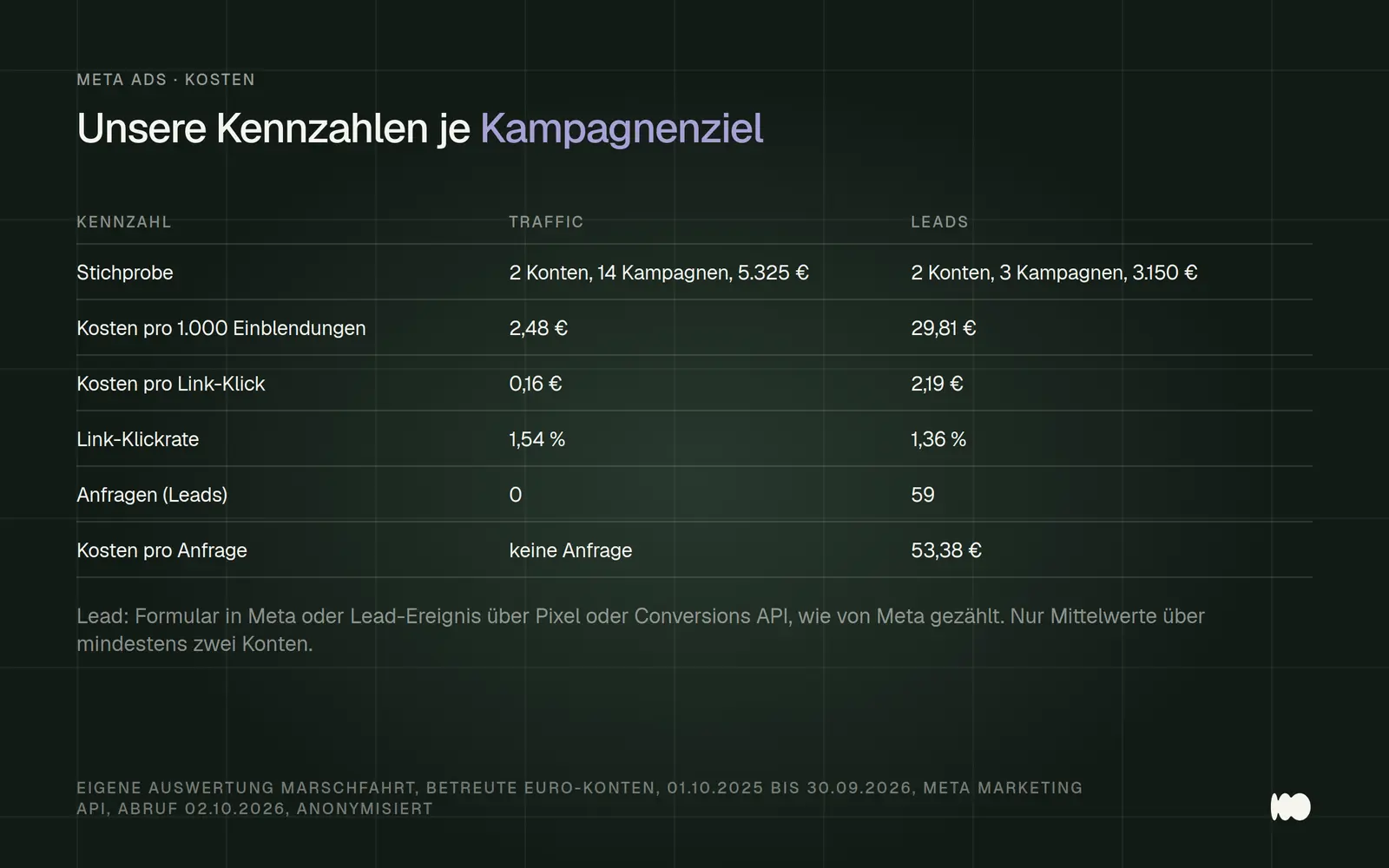
An overview of our key metrics by campaign goal: Traffic gains ground in every click metric but falls short in the one metric that really matters to businesses.
How Meta Determines Price: Bid, Click-Through Rate, and Quality
First improve the ad, then the bid, because on Meta, the highest bidder doesn’t automatically win. According to Meta for Business (“Good Questions, Real Answers,” June 11, 2020), for each ad impression, the advertiser’s bid, the estimated action rate, and the ad’s quality score are combined into a single score. The estimated action rate is Meta’s prediction of how likely someone is to perform the desired action. According to Meta, the quality score incorporates user feedback—such as whether they view or hide an ad—as well as an assessment of low-quality characteristics.
Meta doesn’t publish an exact formula, but the general principle is this: An ad that people find relevant and engage with can outbid a higher bid. That’s why creatives—that is, the images, videos, and text in the ad—aren’t just window dressing at Meta; they’re a cost factor. In our experience, creative performance declines when the same people see the same content repeatedly, and if you only have two creative assets, you can’t test them against each other. That’s why you should plan for new creatives every month—our Ad Management Package for Meta Ads includes 15 or more new creatives per month for exactly this reason.
Choose your bidding strategy carefully, as each one has side effects. According to Meta’s developer documentation on bidding strategies, with “Max Volume” and no cost control, the cost per result may rise once cheaper opportunities have been exhausted. When using the “Cost Per Result” target, Meta notes that there’s no guarantee the limit will be met; setting a bid cap may result in the budget not being spent at all; and setting an ROAS target—that is, a target for revenue per euro spent on advertising—that’s too high will slow down ad delivery. Therefore, start without a cost limit and only set one once you know your actual cost per inquiry based on several weeks of data.
Expect Meta advertising to have become more expensive. According to Meta’s quarterly report dated July 29, 2026, the average price per ad rose by 12% year-over-year in the second quarter of 2026, while the number of ad impressions increased by 14%. These are global figures; while the price per ad for Europe isn’t clearly documented, you should still build in a buffer for the cost per request in your planning.
Learning Phase and Budget: Why We Consider €1,500 the Lower Limit
Based on our experience, give a new campaign four to six weeks and make as few changes as possible during that time. In the German help section, Meta describes the learning phase as “the period during which the delivery system is still being trained on how to deliver an ad set.” According to Meta, ad sets are paused “as soon as performance stabilizes. This usually happens after about 50 results in the week following the last significant change to the ad set.”
Now for the honest calculation, based on our own estimates: If you want about 50 results per week per ad group, you’ll need to multiply the cost per result by about 50 each week. At €53 per lead, that’s 50 × €53 = €2,650 per week—or over €11,000 per month for a single ad group. With a monthly budget of €1,500, these costs would yield about 28 inquiries—that’s 6 to 7 per week. Mathematically speaking, a lead campaign with a normal budget therefore remains in the learning phase, and this applies to any budget that’s significantly below this level.
Structure your campaign so that the few results aren’t scattered. Based on our analysis, this means: a few ad groups instead of many, broad target audiences instead of narrowly defined ones, one objective per campaign, and no major changes every few days. If you have very few inquiries, you can optimize for an earlier event that occurs more frequently, but you’ll then need to carefully check whether that still generates inquiries. The “Delivery” column in Ads Manager indicates whether an ad set is still learning—it will show the status “Learning Phase”—and for ad sets that aren’t getting enough results, Meta has a dedicated help page on the impaired learning phase.
Plan for an advertising budget of at least €1,500 per month if you want reliable results in the foreseeable future. This isn’t a figure set by Meta; Meta only sets low technical minimum amounts, which the Ads Manager displays, and rules of thumb involving a few euros a day don’t tell you whether you’ll ever get enough results for the system to learn. Our threshold is based on real-world experience: Even with €1,500, a lead generation campaign technically remains in the learning phase, but below that amount, so few inquiries are generated that even after months, you still won’t know if it’s working. That’s why we recommend an advertising budget of at least €1,500 per month for our package and don’t expect reliable results until after four to six weeks.
If you're promoting solar energy, you can find an industry overview—including common mistakes—in our article "Meta Ads for Solar Installers: What Works and What Burns Through Money." Set aside a specific time during the first four weeks when you'll deliberately leave the campaign alone, and another time afterward to evaluate it.
Total Cost: What a Meta Ads Campaign Really Costs
Divide all costs by the number of inquiries—not just the advertising budget. The cost per lead in Ads Manager only includes what goes to Meta. On top of that, there are management fees, creative assets, landing pages, and tracking—either billed by an agency or as your own time spent on the project. The formula is simple: advertising budget plus management fees plus creative assets, divided by the number of inquiries, equals the true cost per inquiry.
Here’s a sample calculation using our own package—this is strictly an example and not a guarantee: A €1,500 advertising budget goes directly to Meta; the package costs €1,499 net; together, that totals €2,999, or about €3,000 per month. At about €53 per lead, a €1,500 budget yields approximately 28 inquiries. €2,999 divided by 28 inquiries equals about €107 per inquiry, including support, creative assets, and the landing page.
The €53 comes from two accounts and three campaigns; for you, the figure could be significantly lower or higher. A second example illustrates just how sensitive the calculation is to these changes: If a lead costs twice as much—that is, around €106—then €1,500 will only yield about 14 inquiries, and €2,999 divided by 14 comes to about €214 per inquiry. The level of support remains the same, the number of inquiries is cut in half, and the total cost per inquiry doubles. Therefore, always plan for two scenarios: one based on your expected costs and one based on double the cost per lead.
If you're doing it yourself, be sure to factor in your own labor costs. If you manage the campaign yourself, you won't pay for management services, but you will incur hours spent on creative assets, copy, analysis, tracking, and the landing page. Keep track of how many hours that adds up to over the course of a month, and multiply that by your hourly rate.
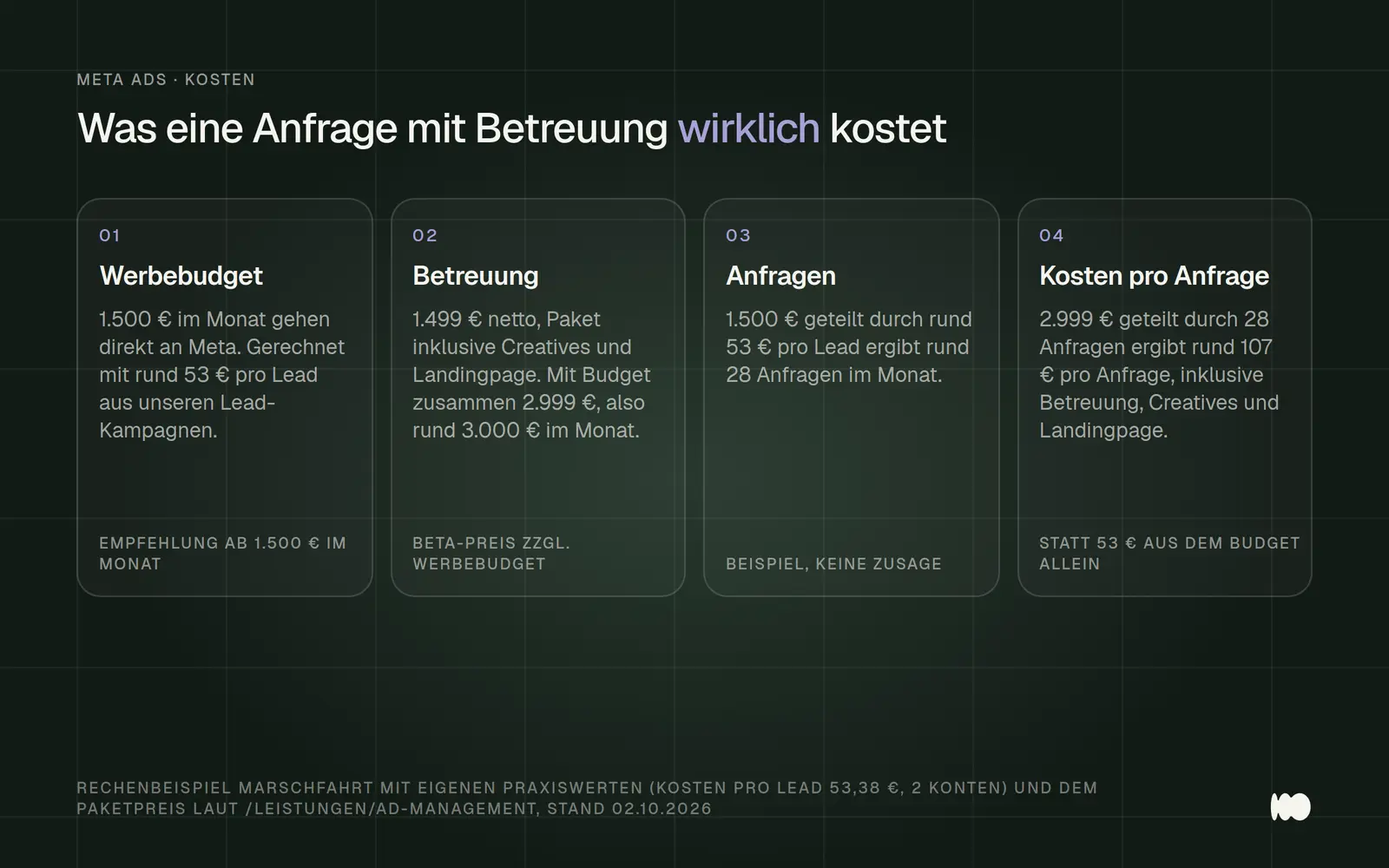
Take full-cost accounting as an example: the advertising budget and client support combined, divided by the number of inquiries, comes to about €107 per inquiry instead of €53. This isn't a promise, but a calculation based on our actual figures.
When Meta Ads Are Worth It and When They Aren't
Before you get started, calculate how much an inquiry is worth to you, and compare that to the total cost per inquiry. The value of a lead is your average order value multiplied by your conversion rate—that is, the percentage of leads that turn into orders. If this value is significantly higher than the cost per lead, advertising can be worthwhile; if it’s lower, it isn’t. Because not all of the revenue from an order stays with you, calculate based on gross profit—that is, what’s left after materials and labor.
Example A: A business with an order value of 8,000 € and a 10% conversion rate. One inquiry is worth 8,000 € × 10% = 800 € in revenue and costs 107 € in the example above. Mathematically, 28 inquiries result in 2.8 orders, and €2,999 divided by 2.8 equals approximately €1,071 in advertising costs per order—a good 13% of the order value. If the gross profit from the order exceeds this €1,071, it’s worth it; assuming a 30% gross profit margin, that would amount to €2,400 per order.
Example B: A business with an order value of €300 and a 10% conversion rate: One lead is worth €30 in revenue but costs €107. Each order would cost approximately €1,071 in advertising—more than three and a half times its revenue—and only with a conversion rate of about 36% would the revenue alone cover the cost per lead. Even without customer support, at a pure cost of €53 per lead, the bottom line remains negative at a 10% conversion rate.
Be honest with yourselves: For small-value orders, a support package like ours isn’t worth it. That’s true unless every customer comes back many times—in which case, you’ll be calculating the value across multiple orders rather than a single one. To find out which channels are more likely to generate leads on a small budget, check out our article “Marketing for Small Businesses in 2026: Which Channels Still Generate Leads.” Fact in your own figures before you talk to any agency—including us.
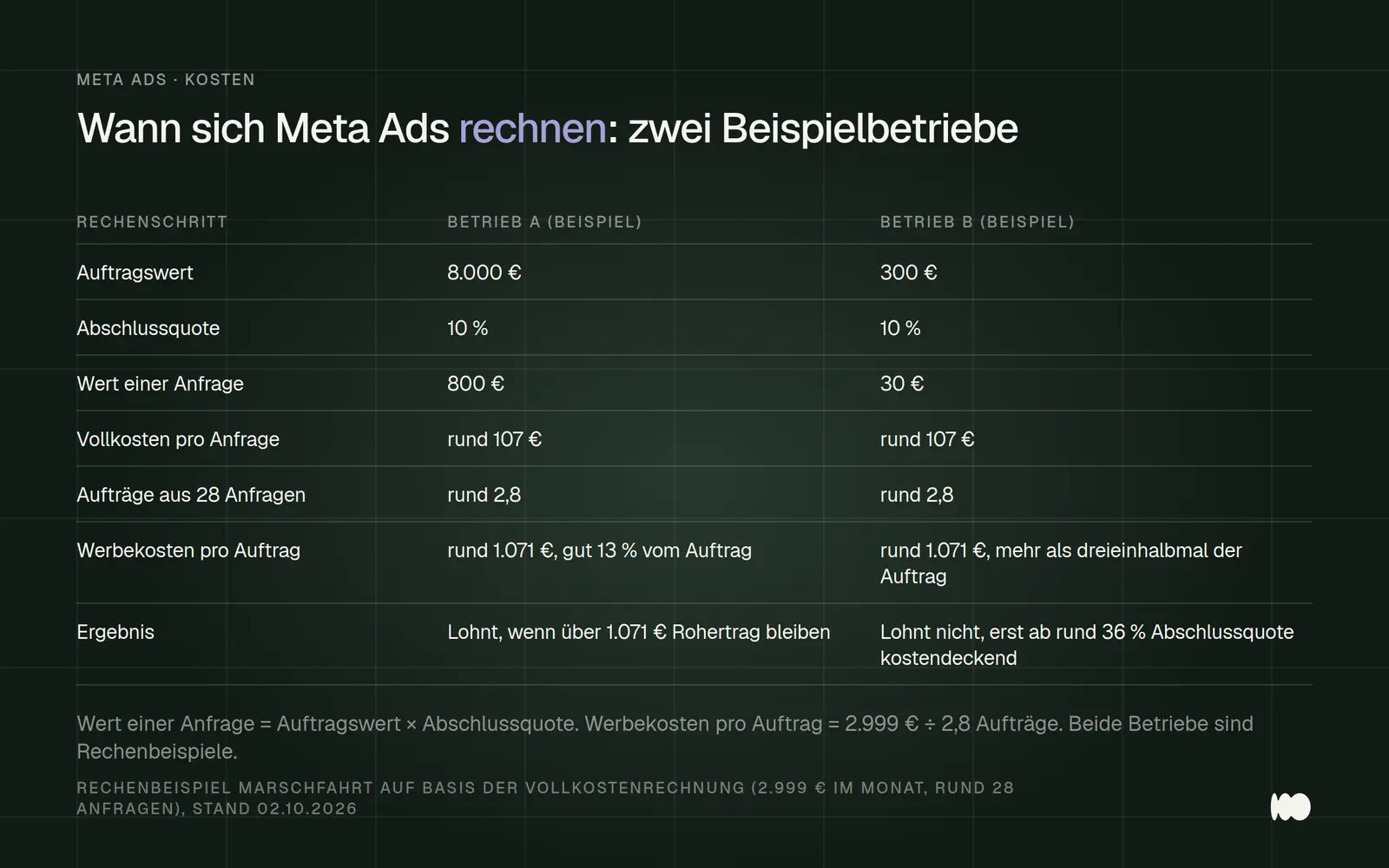
Two example companies, same full costs per inquiry: For an order value of €8,000, advertising costs of approximately €1,071 per order are acceptable; for €300, they are not. Both companies are used for illustrative purposes.
Instagram Ads or Facebook Ads: Who You Can Reach in Germany
Don’t commit to one platform right away; instead, use both and make your decision based on your own needs. According to the ARD/ZDF Media Study 2025 (Media Perspektiven 31/2025, 2,512 respondents aged 14 and older, fieldwork period January through April 2025), 40% use Instagram at least once a week, and 31% use Facebook—two percentage points less than the previous year. Instagram is thus the most widely used social media platform, but according to the study, it is losing ground among younger users for the first time. The average age on Facebook is 45, while on Instagram it is 37.
Regarding advertising itself, DataReportal’s “Digital 2026” report, published on November 5, 2025, and based on Meta’s planning tools from October 2025, cites an advertising reach in Germany of 22.8 million on Facebook—27.1% of the population—and 31.3 million on Instagram—37.2%. According to DataReportal, these figures are not directly comparable to those from previous years. So, while advertisers on Instagram reach a larger audience, those targeting an older demographic should not rule out Facebook—the average age there is eight years higher.
In practice, you’ll set up both platforms within the same campaign; Facebook ads and Instagram ads run through the same Ads Manager. This works well during the learning phase because it prevents results from being split between two campaigns. After the first four weeks, check the breakdown by platform to see where your inquiries are actually coming from, and only then decide whether to exclude any of them.
What's New in 2026: Selection Screen and Less Personalized Advertising
Expect that some of your audience in the EU will see less personalized advertising, and create ads that are effective even without a finely targeted audience. Since November 2024, Meta has been offering the “less personalized ads” option in the EU, the EEA, and Switzerland. Meta itself states in its 10-K annual report that these ads are “less relevant and effective than our premium ad offerings.” Background: In April 2025, the European Commission found a violation of the “pay or consent” model under the Digital Markets Act, resulting in a fine of 200 million euros, according to Meta’s 10-Q quarterly report.
On December 8, 2025, the European Commission announced that Meta would give EU users the choice between personalized and less personalized advertising, to be introduced in January 2026, and that it would monitor “the impact and uptake of this new ad model.” According to PPC Land on March 6, 2026, based on Meta’s report under the Digital Markets Act, all users in the EEA have been seeing a selection screen since January 2026 that cannot be closed by clicking away. According to Meta, the less personalized ads use “90% less data”; Meta has not disclosed how many people have opted for this option. Meta’s CFO, Susan Li, announced changes to this offering during the conference call on January 28, 2026, and anticipated “some headwinds.”
Neither Meta nor any independent source we consider reliable has quantified the extent to which this affects prices and reach for advertisers. Anyone who gives you a percentage figure is just guessing. In our own accounts, we can’t clearly isolate this effect from other factors. Therefore, focus less on narrowly defined interest-based target audiences and more on ads that find their own audience because the offer is clearly visible in the image and in the first sentence.
Tracking: Pixels, Conversions API, and Consent
Send requests from your website to Meta via the Conversions API as well, but only with consent. According to Meta’s developer documentation, the Conversions API connects marketing data from servers, website platforms, apps, or CRMs with Meta’s systems, which, according to Meta, use this data to optimize targeting, reduce cost per result, and measure results. Meta processes server events in the same way as pixel events and merges duplicates when both sources report the same event. This is important for the learning phase, because every lead event that Meta doesn’t see is missing from the system’s learning process.
The pixel is the Meta script on your website; the Conversions API is the server-side method. The legal platform e-recht24 states in its article on the Conversions API, accessed in October 2026, that the Conversions API requires the same consent as the pixel because the legal basis does not depend on whether data is collected in the browser or on the server—so it is not a way to bypass the consent banner. Therefore, do not allow the pixel or the Conversions API to send data until consent has been given via the banner, and be sure to mention Meta in your privacy policy. This is a general overview and not legal advice.
Compare Meta’s lead count once a month with the inquiries that actually reach you. Because not all visitors opt in, Meta tends to underreport website inquiries based on our classification, while for instant forms, it also includes submissions that later turn out to be unusable. Our 59 leads and the zero inquiries from the traffic campaigns are also based on Meta’s count and not a recount of the businesses’ inboxes; inquiries made by phone or without a reported lead event following a traffic click are not included. Keep a simple list with the date, source, and whether the inquiry turned into an order, because that’s exactly what your conversion rate for the calculation above is based on.
The Advertising Library: Monitor the Competition for Free
Before creating your first ad, check out what your competitors are running in Meta’s Ad Library—for free and without signing up. According to the Meta Newsroom on August 22, 2023, since August 2023, the Ad Library has been displaying all ads that reach people in the EU, including their run dates, demographic details such as age, gender, and location, as well as reach—for a period of one year. You can find it at facebook.com/ads/library; select Germany as the country and search for a company name or keyword.
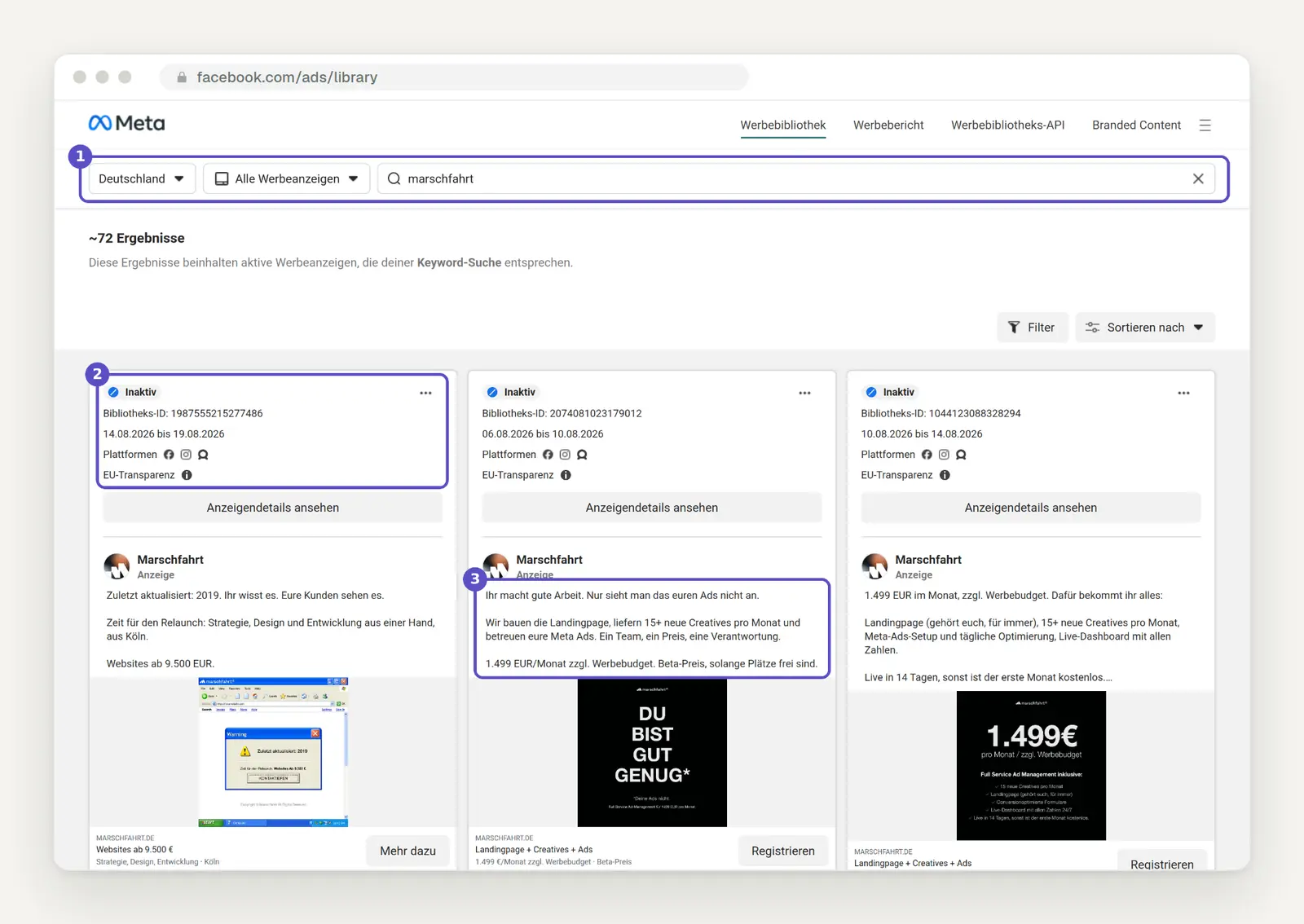
The Meta Ad Library on October 2, 2026, showing search results for “marschfahrt ” for Germany and all ads (1). Each ad displays its status, library ID, duration, platforms, and the EU transparency notice (2), followed by the ad text—here is one of our own ads for ad management (3).
For the screenshot, we searched for ourselves; a search for “marschfahrt ” returns about 72 results. Among them are our relaunch ad, designed to look like an old Windows error message with “Last updated: 2019,” and the ad management ad with the line “You’re doing a good job. It’s just that your ads don’t show it.” So if you want to work with us, you can check out what we run for ourselves first. Do the same for every Meta Ads agency you talk to.
Pay attention to three things when it comes to the competition: duration, number of variations, and the offer in the first line. Ads that have been running for months are likely working for the advertiser, based on our assessment; otherwise, they would have paused them. Many variations of the same message indicate that someone is testing different approaches. Make a note of the three longest-running active ads from your two main competitors and write down next to them what you offer that’s different and better.
Do it yourself or hire someone to manage it: How much does a Meta Ads agency cost?
Compare agency quotes based on total costs, not just the monthly fee. For this article, we reviewed the published prices for Meta Ads from a handful of agencies and freelancers as of October 2026—a small sample—and we won’t be naming any names. Management fees typically range from around €650 to €1,600 net per month; creative work and tracking are usually added as one-time extras, which we found to range from around €250 to €2,500. In addition, there are percentage-based models, which often charge 10 to 20% of the advertising budget, as well as hybrid models combining a fixed price and a percentage, sometimes with setup fees and minimum contract terms ranging from three to twelve months.
None of these models is inherently unfair; each is suited to a different situation. However, a percentage-based model grows with the budget rather than with results, and a low fee without creative services shifts the burden of creating ad copy to you or results in a second invoice. If you’re looking for an agency for Facebook or Meta Ads, you should therefore evaluate every proposal using the same full-cost calculation as above, including all extras for twelve months.
Before signing anything, clarify four questions. Does the advertising account belong to you? Are creatives included, and how many per month? What is the minimum term, including the notice period? Who builds the landing page where the inquiry takes place, and who owns it afterward? The advertising account is the most important point, because that’s where the campaign history, pixels, and target audiences are stored—and you’ll want to keep them if you switch providers. Get this confirmed in writing before the first campaign launches.
Do it yourself if you’re on a tight budget and have time to learn. With a small advertising budget, any management fee will eat up the lion’s share of the total costs, as shown in the example invoice B. Start with a lead campaign, one ad group, a broad target audience, and a few ad creatives that are clearly different from one another. Review the results after four to six weeks before increasing your budget or hiring someone to handle it.
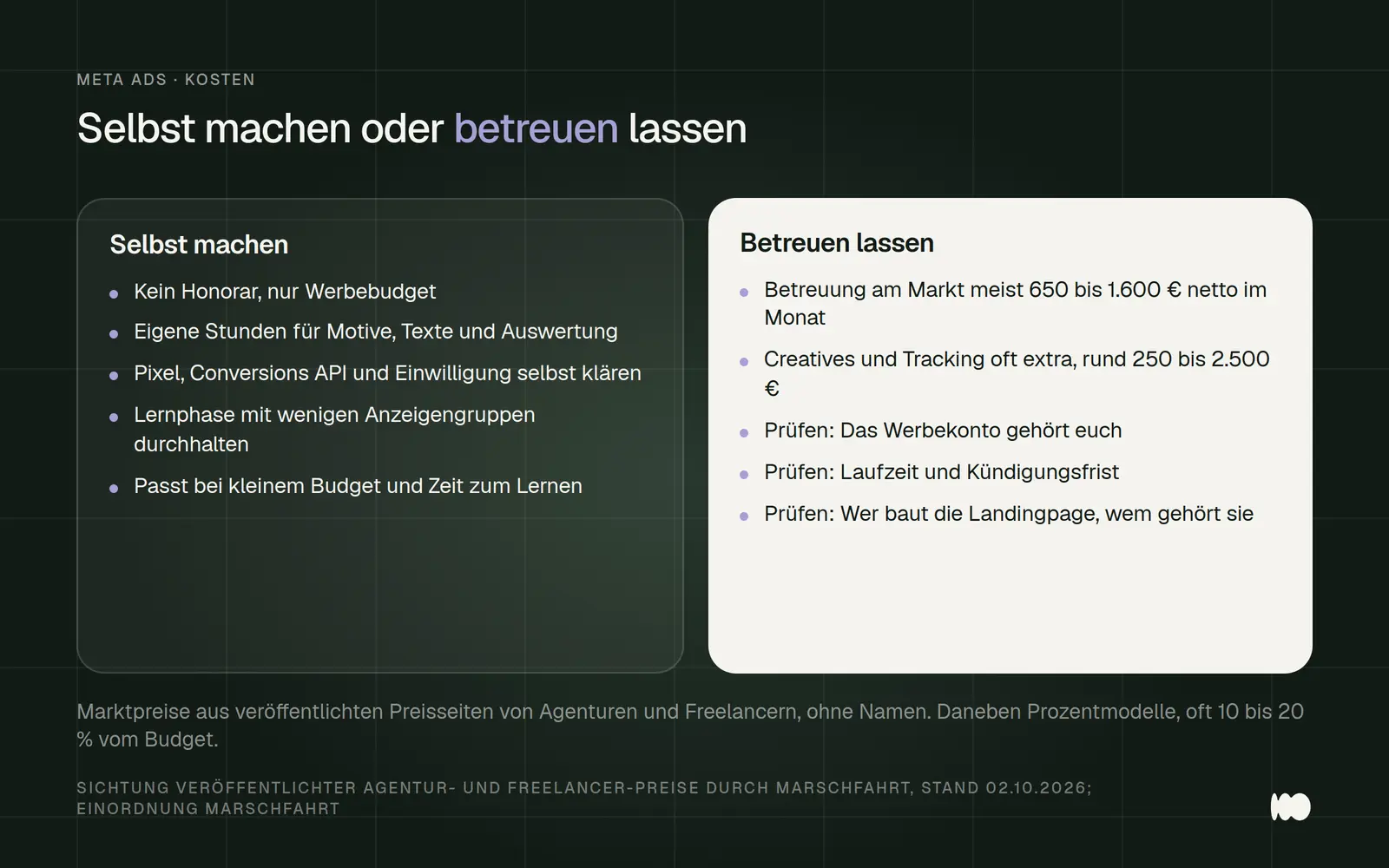
Do it yourself or hire someone to manage it for you: Doing it yourself saves on fees but takes time; when you hire someone to manage it, the ad account, creative assets, campaign duration, and landing page matter more than the monthly price.
Our Ad Management Package: What's Included and Who It's Not For
If you want to have your Meta Ads managed without having to purchase creatives and landing pages separately, our package is designed exactly for that. For €1,499 net per month plus your advertising budget—currently available as a beta with five slots—we’ll handle the setup, structure, and ongoing optimization of your Meta Ads and deliver 15 or more new ad creatives per month. In addition, we’ll build a landing page—including design, copy, implementation, and tracking—that belongs to you, and you’ll receive a live dashboard with all the metrics and a monthly strategy call. All details are available on the page for our Ad Management Package.
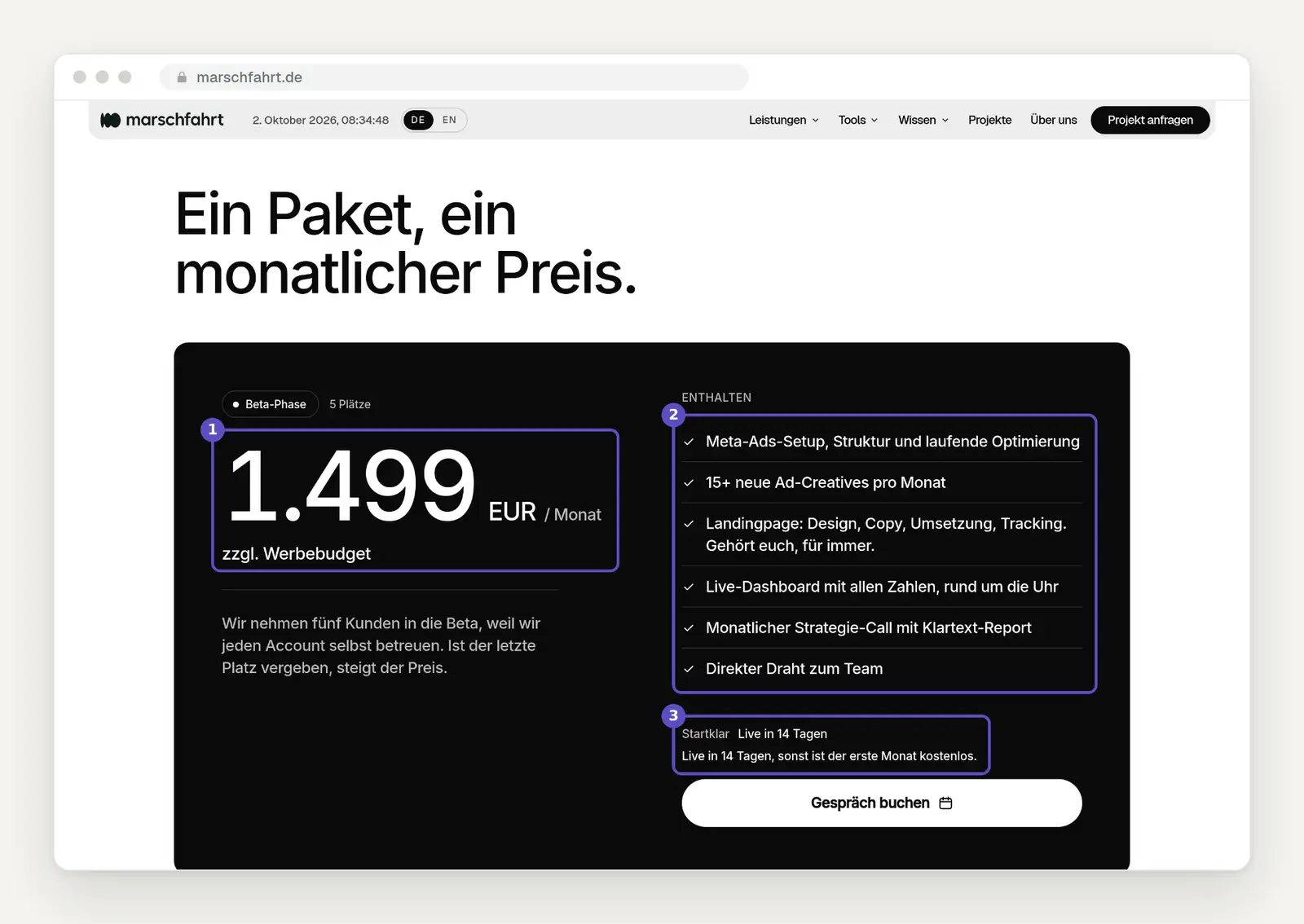
The "Package" section on our Ad Management page as of October 2, 2026: 1,499 EUR net per month, plus an advertising budget during the beta phase with five slots (1), the "Included" feature list (2), and the promise: "Live in 14 days, or the first month is free." (3)
Compared to the pricing models above, this is at the higher end of what is typically charged for pure management services. Creative assets and landing pages—which usually incur additional costs on the market—are included, and that’s exactly what makes full-cost accounting so straightforward: the package plus the advertising budget; according to the service description, there are no additional charges for creative assets or landing pages.
The terms and conditions are clearly listed on the website so you’re familiar with them before your first meeting. Campaigns go live within 14 days; otherwise, the first month is free. The term is three months, after which the package renews monthly and can be canceled with four weeks’ notice by the end of the month. We recommend an advertising budget of at least €1,500 per month; this goes directly to Meta, and reliable metrics become available after four to six weeks. We do not guarantee results because no one other than Meta controls the auction.
The people we don’t work with are listed on the same page, and we mean it. If you can’t allocate an advertising budget of at least €1,500 per month, aren’t willing to commit to three months, or expect results as early as Week 1, we’re not the right fit for you—for the reasons outlined in the sections on the learning phase and the cost breakdown. And if, like Example B, you have small order values, you’re better off using a different channel or, at most, testing Meta Ads on your own with a small budget. So before reaching out to us, calculate the value of an inquiry for your business—then you’ll know whether a conversation is worth your time.
Conclusion: today, this week, later
Today, you’ll check how much of your budget is going toward campaigns that don’t generate inquiries, and set campaigns designed to generate inquiries to the “Leads” objective. To do this, check the “Campaign Objective” and “Cost per Result” metrics for the past few months in Ads Manager. Then, search the Ad Library for your two main competitors and note their longest-running ads.
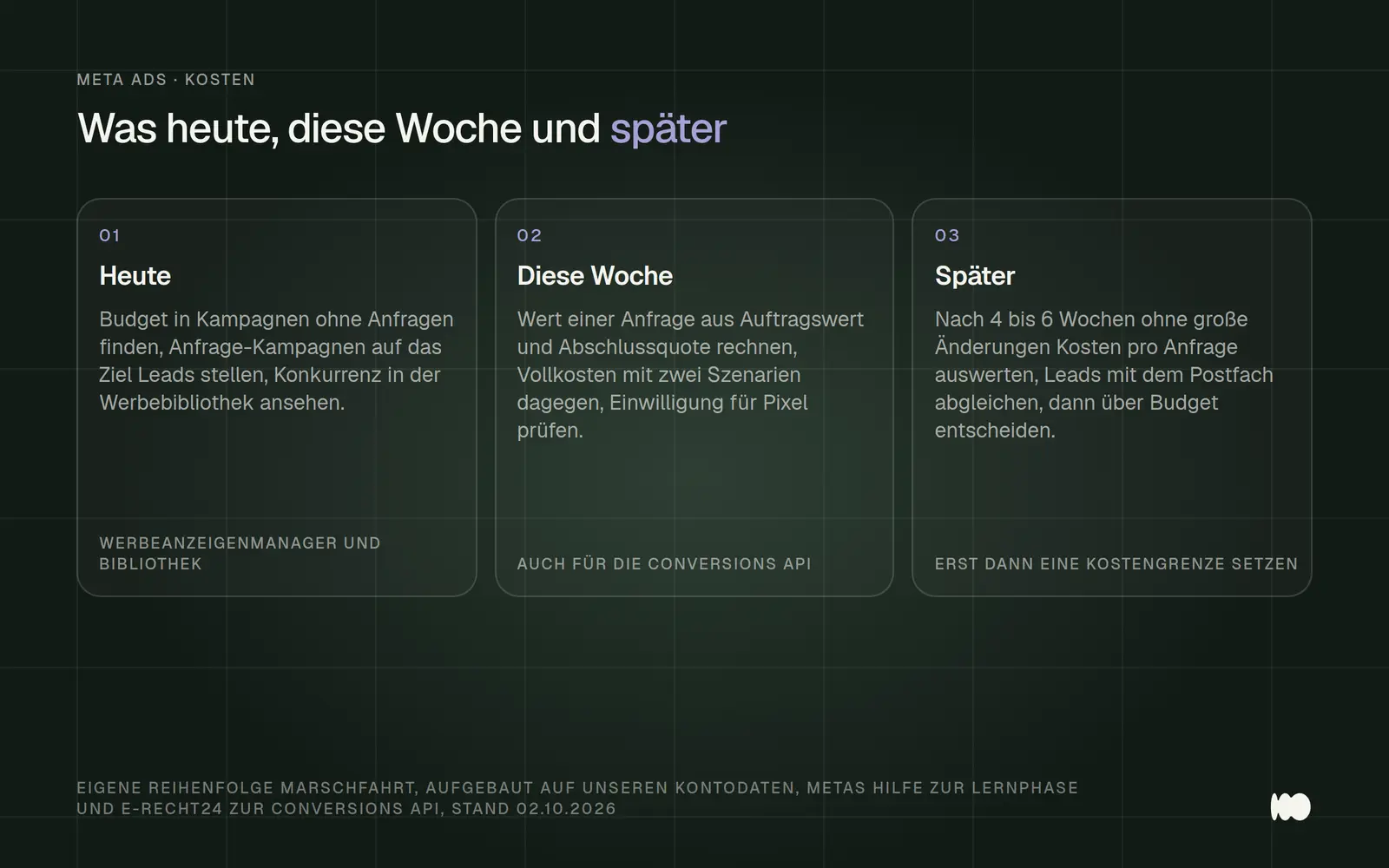
Here's the schedule for your Meta Ads: review your goals and budget today; calculate the value and full cost of a lead this week; and evaluate and make a decision in four to six weeks.
This week, you’ll calculate the value of a lead based on order value and conversion rate, compare that to your full cost per lead using two scenarios, and determine whether the Pixel and Conversions API send data only after consent has been given. If you’re just getting started, set up a lead campaign with a few ad groups, a broad target audience, and several clearly distinct creative variations.
Later, after four to six weeks with no significant changes, you’ll analyze the actual costs per inquiry, compare Meta’s leads with your inbox, and then decide whether to increase your budget, set a cost limit, or use new creatives. If you’d rather not do this yourself, you’ll find out how to reach us below.
What Has Changed and What That Means for You
August 22, 2023: The Ad Library shows all ads that reach people in the EU. For you, this means that monitoring the competition costs nothing but half an hour, and everyone can see your own ads, too.
November 12, 2024: Meta is offering less personalized advertising in the EU, the EEA, and Switzerland, and, according to CNBC, is lowering the price of its web subscription to €5.99 per month instead of €9.99. For you, this means that part of the audience will see ads that Meta itself considers less effective.
January 2026: Selection screen for all users in the EEA. For you, this means: Narrow interest-based target groups will become less reliable, while clear motivations and offers will become more important.
Early 2026: According to PPC Land, it is no longer possible to create new campaigns using the old Advantage+ Shopping and App structure via Meta’s marketing interface in any version. For you, this means: Advantage+ is the standard structure; tools based on the old structure can no longer create new campaigns.
July 29, 2026: Meta reports a 12% increase in global ad prices for the second quarter. For you, this means: Build in a buffer for the cost per request instead of basing your calculations on last year's figures.
October 2, 2026: As of the publication of this post and based on our account data. For you, this means: Cheap clicks didn't generate any inquiries in our accounts, and each inquiry cost €53.38 from our advertising budget.
Should we take over your Meta Ads, or should we run the numbers first?
Send us your order value, your approximate conversion rate, and your planned advertising budget, and we’ll work through the numbers together to see if Meta Ads are a good fit for you. If it is, we’ll show you how we’d set up your campaigns; you can find all the details about the process under “Manage Meta Ads.” If it isn’t, we’ll be just as clear about that—we wouldn’t recommend it for a business like the one in Example B.
Just send us a quick message through our contact form —a link to your website or Facebook page is all it takes to get started. We’ll respond within 24 hours, personally and without any sales pitch.
More Articles
© Marschfahrt Studio
Practical knowledge on web design, SEO, AI, and conversion optimization. Based on real projects, without any marketing spin.

