Why Nobody Reads Most Company Blogs: What Makes a Good Post in 2026
According to Orbit Media, only 13.9 percent of marketers report strong results from their blogs in 2026, even though 92.4 percent use AI for writing. Here’s what the few who do well are doing differently—for Google, AI-generated responses, and real readers.
Date
Category
Author

“For the past two years, we’ve had AI write a blog post every week. Nothing’s happening.” That’s what the CEO of a window manufacturer in the Bergisches Land region told us in August, sounding more perplexed than annoyed. Over a hundred posts, and neither Google nor ChatGPT nor a single customer has taken notice. He’s not alone in this: In Orbit Media’s 2026 blogger survey of 1,042 marketers, only 13.9 percent reported strong results from their blog—the lowest figure since the survey began—while 92.4 percent now use AI for writing.
The few who succeed do five things differently: They put the answer at the beginning, they include their own data, they keep their posts up to date, they have a human editor, and they use images thoughtfully. As of September 2026, this post explains what Google rewards and penalizes, what AI responses cite, what readers actually do, and what a post looks like that achieves all three.
What Google Will Reward and What It Will Penalize in 2026
Google doesn't penalize AI-generated text; it penalizes content that lacks value. The May Core Update ran from May 21 to June 2, 2026, and according to Search Engine Land, Google called it “a major” update with significant movement in the rankings. The advice remained the same: no changes are necessary as long as you create “satisfactory content for people.” In addition, there were three spam updates in March, June, and August 2026, the last of which explicitly applied to all languages.
Google’s guidelines (as of August 28, 2026) define what constitutes spam: “Scaled content abuse” refers to a large number of pages intended primarily to manipulate rankings, and the guideline cites generative AI as an example when it creates “many pages with no added value.” This is the weekly post without editorial review. John Mueller added on September 7, 2026, on Bluesky, as quoted by Search Engine Roundtable: Programmatic content “often leads to a website that is either spam, near-spam, or low-quality,” and Google may then “have lost trust in your website.” A weak cluster drags down the entire domain.
In July 2026, Ahrefs demonstrated that AI itself is not a problem by analyzing one million top-10 pages: 5.3 percent of the top-3 results are written entirely by AI, while 82.2 percent of the top-3 results consist of less than half AI-generated text. Pages with a low or moderate proportion of AI-generated content received two to three times more impressions than pages with a high proportion; the indexing rate was 49.3 percent versus 40.4 percent. According to Ahrefs, it wasn’t the AI content percentage that predicted losses, but rather repetitions, missing links, and poor writing. This is a correlation, not an experiment. To learn how to use AI without falling into these patterns, see “AI Writes Faster, But Not Necessarily Better.”
What AI Responses Cite
AI responses primarily cite pages owned by the companies themselves, but not their advertising pages. Between April 16 and July 16, 2026, Profound analyzed 11.84 billion citations from eight models. On average, 57 percent of citations point to brand-owned sites. For ChatGPT, 47 percent cite brand-owned sites, 30 percent cite press and trade media, and 20 percent cite social networks; for Google’s AI Overviews, the figures are 69, 17, and 15 percent, respectively. Brand-owned sites therefore generally have the greatest chance of being cited in AI Overviews, proportionally speaking.
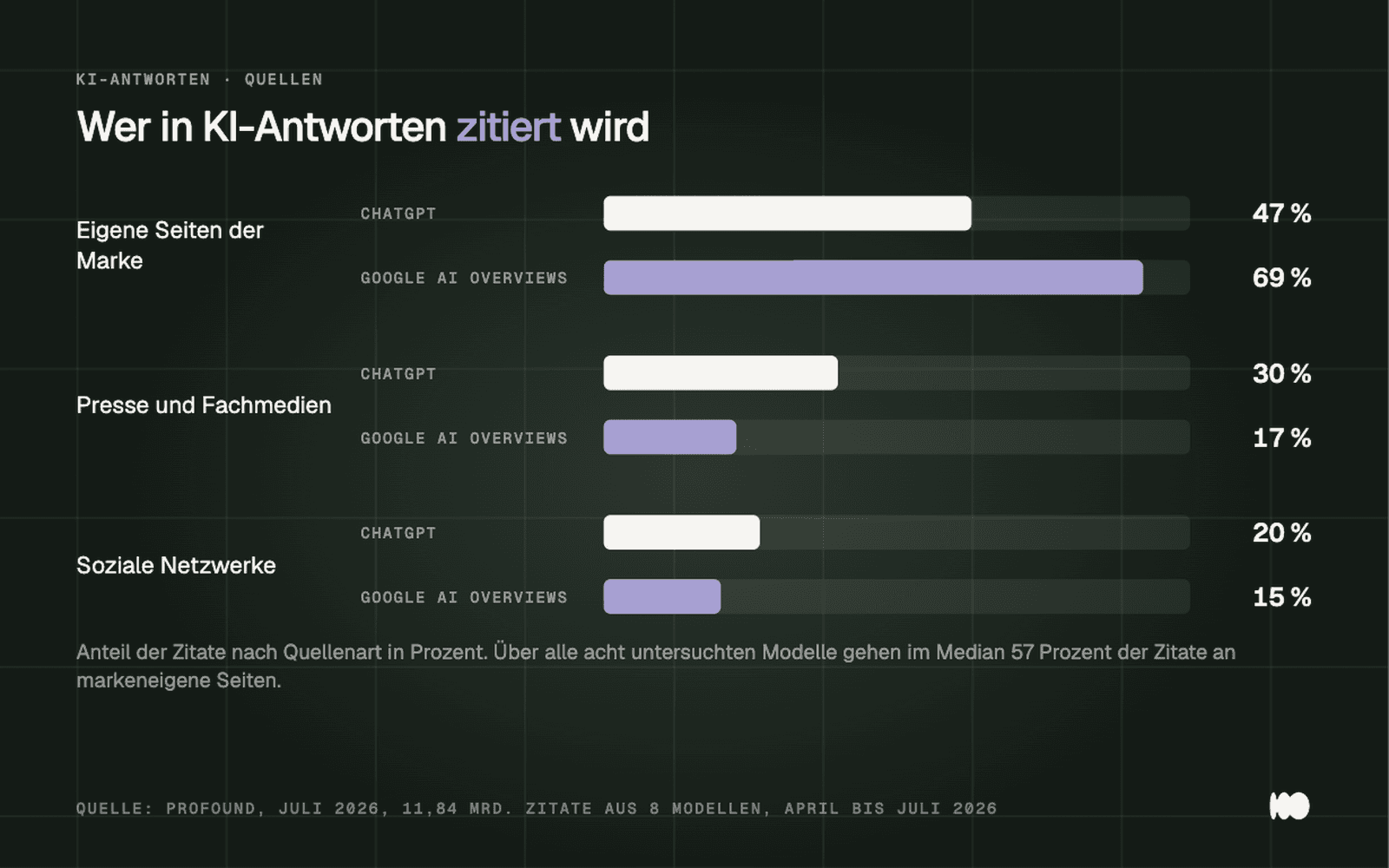
Percentage of citations by source type for ChatGPT and Google AI Overviews, based on 11.84 billion citations according to Profound, July 2026.
However, space is limited: According to Profound (February 2026, 730,000 ChatGPT conversations), a response cites an average of about six sources, and the ten largest domains account for only 12 percent of the citations combined. So there’s room for a crafts blog there, but there are only about six seats per question.
And self-praise doesn’t help. In July 2026, Ahrefs conducted a study on an established brand: Only 6 percent of new AI mentions came from the brand’s own pages, while 94 percent came from external sources. Of the responses that cited a promotional “Best of” page, 43 percent ultimately recommended competitors. For Germany, SISTRIX data (September 1, 2026) supports this: Information-seeking queries trigger AI overviews in 69.7 percent of cases, while purchase-related queries do so in 0.2 percent. The blog is where you’ll appear in AI responses, not the product page. Read more about this in “Companies in AI Responses.”
Why the Date Determines Citation
Pages that are more than three years old are virtually never cited in AI responses. In July 2026, Seer Interactive analyzed 47,097 citations from ChatGPT, Gemini, and Perplexity (March through June 2026): 75 percent of the cited pages were updated in the last twelve months, 88 percent in the last 24 months, and according to Seer, pages older than three years “practically never appear.” Gemini is the strictest, with 78 percent of its citations from the past year; ChatGPT stands at 73 percent, and Perplexity at 65 percent.
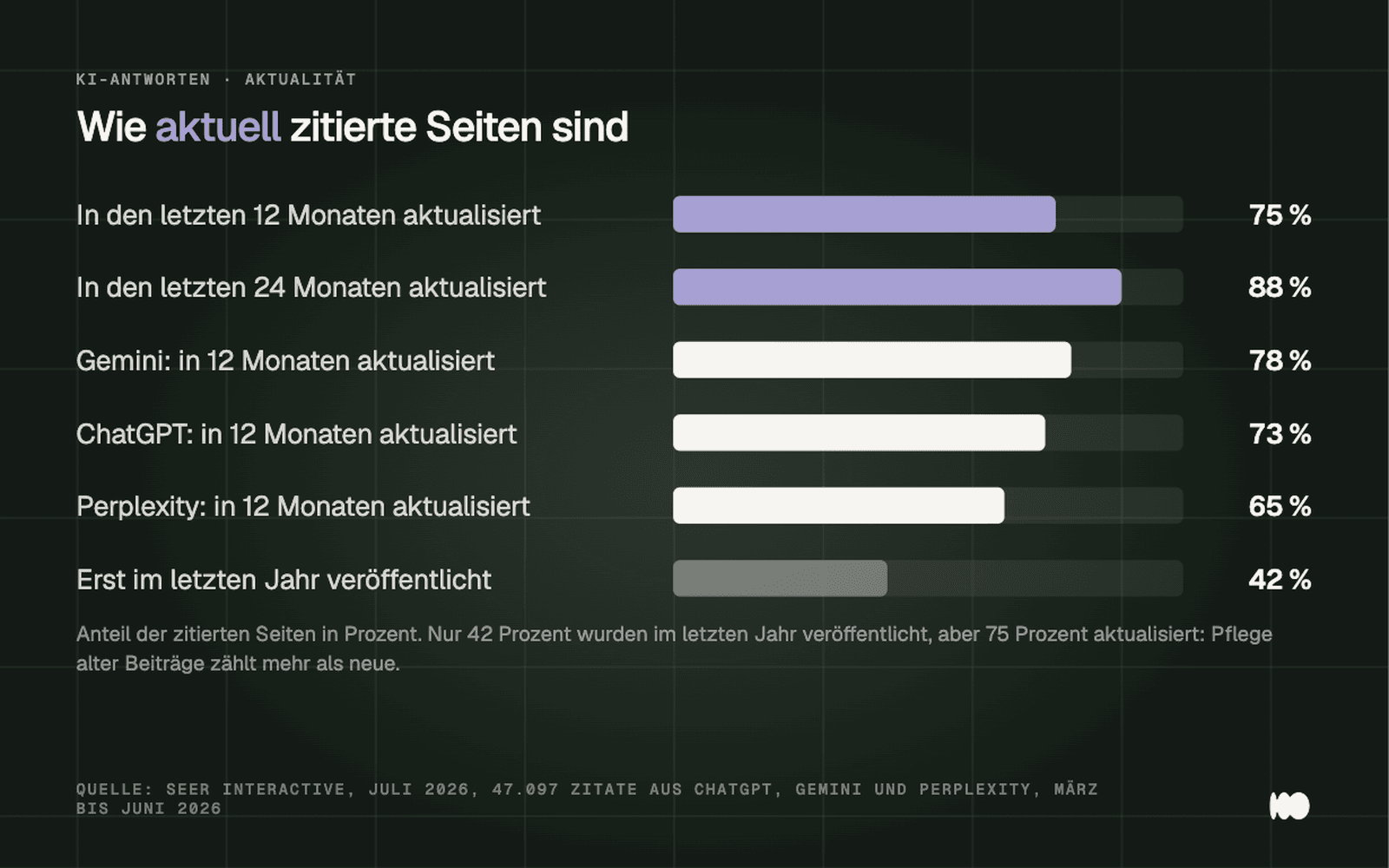
Percentage of pages cited by AI responses by age of last update, based on 47,097 citations according to Seer Interactive, July 2026.
The more important figure lies behind this: Only 42 percent of the pages cited were published last year. The rest are older and have been maintained. Updating, then, trumps rewriting, and that’s good news for businesses with an older content library.
The same applies to Google. In August 2026, Growth Memo analyzed 60,000 search results pages and 3,000 list entries: recency was the only robust predictor for the top three spots. 66.6 percent of the top-3 pages were dated within the last two years; for positions 8 through 10, the figure was 57.3 percent; older or undated pages had a 56 percent lower chance of ranking. This, too, is a correlational finding, but it is the most consistent observation across all studies.
We experienced this firsthand with a heating contractor in the Rhineland: An article on heat pump incentives didn’t generate much interest in the year it was published. After revising it to reflect the 2026 incentive status and including a visible update date, we started receiving the first inquiries.
What Real Readers Do on the Site
Readers don’t read—they scan—and that hasn’t changed in over twenty years. In 2008, the Nielsen Norman Group analyzed 45,237 page views and found that users read at most 28 percent of the words per visit, and more likely 20 percent. In 2018, an eye-tracking study followed with 120 participants and 130,000 fixations: 57 percent of viewing time is spent above the fold—that is, on the first visible screen—and 74 percent within the first two screens. In 2020, NN/g confirmed this scanning behavior once again.
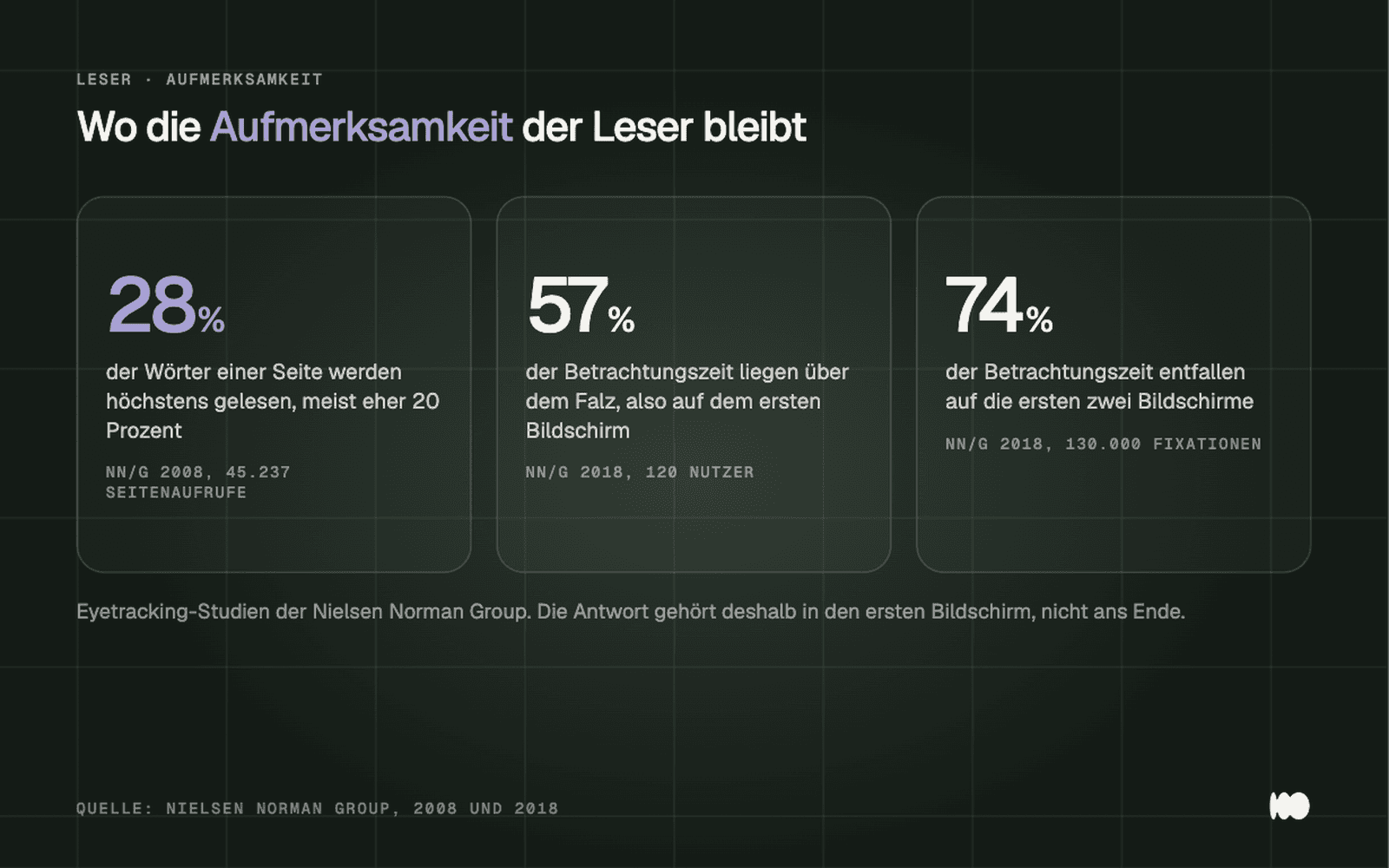
Three metrics from the Nielsen Norman Group (2008, 2018): words read, attention above the fold, and attention within the first two screens.
The data is outdated—that’s both its weakness and its strength: It describes behavior, not technology, and we haven’t found any more recent, reliable measurements. What has changed is the device. According to Statcounter, in August 2026 in Germany, 50.9 percent of page views came from mobile phones and 47.4 percent from desktops. So the first screen is a mobile phone display. Our rule of thumb: about 40 words, then people start scrolling.
This leads to the most important rule of this post: The answer is at the top. Not the introduction, not the company history, not “in this post, you’ll learn.” Anyone who knows within 40 words whether the text answers their question will scroll on or call. Everyone else is gone.
Why Most Company Blogs Fail
Most company blogs fail not because of AI, but because they leave out precisely the elements that have a measurable impact. Orbit Media clearly demonstrates this in 2026: Posts based on original research are about 50 percent more likely to yield strong results; posts that undergo formal human editing perform roughly twice as well as the average; and posts that are only proofread by AI fall short of that. Nevertheless, the effort required is decreasing: The time per post fell from 4 hours and 10 minutes in 2022 to 3 hours and 20 minutes. The survey is international, not a German study; we recognize this pattern from almost every initial consultation.
On top of that, there are four common mistakes that run through the studies: content with no added value that Google classifies as spam; outdated pages without dates that neither Google nor ChatGPT touch; Promotional posts that use AI-generated responses to compare competitors. And over-structuring: At Growth Memo, pages with more H2 and H3 headings were 29 percent less likely to rank in the top 3. A post with twelve subheadings and just two sentences beneath each one isn’t a post—it’s a table of contents.
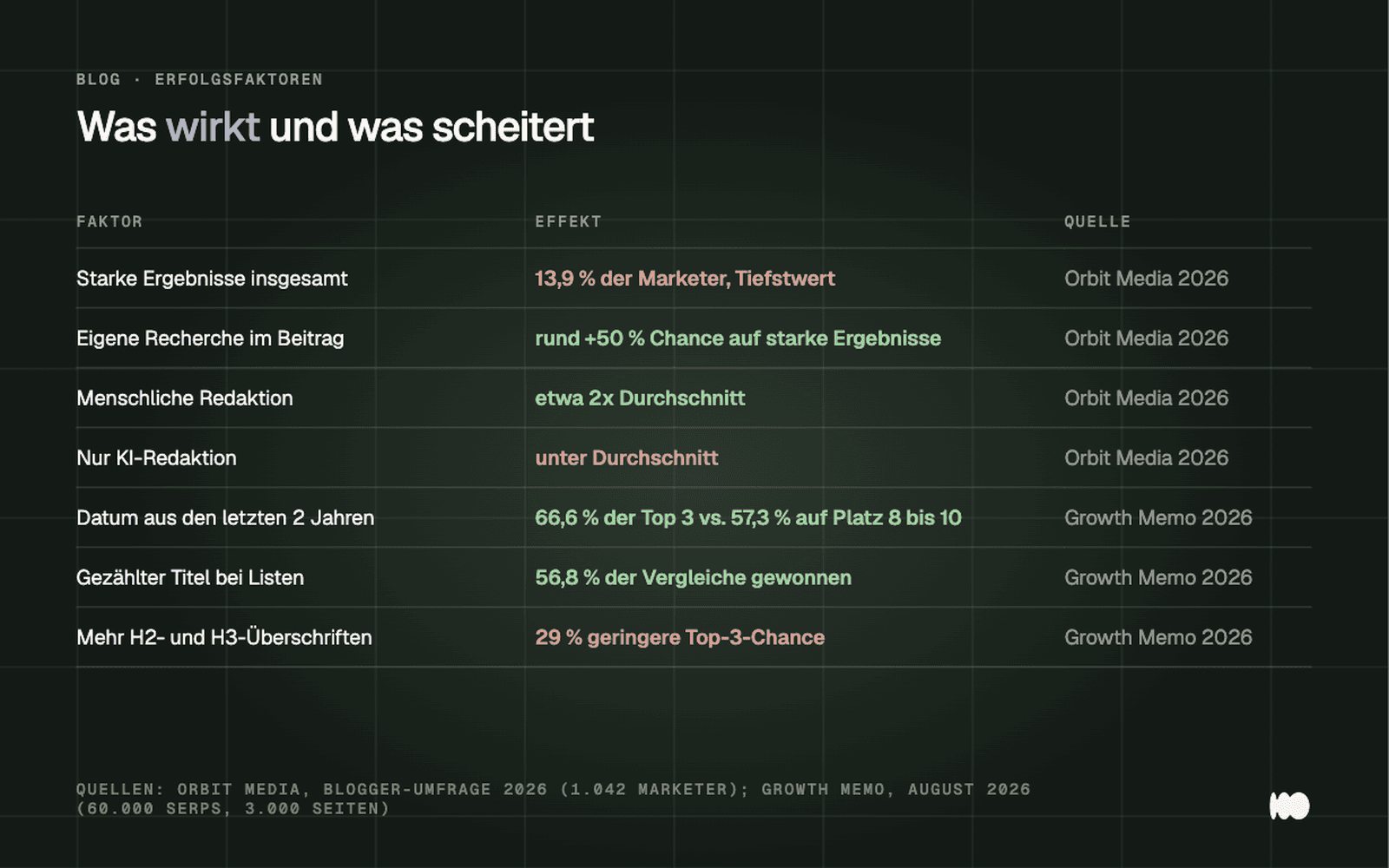
A comparison of the factors that, according to Orbit Media and Growth Memo 2026, are associated with the success or failure of blog posts.
In 2025, we took over a blog for a dental practice in Cologne that an agency had been updating weekly with AI-generated content for a year. In Search Console, most of the posts were listed as “Crawled, currently not indexed.” Google had seen the pages and determined that they added no value. We deleted most of them and revised the few that had substantive content.
Building Instructions, Part 1: Answer First, a Separate Receipt, a Visible Date
A good article starts with the answer in about 40 words. Write that first: What is the question, what is your answer, and what number does it correspond to? This paragraph is what the reader sees on their phone, what Google uses as a snippet, and what ChatGPT draws from as one of its roughly six sources. It has to work on its own, without the rest of the text.
Then there’s the data that no one else has—and this isn’t a research project. An electrical contractor can track how many wallbox inquiries per month fall through because the home’s electrical connection is too small. A restaurant can report its no-show rate before and after requiring a deposit. Orbit Media’s own data shows a roughly 50 percent higher success rate (by 2026), and an AI can’t replicate that for a competitor.
Third, the date. A visible “Updated: September 2026” in the post and a calendar reminder that brings anything older than twelve months back to the forefront. Seer’s 75 percent (July 2026) is the benchmark. If you have twenty old posts, you’re better off revising the five best ones than writing five new ones.
The Construction Guide, Part 2: Title, Structure, Author, Mentions, Images
Titles with numbered lists work, but only for actual lists. In Growth Memo (August 2026), articles with numbered titles—such as “7 Reasons”—won 56.8 percent of direct comparisons against vague roundup articles. But if you cram an explanation into a “5 Things” format, you’ll end up with a choppy text and no ranking.
Fewer headings, more substance beneath them. Our rule of thumb: If a section doesn’t contain at least 150 words, it belongs in the neighboring section. And under each H2 heading, include a short paragraph that articulates the key message so completely that a language model can reproduce it verbatim.
Author and Disclosure. Google’s self-assessment for helpful content (as of December 2025) asks “Who, How, Why” and specifically whether the use of automation is “recognizable to visitors through disclosure.” Google calls trust the most important component of E-E-A-T. While Growth Memo found no measurable effect from author boxes, a name with a face costs nothing and answers every reader’s question: Was this written by a human?
External mentions. Since, according to Ahrefs (July 2026), 94 percent of new AI mentions came from external sites, every post requires an action outside your own website: sending the post to a partner, posting it in a professional group, or updating an industry directory. A post that isn’t mentioned anywhere might as well not exist for ChatGPT.
Images with meaning. Orbit Media finds that two to three images per post yield the best results in 2026; at Growth Memo, top-3 list posts had 38.9 percent more images than the rest. We’re talking about graphics featuring your numbers, photos from the construction site, or a screenshot—not a stock photo of people shaking hands.
How We Do It Ourselves
We write our articles with the help of AI, but we don’t leave it entirely up to the AI. Before each article is written, we compile a research package that includes the source, date, and a note indicating whether we found the figure on the original page or only know it secondhand. We do not use figures that we were unable to verify, even if they sound plausible. The draft is generated by the model according to a set house style, and a human editor revises it, adds project experience, and verifies every figure against the research package.
We create our graphics based on the data in the article, not from image databases. Each article is dated, and we review the older ones once a year. We’re not entirely sure if that’s enough. However, it’s the only process through which we continue to stand behind every sentence even after publication. This article was created in the same way.
Conclusion: The order for your next post
Don’t start with a new post—start with your existing content. Check Search Console to see which posts are indexed, and delete or merge those that aren’t adding value. Then select the five posts with the most potential and revise them. Include an answer within the first 40 words, a personal observation from your business, a visible update date, and fewer headings. Include two to three graphics with real numbers, an author by name, and a sentence about AI usage. Send each revised post to a partner or a specialist group. Only then should you write new content—and do so less frequently: One good post a month is better than four that nobody reads. If you need someone to handle research, editing, and graphics for this: That’s exactly what our SEO work is all about.
Related: Why Having Your Own Website Remains Essential Even with Social Media and AI Search Assistants, and Local SEO—the Key to Regional Visibility
Do you want to know why your blog isn't generating any inquiries?
Send us the link to your blog. We’ll review its search engine indexing, how up-to-date it is, and its structure, and give you our honest opinion on whether it’s worth revising or deleting. Send us a quick message using the contact form. We’ll respond within 24 hours—personally and without any sales pitch.
More Articles
© Marschfahrt Studio
Practical knowledge on web design, SEO, AI, and conversion optimization. Based on real projects, without any marketing spin.