Marketing for Small Businesses in 2026: Which Channels Will Still Generate Leads When Google Delivers Fewer Clicks
According to Sistrix, AI-powered summaries account for about 6.6 percent of all organic clicks in Germany, but searches with purchase intent are affected by only 0.2 percent. We’ll show, channel by channel, what tradespeople, restaurants, medical practices, and B2B service providers should do first in 2026.
Date
Category
Author

“Google isn’t helping anymore—should we switch to TikTok now?” The question came in August from a plumbing company with eight employees that had been easily found via Google Search for years but has seen fewer calls since this spring. The short answer: The drop in clicks on Google is real, but it affects informational pages, not searches for a local plumber. For local businesses, the Google Business Profile will remain the strongest channel even in September 2026. After that, depending on the type of business, come Google Ads, Meta Ads, LinkedIn, or the newsletter. TikTok isn’t a top priority for almost any small business.
This post breaks down, channel by channel, what the data from Germany and the U.S. reveals—specifically, where we’re seeing inquiries in our projects involving trades, the restaurant industry, and solar companies—what you can cut from your plans, and in what order you should plan your quarter when time and budget are tight.
What Has Really Changed at Google
AI summaries have arrived in Germany, but not everywhere. According to Sistrix (over 100 million keywords, published in February 2026, updated in August 2026), an AI summary appears in about 20 percent of German search queries. In 78.6 percent of cases, it appears above the regular results.
Wherever it appears, it costs clicks. According to Sistrix, on results pages with an AI overview, the click-through rate for the No. 1 position drops from 27 to 11 percent, and the total number of organic clicks falls from 57 to 33 percent. Extrapolated, this amounts to 265 million organic clicks missing per month—about 6.6 percent of all organic clicks in Germany. The impact on an affected site is therefore significant, though manageable when viewed across all searches.
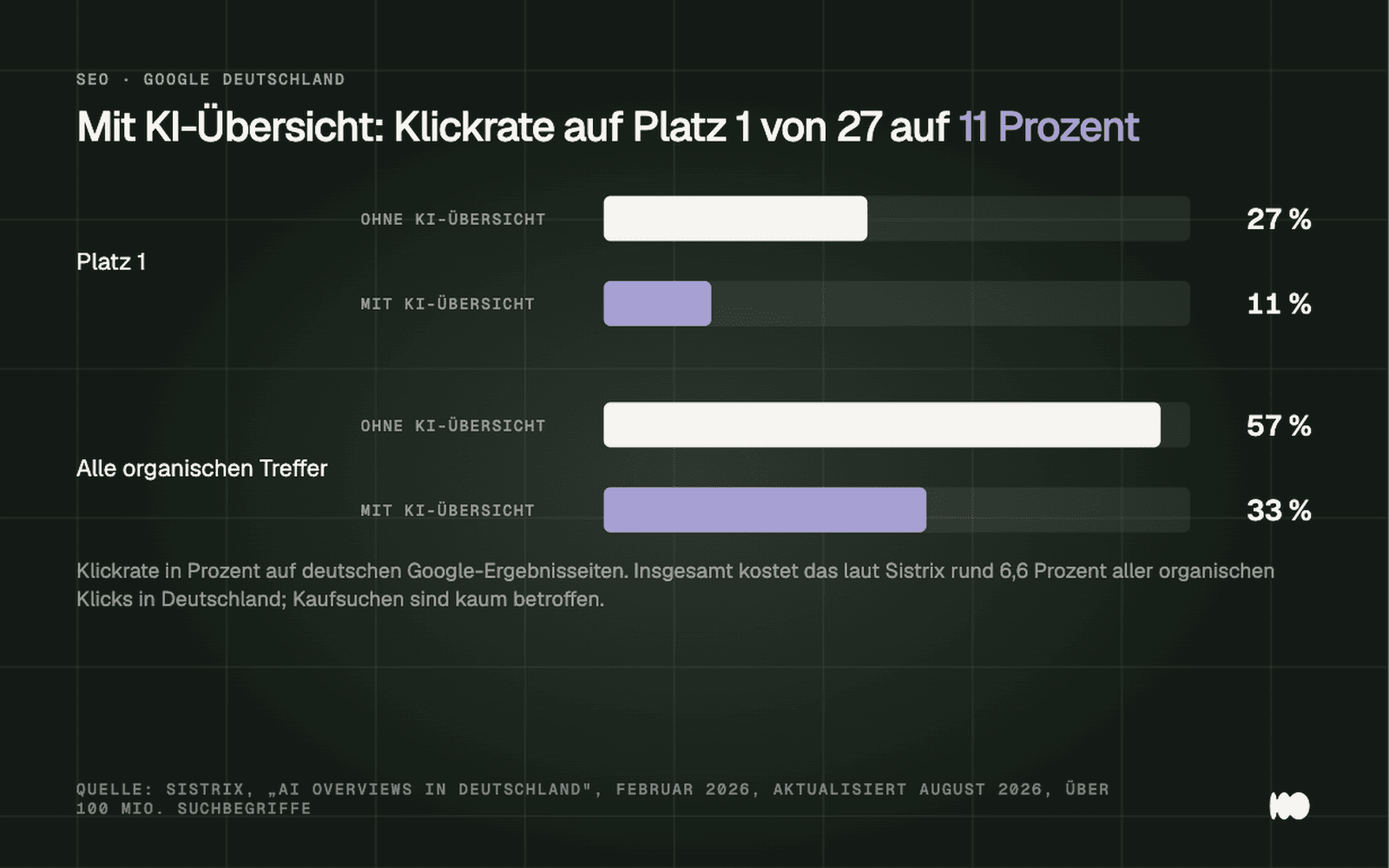
Click-through rates on German Google results pages with and without the AI overview, for the No. 1 position and for all organic results, according to Sistrix (February 2026, updated August 2026).
The U.S. data shows the same pattern. In March 2025, Pew Research analyzed the search behavior of 900 adults in the U.S., totaling 68,879 searches: In searches with AI summaries, users clicked on a result in 8 percent of cases; in searches without summaries, they clicked in 15 percent of cases. Only 1 percent clicked on a link within the summary. Seer Interactive measured a decline in the organic click-through rate from 1.41 to 0.64 percent between January 2024 and January 2025 for approximately 10,000 U.S. keywords with an intent to seek explanations.
Google itself disputes this: Liz Reid, head of search, wrote in August 2025 that organic click volume was “relatively stable year-over-year.” Google has not published any data on this. We stick to the measurable figures. To learn how to identify affected pages, check out our article on AI overviews and AI Mode.
Why Local Businesses Lose Less
The key figure comes from a second Sistrix analysis dated September 1, 2026: 69.7 percent of informational search queries trigger an AI overview, while transactional searches with the intent to purchase or book account for 0.2 percent. Anyone who wants to know how the subsidy for a heat pump works will receive an AI response. Anyone searching for “heating contractor Cologne Ehrenfeld” will still see the map results showing three businesses, reviews, and phone numbers.
That’s why publishers and advice websites are struggling, while a painting company is barely affected. Sistrix reports a loss of about 1 percent for recipe sites and up to 30 percent for health portals. The plumbing company mentioned at the beginning had lost clicks to its advice pages, not to its service pages. The lack of phone calls had a different cause.
And Google remains the go-to search engine: 88.49 percent market share in Germany in August 2026, according to Statcounter, with Bing at 5.84 percent. Anyone who gives up on Google is giving up the marketplace, not just a channel.
Google Business Profile and Reviews: The Most Effective Channel Costs Nothing
The Google Business Profile is the listing that appears in the map pack and on Google Maps, featuring business hours, photos, reviews, and a call button. Every year, Whitespark surveys local search experts about ranking factors. In the 2026 edition (published in November 2025), approximately 26 percent of the weight is attributed to signals from the profile itself, 18 percent to reviews, 16 percent to behavioral signals such as calls and clicks, 15 percent to links, 12 percent to directory listings, 10 percent to the website, and 3 percent to personalization.
This is a survey of experts, not an experiment, and its findings apply worldwide. Nevertheless, the trend is clear: Whitespark explicitly points to the increased importance of review and behavioral signals, while directory listings are becoming less influential for rankings. Profile, reviews, and behavior together account for 60 percent, and all three require no money—just discipline.
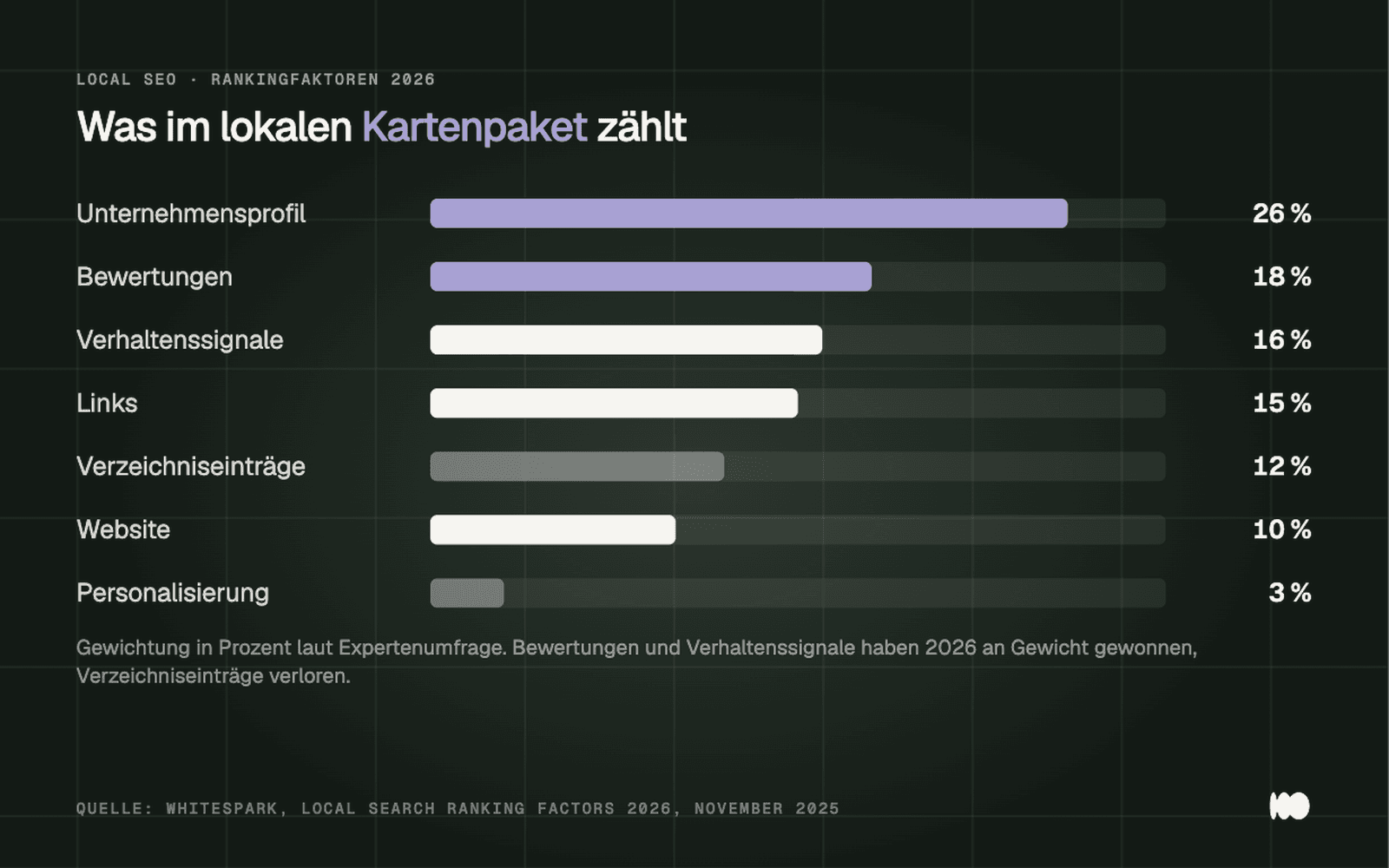
Weighting of ranking factors for the local map pack according to Whitespark's "Local Search Ranking Factors 2026," an expert survey conducted in November 2025.
Last year, for an electrical contractor in the Rhineland, we simply optimized their profile: we corrected the categories, added their services, posted weekly photos from job sites, and sent a brief message with a review link after each job. Since then, the “Call” button on their profile has been the main source of new inquiries. You can find instructions on how to set up your profile in our guide to company profiles for trade businesses.
Google Ads: How Much a Click Costs
Google Ads are the ads that appear above search results and reach people the moment they start searching. There is no publicly available, reliable cost data for Germany; the best estimate comes from LocaliQ, based on U.S. benchmarks from June 2026, with all amounts in U.S. dollars. Across all industries, a click cost $5.42 and an inquiry cost $66.69. According to LocaliQ, the cost per lead fell in 2026 for the first time in five years.
The costs vary by a factor of four across industries. According to LocaliQ, restaurants paid $30.57 per inquiry, medical practices $40.04, dentists $72.97, home and renovation services $90.92, business service providers $93.69, real estate $102.51, and law firms $131.63. While the absolute amounts cannot be directly applied to Cologne or Kassel, our experience shows that the order holds true: skilled trades and B2B are expensive, while the restaurant industry is inexpensive.
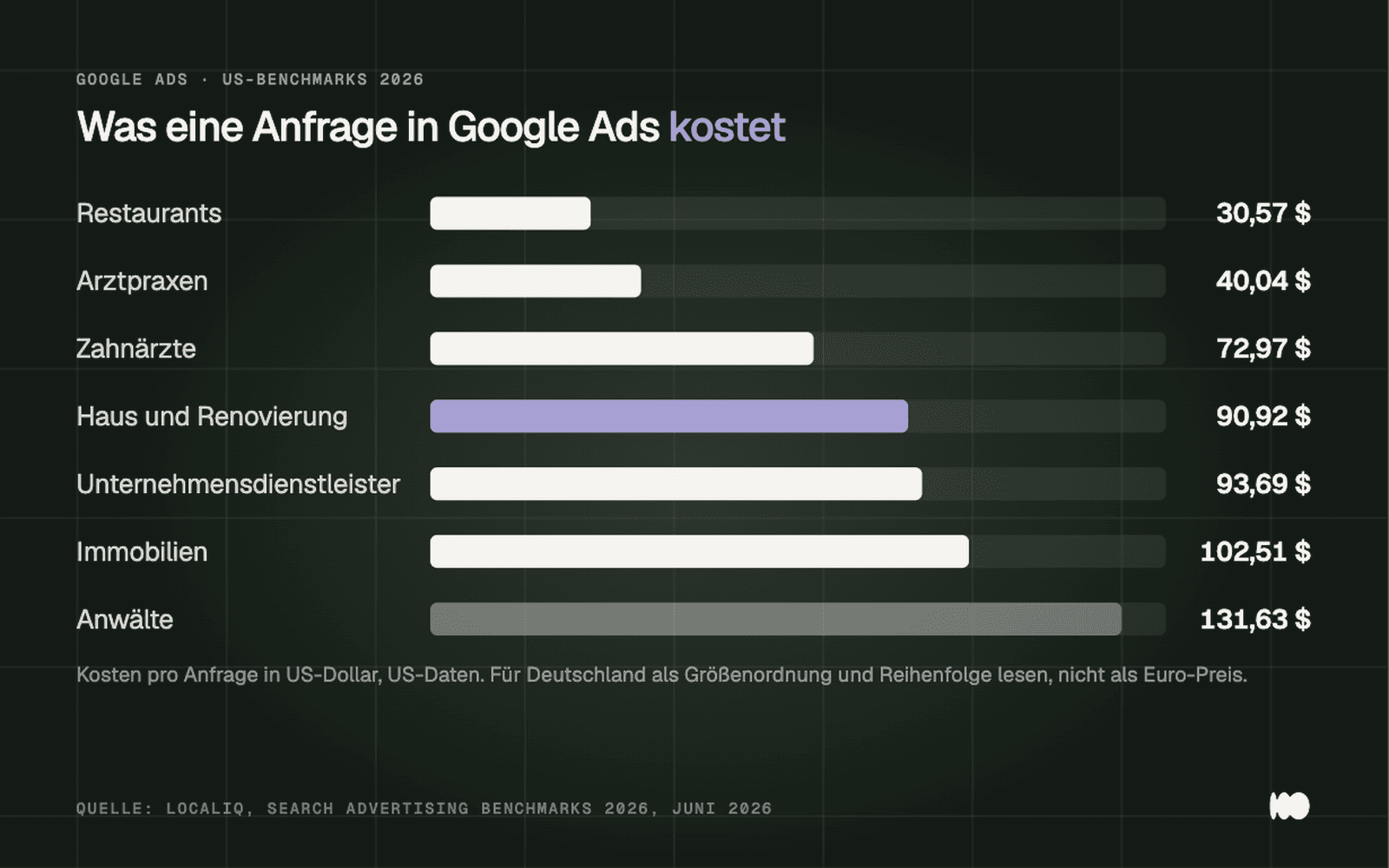
Cost per inquiry in Google Search Ads by industry, U.S. data in U.S. dollars according to LocaliQ, June 2026.
The plumbing company mentioned at the beginning had a Google Ads account that had been running unchanged since 2024: the same keywords, no exclusions, no new services. That’s where the decline came from—not from the AI overview. In our experience, an account that no one maintains costs more in lost leads than any change to Google’s search results page.
Meta Ads: Affordable for Restaurants, Expensive for Medical Practices
Meta Ads run on Facebook and Instagram and reach people who aren’t actively searching. This makes them cost-effective in terms of reach but less effective in terms of purchase intent. LocaliQ reports an average of $27.66 per inquiry for lead campaigns in the U.S. (October 2025, U.S. dollars), 21 percent more than the previous year. Restaurants average $3.16, home and renovation services average $41.26, and dentists average $76.71—all higher than the cost per lead on Google Search.
The logic behind this: It’s easy to decide to make a reservation while scrolling, but not to switch dentists. For restaurants and for events such as grand openings or season passes, Meta Ads are therefore often the best secondary channel, but rarely for dental practices.
With solar companies for which we manage Meta campaigns, we see a pattern that’s important to be aware of: The cost per lead is significantly lower than with Google Ads, but the percentage of leads that result in an on-site appointment is lower because many people are just curious. If you run Meta Ads without a quick callback and without pre-qualification, you’re buying leads, not orders.
LinkedIn for Small B2B Service Providers
For tax advisors, IT service providers, agencies, and engineering firms, LinkedIn is the channel where decision-makers are found. LinkedIn reports 257 million members in Europe and cites a survey in which 40 percent of B2B marketers describe LinkedIn as the most effective channel for high-quality leads; these are figures provided by the company without a specific date, so they should be interpreted with caution. A more independent estimate of advertising reach comes from DataReportal (“Digital 2026 Germany,” November 2025): 24.0 million people in Germany, or 28.6 percent of the population.
What works in our projects is unspectacular: the owner’s personal profile instead of the company page, two short posts per week about real projects, and comments on the profiles of people you’d like to have as clients. LinkedIn Ads are expensive for small budgets because they’re targeted by job title and company; they’re only worth it once conversations are already happening organically.
Email and WhatsApp: The Channels That Belong to You
A newsletter is a channel that no algorithm can shut down. Mailchimp reports a global open rate of 35.63 percent and a click-through rate of 2.62 percent; the data is from December 2023 and is therefore somewhat outdated, and German benchmarks are behind paywalls. The scale is significant: A newsletter sent to existing customers reaches people who already know you, at a cost close to zero.
According to Statista (no year specified), WhatsApp Business has approximately 44 million active users in Germany. For small businesses, the two-way communication channel for inquiries is more important than the channel for sending messages to all users. Since July 2025, Meta has charged per message delivered; replies within 24 hours of a customer message are free, and after a “Click-to-WhatsApp” ad, the window is even 72 hours. For a catering business in Cologne, inquiries have been turning into quotes noticeably faster since switching the contact button to WhatsApp, because questions about the number of guests and the date are clarified in minutes instead of days.
YouTube, Instagram, TikTok: wide reach, but very little of it is free
The reach is there. According to DataReportal (Digital 2026 Germany, November 2025), ads on YouTube reach 64.7 million people in Germany, on Instagram 31.3 million, on Reddit 29.3 million, on TikTok 23.7 million adults, and on Facebook 22.8 million. This puts Facebook behind Reddit. For the plumbing business, this means that TikTok reaches one-third of adults, but hardly anyone searches for a plumber there.

Audience reach of the major platforms in Germany, in millions of people, according to DataReportal Digital 2026 Germany, November 2025.
What has declined is organic reach. Rival IQ analyzed approximately four million posts for its 2025 report: The engagement rate fell year-over-year by 36 percent on Facebook, 16 percent on Instagram, and 34 percent on TikTok. Organic posts are therefore a channel where you invest time without having control over the results. For the restaurant industry, Instagram is still worth it: At a restaurant in Cologne, we see that short videos from the kitchen generate reservations, as long as the reservation link in the profile works. For a roofing contractor with three employees, however, this is generally not the case.
So you can cross three things off your list. First, the Facebook page as a mandatory task; a well-maintained profile with business hours is enough. Second, directory listings as a ranking factor—according to Whitespark, they still account for about 12 percent and remain important primarily for ensuring consistent company information. Third, general how-to articles that answer a question any AI can also answer; according to Sistrix, this is the sweet spot, with 69.7 percent of results being AI-generated summaries. Instead, write specific, dated pages with your own data: According to Seer Interactive (U.S., February 2025), websites cited in an AI summary receive 38 percent more organic clicks.
The order by business type
Trades. First, create a company profile with a set process for reviews after every job, then run Google Ads for the two or three services with the highest profit margins, using WhatsApp as your response channel. Use Meta Ads only for services that can be scheduled in advance, such as bathroom renovations or solar panel installations, and only with someone who can call back within an hour. You can skip TikTok and Facebook.
Restaurants. Start with the business profile, including current photos, a menu, and a reservation link, along with an Instagram account featuring short videos from the kitchen and dining area. As a second channel, use Meta Ads to promote openings, holidays, and seasonal menus, because—according to U.S. data—this is where inquiries are most cost-effective. Google Ads are usually only worthwhile for catering and event venues.
Practical approach. First, create a company profile with a valuation process that aligns with professional standards, then build a website with one page per service and location so that people searching with the intent to book an appointment end up on your site. Use Google Ads as a secondary channel—it has the second-lowest cost per lead among U.S. benchmarks. Avoid Meta Ads; use LinkedIn only for occupational health services or corporate clients.
Small B2B service providers. Start with a personal LinkedIn profile and a newsletter for existing customers and contacts, then run Google Ads targeting the specific services people are searching for, and publish industry articles featuring your own data that can be cited as a source. You maintain your company profile on the side, since most inquiries come through referrals and your network.
Conclusion: Here's How to Plan for the Next Quarter
The loss of clicks on Google is real, but it affects informational searches, not purchase-intent searches, and for local businesses, the business profile remains the strongest channel. For a quarter with limited time, here’s what that means: In the first month, you’ll clean up your business profile and set up a consistent review process—this costs nothing. In the second month, you’ll check whether your Google Ads account still aligns with your offerings, or start one with a small budget focused on the services with the best margins; restaurant owners should use Meta Ads instead, B2B service providers should use LinkedIn, and newsletters.
In the third month, you’ll switch your response channel to WhatsApp and remove anything that hasn’t generated any inquiries. If you don’t want to manage the ads yourself, we’ll handle that through Ad Management and provide you with a monthly breakdown of how much each inquiry cost.
Related: ChatGPT Shopping, Google UCP, and Agentic Commerce: What Online Stores Really Need to Prepare for in 2026, and Why Your Solar Company's Website Isn't Generating Leads
Do you want to know which channel is up next for you?
Let us know what you do, where your inquiries are coming from these days, and how much you can spend each month. We’ll take a look at your company profile, ad account, and website, and tell you what we’d tackle first and what you can handle on your own. Just reach out to us via the contact form. We’ll respond within 24 hours—personally and without any sales pitch.
More Articles
© Marschfahrt Studio
Practical knowledge on web design, SEO, AI, and conversion optimization. Based on real projects, without any marketing spin.