ChatGPT Shopping, Google UCP, and Agentic Commerce: What Online Stores Really Need to Prepare for in 2026
OpenAI has once again suspended in-chat purchases, Google’s “Buy” button is only available in the U.S., and German customers are turning to AI for advice rather than to make purchases. What matters for your store right now: product data, crawlers, checkout, and the new cancellation button.
Date
Category
Author

“Do we have to connect our store to ChatGPT now? Our agency newsletter says that anyone who isn’t in ‘Agentic Commerce’ by 2026 will lose everything.” The question came from a retailer of auto repair supplies—40,000 items, with a store since 2011. And the newsletter was off the mark by half a year. That’s because in March 2026, OpenAI discontinued in-app purchasing directly within ChatGPT; Google’s “Buy” button is currently only available to U.S. users; and according to the bevh, just 6.3 percent of online customers in Germany shop via AI platforms.
This article separates hype from reality and explains what will actually matter for a German online store in 2026: not integration with a purchase log, but clean product data so that AI systems can find, understand, and recommend your items, and a proprietary checkout process that handles the rest. It includes figures, data, and the legal requirements that apply in Germany anyway.
What Was Announced in 2025 and What Remains of It in 2026
The timeline is brief and informative. In April 2025, ChatGPT began including products with images, prices, and reviews in its responses for the first time—explicitly not ads. In September 2025, “Instant Checkout” was introduced: U.S. users could make purchases from Etsy sellers directly within the chat, with Shopify merchants set to follow. At the same time, OpenAI and Stripe released the Agentic Commerce Protocol, an open standard in which the merchant remains the contracting party and the AI never sees card data.
On March 24, 2026, OpenAI pulled the plug. The first version of Instant Checkout “did not offer the flexibility we were aiming for,” the company said, so retailers would once again be allowed to use their own checkout systems while OpenAI focused on product search. According to a Forbes report, only about a dozen retailers had even integrated the checkout process. What remained: product search with images and comparison tables, product feeds from retailers such as Target, Sephora, and Best Buy, and retailers’ own apps within the chat, such as Walmart’s. Since the week of August 24, 2026, ChatGPT has also been displaying ads, including in Germany, though only on the free plan and the budget-friendly Go plan.
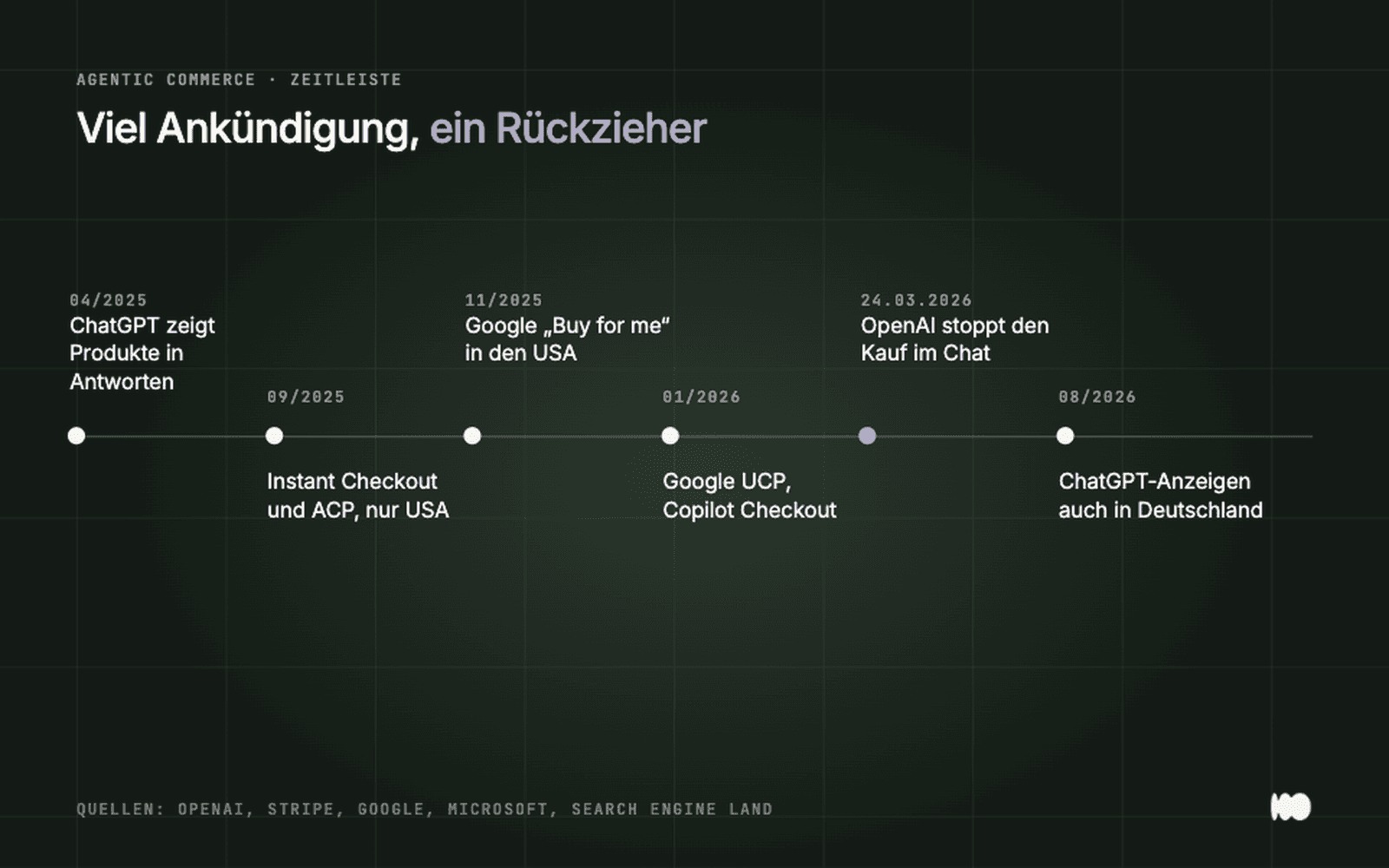
Sixteen months of Agentic Commerce: many launches, one reversal, and ads in ChatGPT as the latest change.
Google took the opposite approach. In November 2025, it launched the “Buy for Me” feature in AI Search in the U.S., followed in January 2026 by the Universal Commerce Protocol, developed in partnership with Shopify, Etsy, Walmart, and Target, and supported by Visa, Mastercard, Stripe, and Zalando. In May 2026, Google announced a shopping cart feature across Search, Gemini, and Maps. However, according to Google’s own help center, the “Buy” button is currently available only to “select merchants”; so far, only registered U.S. users can make purchases in English, with Canada and Australia set to follow in the coming months. No date has been set for Europe.
In addition, Microsoft has been offering a Copilot checkout in the U.S. since January 2026, Perplexity has integrated PayPal, Amazon has been offering Alexa for Shopping since May 2026, and the card networks Visa and Mastercard have their own agent standards. There’s a lot of activity, almost all of it in the U.S.
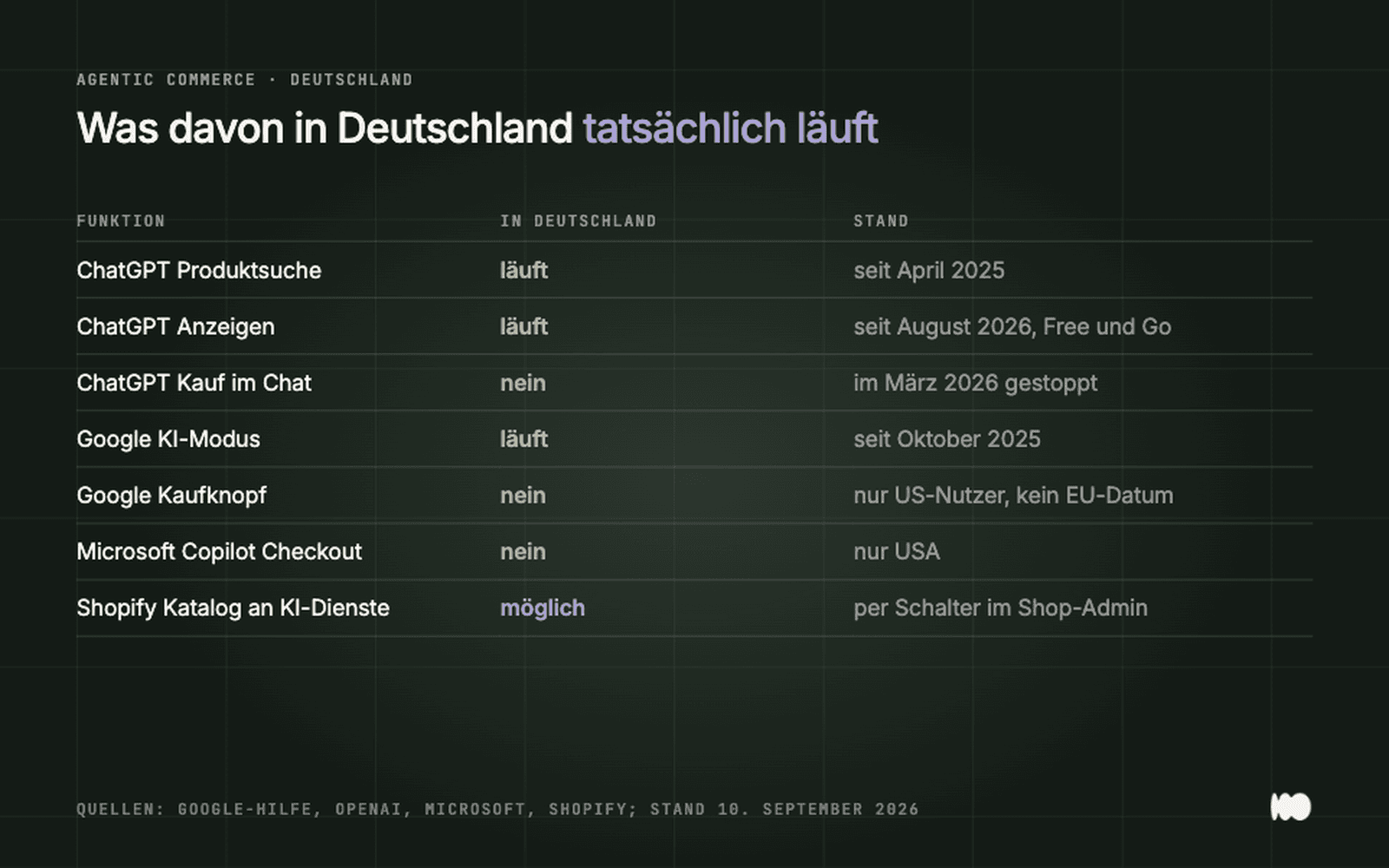
As of September 10, 2026: What's working in Germany—and what isn't.
How Much Revenue Is Actually Generated Through AI?
Two figures from the 2025 holiday shopping season sound like a revolution. Adobe analyzed traffic from major U.S. online retailers: Visits originating from AI services rose by 693 percent compared to the previous year, and these visitors made purchases 31 percent more often than visitors from other sources, with revenue per visit 254 percent higher. Salesforce estimates, based on its own model, that AI “influenced” $262 billion in global sales during the holiday season—one-fifth of all online retail sales.
The other side of the story: In September 2026, Similarweb found that even on marketplaces that benefit the most from AI recommendations, these account for only a “low single-digit percentage” of total traffic. Bain estimates this share of total traffic at less than 1 percent. And a study by the University of Hamburg and the Frankfurt School, which analyzed 973 online stores and 50,000 ChatGPT orders, reached a sobering conclusion in October 2025: ChatGPT visitors accounted for 0.2 percent of sessions and made purchases less frequently than visitors from nearly every traditional channel, with a rising trend from month to month.
Both are true. Major brands with comprehensive data are the first to benefit, and the results are visible. So far, mid-sized online stores have seen a small but rapidly growing stream in their statistics.
What German customers think of it
The German E-Commerce and Mail-Order Trade Association (bevh) released its annual figures in January 2026: 83.1 billion euros in merchandise sales, an increase of 3.2 percent; growth of 3.8 percent is expected for 2026. 6.3 percent of online customers shop and pay via AI platforms, while 91.7 percent have so far rejected shopping AIs. Bitkom added in April 2026: 35 percent of those who use AI ask it questions about shopping. And Bain found that half of consumers do not want to entrust a complete purchase to AI, but trust a retailer’s agent three times more than that of a third-party platform.
Translation: Customers seek advice from AI and compare options, but they want to buy from you. Whoever appears in the results wins the comparison. Whoever doesn't appear doesn't exist for that customer.
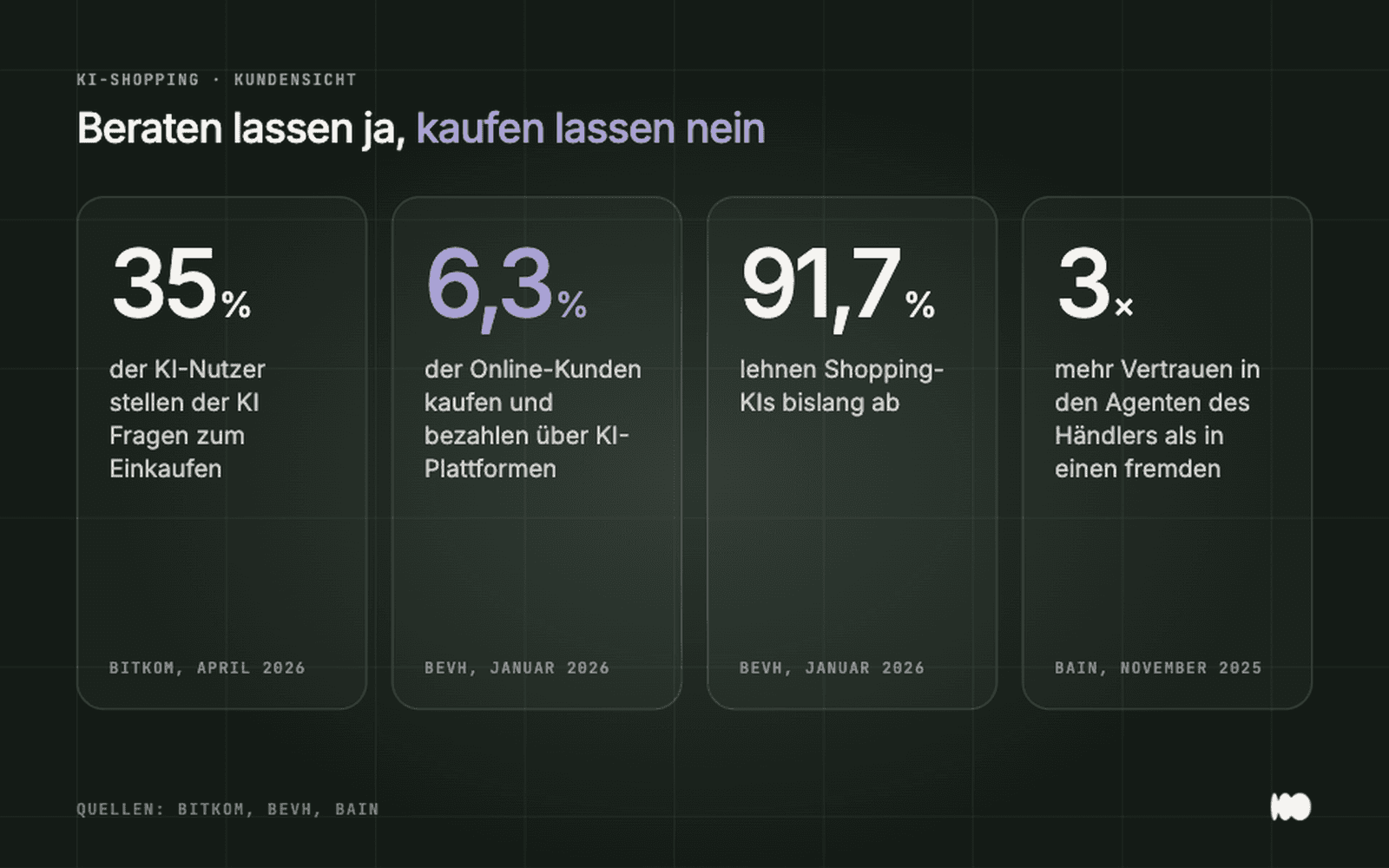
German customers seek advice, but they want to make their purchases at the store.
The Real Lever: Product Data That a Machine Can Understand
All systems—ChatGPT, Google’s AI search, Copilot, and Perplexity—operate on the same foundation: structured product feeds, i.e., machine-readable product files. OpenAI has published its requirements, which include nine mandatory fields per item: a unique ID, a title of up to 150 characters, a description of up to 5,000 characters, a URL, brand, seller name, image, availability, and price with currency. The feed should be updated as soon as the price or inventory changes. To be honest: This file is currently geared toward the U.S. market; German retailers can practically only access it through Shopify. Google feeds its AI search from the Merchant Center—free listings are sufficient for this—and additionally recommends structured data according to schema.org on every product page: name, image, price, currency, availability, GTIN, brand, and shipping and return policies.
We typically find the same gaps among our online store clients: missing GTINs; availability information listed only in the store system and not in the feed; shipping costs and return policies that aren’t machine-readable anywhere; and product descriptions copied from the manufacturer’s text—which, to AI, are identical to those of twenty other stores. In May 2026, Google introduced “conversational attributes”—product descriptions that answer questions such as: Who is this for? What makes it unique? What is it compatible with? These are exactly the factors that determine whether an item appears in an AI-generated response.
Feed, Crawler, robots.txt: The Technical Checklist
1. Complete the Merchant Center feed. GTIN, brand, condition, availability, price, shipping, returns—updated at least once a day. This is your ticket to Google’s AI search, which has been available in Germany since October 2025.
2. Ensure that structured data on the product page matches the feed. The information in the feed must also appear in the page’s schema.org markup. In our experience, if two sources conflict, the AI will not trust either of them.
3. Allow the right bots to access your site. OpenAI uses three crawlers. According to OpenAI, if you block OAI-SearchBot, your site will not appear in ChatGPT search results. GPTBot is used for training and can be blocked separately. Many German online stores have blocked “all AI bots” across the board and have since been surprised that they do not appear in ChatGPT.
4. Shopify merchants: Check the settings. Since December 2025, Shopify has been automatically sending catalogs to ChatGPT, Perplexity, and Copilot as soon as a merchant enables the feature. For Copilot in the U.S., Shopify merchants are automatically included and must actively opt out. Those who aren’t aware of this may already be selling through channels they’ve never reviewed.
5. No llms.txt. Google’s John Mueller made it clear in 2025: No AI system uses this file. It doesn’t do any harm, it doesn’t do any good, and anyone who charges you for it is charging you for nothing.
6. Track AI visitors. Create segments in your analytics for visitors from chatgpt.com, gemini.google.com, perplexity.ai, and copilot.microsoft.com. Only then will you be able to see if this trickle is growing on your site and what these visitors are buying. Important: Since May 2026, ChatGPT has been linking more frequently to homepages rather than product pages, which makes attribution more difficult.
Why Having Your Own Checkout Is Becoming More Important, Not Less Important
Because OpenAI has discontinued in-chat purchases and Google has so far limited the feature to the U.S., the AI-guided customer will end up on your product page and in your checkout in 2026. And they’ll arrive with a decision already made: They’ve compared options, they know what they want, and they have little patience. Adobe reports a 33 percent lower bounce rate for these visitors. In our view, this only holds true if the page delivers what the AI response promised: the same price, the same availability, and the same delivery time. A checkout process that requires an account, involves five steps, and displays the shipping cost only at the very end squanders exactly this advantage. What a contact form and a checkout process have in common is explained in our article on why inquiries don’t come through forms: Every hurdle costs, and AI-driven customers are the most impatient of all.
What's Changing Legally—and What Isn't
Here’s an important note: We are web designers, not lawyers; for specific cases, you’ll need to consult a law firm. But the basic principles have now been clearly outlined. On September 1, 2026, the Händlerbund published a guide on contract formation through AI agents. The key takeaway: An AI is not a legal entity. If an agent places an order on behalf of a customer, the contract is attributed to the person who sent the agent. The customer retains their full right of withdrawal, the merchant remains the contracting party, and the “button solution” under Section 312j of the German Civil Code (BGB)—that is, the “place order with obligation to pay” button—remains in full effect.
New and independent of AI: As of June 19, 2026, the cancellation button is mandatory. Customers must be able to cancel a distance sales contract via a clearly visible button in two steps, without logging in, and with automatic confirmation. Violations can be penalized with a fine of up to 50,000 euros or 4 percent of revenue. Anyone who is already updating their online store for AI customers should take care of this requirement at the same time.
It remains to be seen what happens when an agent makes a mistake. The Händlerbund anticipates more disputes along the lines of “It was the AI, not me.” Clear order confirmations, transparent pricing in the feed and on the website, and a return process that works without any hassle are the best way to prepare for this.
Our recommendation: What you should do by the end of 2026
First, the data foundation—this is a must: a complete product feed, mirrored markup, open crawlers, and descriptions that answer questions. For a store with a few thousand items, this takes one to two weeks and has an immediate impact on Google, ChatGPT, and Copilot. Second, the checkout process—this is a bonus with immediate results: guest checkout, shipping costs displayed before the first click, a cancellation button, and mobile speed. Third, analytics—so that in a year’s time, you’ll know whether that small stream has turned into a big one. What you can skip: connecting to a purchase log. That won’t be an issue until 2027 at the earliest, assuming Google brings the “Buy” button to Europe—and even then, e-commerce platforms like Shopify will handle the integration automatically.
Conclusion: The AI gives advice; you make the sale
In 2026, Agentic Commerce is primarily an American experiment marked by setbacks. What’s already making a difference in Germany is AI-powered advice before a purchase: ChatGPT search, Google’s AI mode, and ads in ChatGPT since August. There, the winners are those whose product data is complete, up-to-date, and distinctive—and whose online store doesn’t hold back customers who’ve received that advice. This isn’t a new field. It’s good store management tailored to a new, very impatient audience.
Related: More Leads Rarely Come from More Traffic and Meta Ads for Solar Installers: What Works and What Burns Through Money
Do you want to know if your products appear in AI responses?
We’ll review your feed, markup, robots.txt, and checkout process from the perspective of AI systems and let you know which two or three gaps you should address first. Just send us a quick message using the contact form. We’ll respond within 24 hours—personally and without any sales pitch.
More Articles
© Marschfahrt Studio
Practical knowledge on web design, SEO, AI, and conversion optimization. Based on real projects, without any marketing spin.