Website Funding in 2026: Which Grants Are Still Available—and Which Aren't
Will there still be grants available for a company website in 2026? What the federal and state governments fund according to their guidelines, what they exclude, where funding is actually available, and what to do if it doesn't work out.
Date
Category
Author

“Isn’t there a grant for that?” We hear this question in almost every initial consultation about a new website. The honest answer for 2026: In most federal states, there are no longer any grants available for building a standard company website. However, the situation looks better when it comes to the initial consultation, for websites with real functionality, and in certain states.
For this guide, we reviewed the guidelines, fact sheets, and FAQs for the most important federal and state programs on October 13, 2026. Many websites still advertise programs that have long since ended. Here’s what actually applies today, backed by direct quotes, and what you can do if no funding program is a good fit.
In a nutshell (as of October 13, 2026)
By 2026, subsidies for a standard corporate website will be virtually nonexistent. The federal “go-digital” program ended in late 2024 and had already excluded websites prior to that. Most state programs, including those in North Rhine-Westphalia and Bavaria, explicitly exclude “websites.” Exceptions include Saxony-Anhalt, where websites are explicitly eligible for funding, and websites with actual functionalities such as booking or ordering, for example through the KfW Digitalization Grant Loan. Consulting services prior to website development, on the other hand, are often subsidized or even free of charge, for example through the Chamber of Crafts. Important: Do not hire anyone before you receive the grant approval notice.
An Overview of the Programs
The overview shows what the programs explicitly state regarding the website. Green means a grant is possible; purple means only consulting services; yellow means only under certain conditions; gray means excluded.
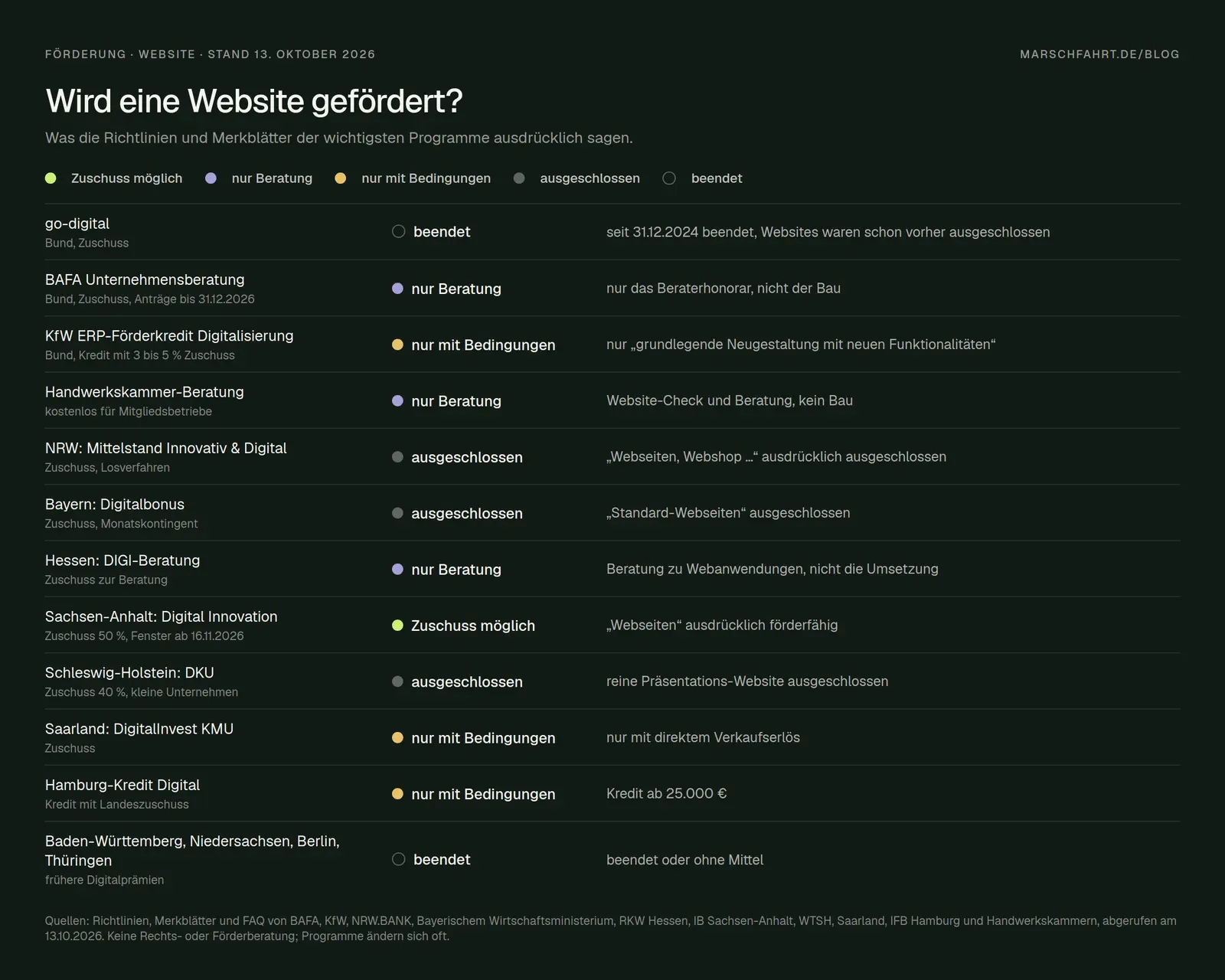
Funding for a website by program, as of October 13, 2026. This information is based on the guidelines and fact sheets issued by development banks and ministries.
What No Longer Exists
The go-digital program has ended, and websites were never eligible for funding under it. Many providers are still advertising the federal program. It expired on December 31, 2024. And even while it was still active, the FAQs stated that “funding for the initial creation or modification of an existing website” was excluded from eligibility.
Several state grants have also expired. The Berlin Digital Grant ended in 2023, the Digitalization Grant Plus in Baden-Württemberg on June 30, 2025, the Lower Saxony Digital Bonus at the end of 2025, and the Hesse DIGI Grant in June 2026. Anyone who promises you any of these today hasn’t updated their website in a long time.
What the states expressly exclude
Since 2026, North Rhine-Westphalia has provided funding exclusively for AI and similar products. The “Innovative & Digital SMEs” program explicitly states in its list of ineligible measures: “Measures aimed at corporate and product presentation and the digitization of sales, such as websites, online stores, social media tools, and marketing tools.”
Bavaria excludes standard websites. The Digital Bonus guidelines specify that “expenses for standard websites or online stores, and standard online marketing measures” are ineligible for funding. According to the implementation guidelines, this refers to “conventional websites for corporate and product presentation” that are not deeply integrated into business processes.
The situation is similar in Schleswig-Holstein, Brandenburg, Saxony, and Bremen. Schleswig-Holstein excludes the “creation or optimization of a website … for the sole purpose of presenting a company or product,” while Saarland excludes “simple, standard websites.” Anyone who simply wants a more attractive online business card will not receive a grant in these states.
If it's possible, after all
Saxony-Anhalt explicitly supports websites. The “Digital Innovation” program of the Saxony-Anhalt Investment Bank lists as eligible “web applications that take usability into account (across all devices), such as websites, apps, and creative content.” Funding covers 50% of eligible costs, up to a maximum of €70,000, for small and medium-sized enterprises based in Saxony-Anhalt. The next application window opens on November 16, 2026, at 1:00 p.m. and closes after 90 applications have been received; after that, decisions will be made based on a points-based evaluation.
Websites with real functionality are funded through the KfW loan. KfW’s ERP Digitalization Subsidy Loan has been available through participants’ primary banks since July 2025. According to the information sheet, the “funding is available for the fundamental redesign of a company’s website or app with new functionalities, e.g., interactive applications for customers,” provided that digital systems are interconnected—such as the website, appointment scheduling, and inventory management. It is a loan, not a grant: Depending on the tier, a repayment subsidy of 3 to 5% is available.
In Saarland and Hamburg, funding is available only for sales-related functions or as a loan. Saarland provides funding for websites that “generate direct sales revenue (order systems, ticket booking systems, or similar).” Hamburg offers the “Hamburg-Kredit Digital” loan starting at €25,000, with a state subsidy.
Pre-treatment counseling is often subsidized
Consulting services at the Chamber of Crafts are free of charge. Craft businesses receive free advice from their chamber’s business consultants, including guidance on websites and online visibility. The chamber does not build websites, but it helps clarify goals and requirements before you request quotes.
The BAFA consulting grant program will continue through the end of 2026. The program provides a subsidy toward the fees of a registered management consultant; in North Rhine-Westphalia and most western states, this amounts to 50% of up to €3,500, or up to €1,750. According to the guidelines, applications can only be submitted until December 31, 2026. The implementation—that is, the construction of the website—is not eligible for funding, and the consultant must be impartial. Therefore, an agency that subsequently builds the website generally cannot provide this consulting service itself.
Hesse and several other states provide funding for digital transformation consulting. In Hesse, the RKW’s DIGI-Beratung program explicitly subsidizes consulting services related to “web applications … e.g., websites.” Rhineland-Palatinate, Bremen, and Hamburg have their own consulting programs.
Here's how to do it
First, determine what the website is intended to do. Whether funding is an option almost always depends on whether the website does more than just serve as a showcase: booking appointments, processing orders, integrating with calendars, inventory management, or customer data management. If so, it’s worth looking into KfW and state programs. If not, consulting grants are the most realistic option.
Get quotes, but don’t sign them until you’ve received the decision. For almost every application, you’ll need a quote or a cost estimate. That’s not a problem. It’s the contract itself that can cause issues: At BAFA, simply signing the consulting contract counts as the start date; in Bavaria, even a verbal agreement counts; and in North Rhine-Westphalia, no agreements may be legally binding before approval is granted. We’d be happy to provide you with a quote that you can include with your application, and we won’t start until you have the green light.
Expect to cover a portion of the costs yourself and deal with red tape. Almost everywhere, you’ll need to cover at least 50% of the costs yourself; on top of that, there are minimum thresholds (€8,000 in eligible costs in North Rhine-Westphalia, €4,000 in Bavaria) and the de minimis declaration, in which you confirm that you have not received more than €300,000 in subsidies over the past three years. For a website costing a few thousand euros, the effort involved may exceed the grant amount.
Ask your tax advisor about depreciation. There is no blanket rule for tax purposes regarding whether a website is treated as an expense immediately or depreciated over several years. The 2022 BMF circular on the one-year useful life for software does not mention websites. It’s best to clarify this before making the investment.
What if the funding doesn't work out?
In that case, you can pay us in installments. Grant programs have quotas, lotteries, and deadlines, and often your project simply doesn’t meet the guidelines. To ensure that a worthwhile project doesn’t fall through because of this, we offer installment payments for all our services. For example, you can pay for the website (999 euros ) in four installments with no extra charge; for larger projects, we’ll work with you to determine the installment schedule during our initial consultation. Just ask about it, even if you’re still waiting for a funding decision at the same time.
What Has Changed and What That Means for You
The era of broad-based digitalization grants is over. Between 2024 and 2026, the “go-digital” program, several state grants, and the DIGI grant in Hesse have expired; North Rhine-Westphalia has shifted its program to focus on AI products; and, according to the guidelines, the BAFA consulting grant will end with applications submitted by the end of 2026. For you, this means: Plan a website using your own budget, consider funding as a bonus, and take advantage of free or subsidized consulting while it’s still available.
Date of this version: October 13, 2026. Funding programs often change, and quotas are sometimes filled within hours. Always check the current status directly with the program before making plans. This article does not constitute funding or legal advice.
Are you planning a new website?
We build websites for businesses looking to attract customers, with a fixed price and a delivery date. If you’re eligible for a grant, we’ll prepare a tailored proposal for your application. And if not, we offer payment plans. Related: How much does a website cost? · The 10 UX mistakes that cost you leads · Services: Web Design · Website for 999 euros
Use our contact form to tell us what you're planning and in which state your business is located. We'll respond within 24 hours—personally and without a sales pitch.
More Articles
© Marschfahrt Studio
Practical knowledge on web design, SEO, AI, and conversion optimization. Based on real projects, without any marketing spin.

