Websites for Medical Practices in 2026: What Must Be Included, What Doctors Are Not Allowed to Do, and What Patients Expect
What a website for medical and dental practices should include: online appointments, services categorized by symptoms, a legal notice with professional association information, advertising restrictions, and data protection for appointment requests. Includes statistics from Bitkom and KBV and a project example.
Date
Category
Author

A medical practice’s website has a simpler purpose than most company websites, yet it is subject to more regulations. It’s simpler because patients come with a clear set of questions: Does the practice treat my condition? When is it open? And how do I make an appointment? It’s subject to more regulations because doctors and dentists are bound by professional regulations, the Law on the Advertising of Medicines, and health data protection laws—regulations that don’t apply to a painting contractor.
This guide explains what should be included on a website for a medical or dental practice, what patients expect today, and where the boundaries lie when it comes to advertising. We reviewed the relevant regulations on October 12, 2026, in the Model Professional Code of Conduct, the German Law on the Advertising of Medicines, with data protection authorities, and in rulings by the Federal Court of Justice; the figures on patient behavior are sourced from Bitkom, Eurostat, and the National Association of Statutory Health Insurance Physicians. The website we built for an ENT practice serves as an example. Legal notices are not a substitute for advice from your professional association or a lawyer specializing in medical law.
In a nutshell (as of October 12, 2026)
A good medical practice website provides answers within seconds about which conditions you treat, when you’re available, and how to make an appointment—preferably online. According to Bitkom, 64% of Germans have booked a doctor’s appointment online at least once, but only 40% of medical practices offer this option, according to the KBV. You may provide factual and detailed information; promotional, misleading, and comparative advertising is prohibited under professional regulations. Since the relaxation of the German Law on the Advertising of Medicines, patient testimonials are no longer strictly off-limits, though “before-and-after” photos for cosmetic procedures still are. The legal notice must also include your medical association, professional title, and professional code of conduct. Even a simple appointment request can contain health data, so the form, appointment booking system, and email must be set up with appropriate care.
What Patients Expect Today
Online appointments are no longer a bonus—they’re an expectation. According to Bitkom, by the end of 2025, 64% of Germans aged 16 and older will have scheduled at least one doctor’s appointment online; in 2024, that figure was 50%, and in 2023, just 36%. The most important benefit cited by 84% of users was that they no longer have to rely on being able to reach the practice by phone. As early as 2024, 88% agreed with the statement that medical practices are often hard to reach by phone, and 27% specifically chose their practice based on whether it offered online appointments.

Patients are booking appointments online more and more often, but fewer than half of medical practices offer this option. The two surveys have different populations and cannot be directly compared.
Medical practices are catching up more slowly. In the KBV’s 2025 Digitalization Practice Barometer, 40% of the medical practices surveyed reported offering online appointment scheduling—7 percentage points more than the previous year. Practices with multiple doctors do so more frequently than solo practices. For a solo practice, this presents an opportunity: those that offer online booking stand out from the crowd.
Reviews are read. According to Bitkom, 55% of internet users read online reviews at least occasionally before choosing a medical practice or clinic. When selecting a doctor, reviews are very important to 57% of them. Your website is often the second stop in this process: Patients first see your profile on Google or a review site, then check your website to see if you’re a good fit for their needs.
What Should Be Included on a Medical Practice Website
Top: Specialty, location, appointment date. The first screen on the phone should show: which practice, which specialty, where, and clear directions to the appointment, along with a phone number you can tap and, if available, a button for online booking. The opening hours and office hours should be right next to that, not three clicks down.
List services by condition, not by billing codes. Patients search for “dizziness,” “snoring,” or “dental implant,” not for the technical terms from the fee schedule. Organize your services so that people can find their specific problem, and briefly explain what happens at your practice. This also helps with Google, because your site will then match the words people type in.
A photo and a sentence describing your approach. Anyone visiting a new doctor wants to know who will be treating them. A photo, a brief summary of your professional background, the languages spoken at the practice, and a sentence describing how you work build more trust than any image database. Be careful with areas of specialization: The professional code of the North Rhine Medical Association allows a maximum of three areas designated as “areas of specialization,” and only if you have been practicing them extensively for at least two years. Other medical association districts have different rules, so check your association’s professional code.
Practical information for your visit to the office. Directions and parking, accessibility of the rooms, what to bring to your first appointment, coverage during vacations, prescription orders, and emergency numbers. This page is often viewed more frequently than the home page.
An example from our work
We built this exact structure for an ENT practice in Saarbrücken. The practice’s services range from pediatric ENT to sleep medicine and allergology. The services are therefore organized by concern so that patients can easily find the information they need. Appointments can be booked online at any time through the practice’s booking service, regardless of office hours. The doctor introduces herself personally on a dedicated page, including her background, areas of expertise, and languages spoken. The project was completed in one month.
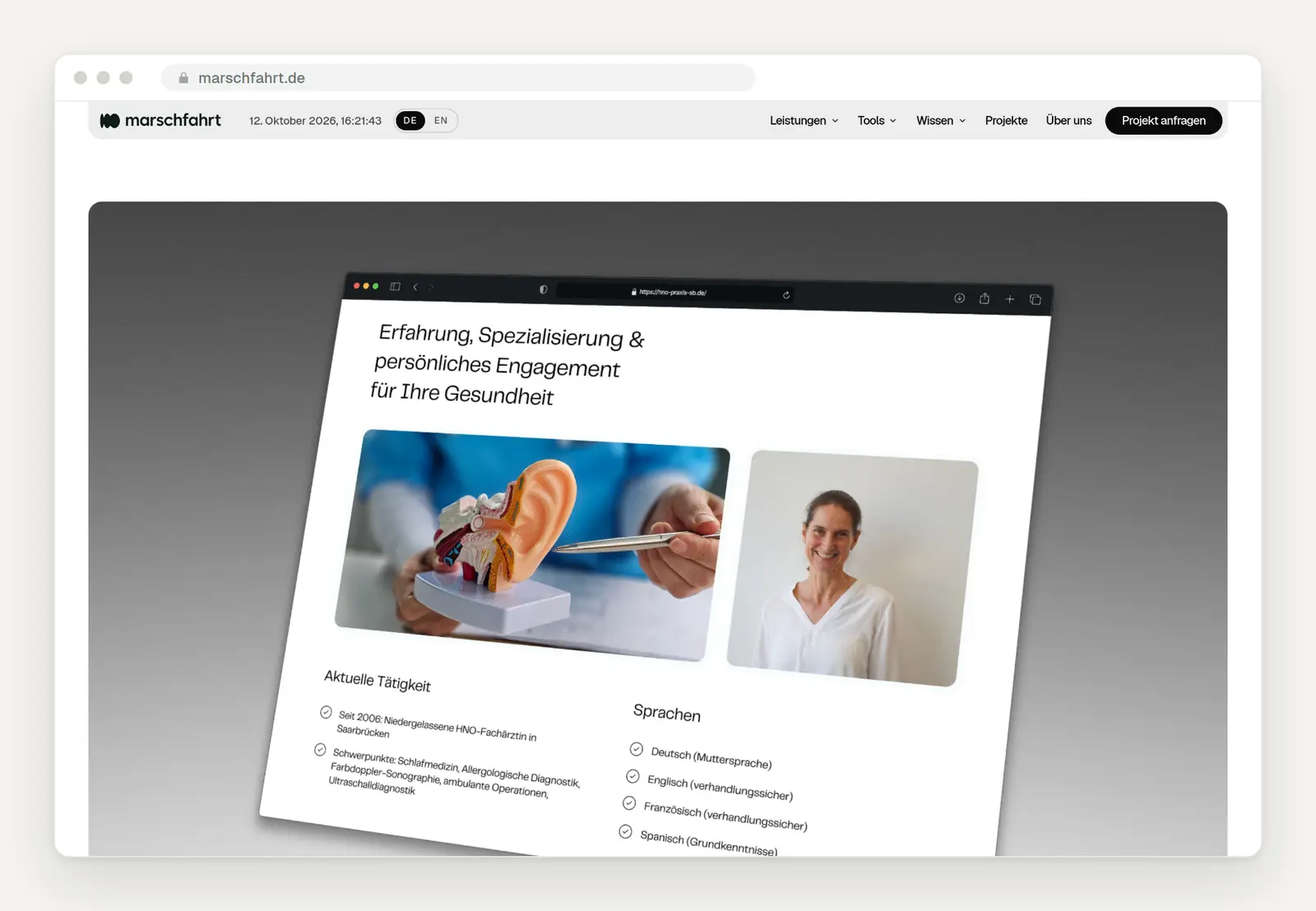
Excerpt from our project for Dr. Lohmann's ENT practice: a personal introduction including his professional background, areas of expertise, and languages spoken.
What Doctors Can and Cannot Do on the Website
Providing factual information is permitted; promoting services is not. Section 27 of the Model Code of Professional Conduct for Physicians permits “factual, profession-related information.” Unprofessional advertising is prohibited, and according to Section 27(3), “in particular, promotional, misleading, or comparative advertising” is considered unprofessional. For dentists, § 21 of the Model Code of Professional Conduct additionally prohibits “derogatory” advertising. The code of professional conduct of your state dental association is binding in each case and may differ from the model version. In practice, this means: “We treat vertigo and perform these examinations for that purpose” is information, while “the best ENT practice in the city” is promotional advertising.
Patient testimonials are no longer prohibited in principle. The German Law on the Advertising of Medicines (HWG) now prohibits statements by third parties—such as letters of thanks or recommendations—only “if they are made in an abusive, offensive, or misleading manner” (Section 11(1)(11) HWG). Some overviews published by the medical associations still cite court rulings from before this relaxation of the law, which are no longer a reliable benchmark today. Anyone displaying reviews on their own website must, pursuant to Section 5b(3) of the Unfair Competition Act (UWG), disclose whether and how they verify that the reviews come from real patients. Fake reviews are always prohibited, and a Higher Regional Court ruled as early as 2013 that displaying only positive reviews is not permitted. The simplest solution: link to your profile on Google or a review portal instead of posting a selection on your own website.
Use “before-and-after” photos only with great caution. For elective plastic surgery procedures that are not medically necessary, Section 11(1), Sentence 3, No. 1 of the German Health Products Act (HWG) prohibits advertising using “before-and-after” photos. On July 31, 2025, the Federal Court of Justice ruled that hyaluronic acid injections that alter the shape of the nose or chin also fall under this prohibition (Case No. I ZR 170/24). The prohibition does not apply to medically necessary treatments; however, even in such cases, depictions must not be abusive, repulsive, or misleading.
Review seals and awards. On July 30, 2026, the Federal Court of Justice addressed the issue of advertising using a medical seal from a magazine and established strict requirements for such health-related seals, but remanded the case (Case No. I ZR 130/25). Anyone advertising with a “Top Physician” seal should first clarify whether this is permissible.
A Medical Practice's Legal Notice
Physicians and dentists are required to provide additional information. In addition to name, address, contact information, and, if applicable, a VAT ID, Section 5(1)(5) of the Digital Services Act requires regulated professions to disclose: the professional association to which they belong, their legal professional title and the country in which it was granted, as well as the name of the professional regulations and where they can be accessed. In practice, this means: list the medical association, “physician” or “dentist,” “awarded in Germany,” and provide a link to your association’s code of professional conduct. Some commentaries still refer to the old Telemedia Act, but the Digital Services Act has been the governing law since May 2024.
Contact Form, Online Appointment, and Privacy Policy
Even an appointment request can contain health data. According to Recital 35 of the GDPR, health data also includes information collected “in the course of registration” for treatment. Anyone who writes “Appointment due to severe ear pain” in a contact form is transmitting specially protected data under Article 9 of the GDPR. The form must therefore be transmitted via a secure connection (HTTPS, as required by the KBV’s IT security guidelines); the message must not pass through third-party systems in unencrypted form; and the privacy policy must explain what happens to the information provided.
Appointment scheduling services are data processors. The Berlin Data Protection Commissioner states that medical practices generally use appointment management companies as data processors. You do not need patients’ consent for this, but you must disclose this information in your privacy notice and have a data processing agreement in place. However, according to the German Medical Association (Bundesärztekammer) and the National Association of Statutory Health Insurance Physicians (KBV), you need explicit consent—which you must be able to document—for reminders via text message or email. And when booking, patients must be able to recognize that they are booking with your practice, not through an anonymous portal.
Carefully review third-party services on the website. The same agency points out that embedded third-party content—such as fonts, maps, or scripts—also discloses personal data to these providers and that there is “often no legal basis” for doing so. Fonts should be hosted on your own server, and maps and videos should only be loaded after consent has been obtained.
Email is unsuitable for medical reports. The Data Protection Conference requires end-to-end encryption for emails that pose a high risk to the individuals concerned, and professional confidentiality is an indication of such a risk. You may only waive protective measures at the express, voluntary request of an informed patient in a documented, individual case. For appointment requests via email, a notice on your website stating that you do not discuss medical matters via email is sufficient.
Contract physicians are also subject to the IT security policy. The KBV policy under Section 390 of SGB V contains specific requirements for practices that offer a web service, such as an online appointment system with registration: authentication, protection against automated use, and encrypted connections. A simple informational website is less affected by these requirements than a self-hosted patient portal.
Accessibility: Mandatory or Not?
While the Accessibility Enhancement Act does not apply to many private practices, accessibility is still advisable. The Act has been in effect since June 2025 for services provided through electronic commerce. The Federal Agency for Accessibility specifically cites online appointment booking as an example; a website that is purely for presentation purposes, on the other hand, generally does not fall under its scope. Micro-enterprises with fewer than ten employees and an annual turnover of no more than 2 million euros are exempt. Whether medical appointments with doctors are covered at all has not been conclusively clarified in legal terms. Regardless, according to the Federal Statistical Office, 7.8 million people with severe disabilities were living in Germany at the end of 2025—9.4% of the population—and many of them are patients. The KBV recommends that medical practices themselves use high contrast, descriptive images, and online appointments as supplementary measures. Learn more in “Accessible Websites According to the BFSG.”
Google Profile and Reviews
Doctors may have their own profile, and the practice may have its own as well. Google classifies doctors and dentists as “independent professionals.” Anyone who has patient contact and is available at the location during business hours can create their own business profile; multiple profiles for different specialties are not permitted. In a group practice, the practice gets its own location profile, while the doctors’ profiles simply bear their names. For instructions on how to set up the profile, see “Set Up, Verify, and Manage a Google Business Profile.”
As a general rule, you must tolerate review sites. In several cases involving Jameda, the Federal Court of Justice has ruled that doctors must, in principle, accept review sites. If a doctor disputes that the reviewer was ever treated by them, the site must follow up and obtain proof of the contact. You may respond to reviews, but due to the duty of confidentiality, you must never disclose details about the treatment. For more information, see “Deleting, Reporting, and Responding to Google Reviews.”
The Checklist for Your Practice Website
What Has Changed and What That Means for You
Patients expect to be able to schedule appointments online, and at the same time, the rules have become more specific. Within two years, the percentage of Germans who have already booked a doctor’s appointment online has risen from 36% to 64%. The new requirements of the IT Security Directive for contract physicians have been in effect since October 2025; the Accessibility Enhancement Act has been in effect since June 2025; and in 2025 and 2026, the Federal Court of Justice tightened the restrictions on “before-and-after” advertising and physician seals of approval. For you, this means that a good practice website today is, above all, a reliable way to book an appointment—written in a factual manner and built in compliance with data protection regulations. The KBV’s new Practice Barometer is expected in the fall of 2026; we will update the figures then.
Date of this version: October 12, 2026. The legal notices do not constitute legal advice. The rules of professional conduct of your bar association and the guidance provided by your data protection authority are binding.
Are you planning a new website for your practice?
We build websites for medical practices that help patients find the right appointment in seconds: with services organized by need, integration with your booking service, a clean legal notice, and fonts hosted on our own server. For small practices, we offer a ready-made one-page website at a fixed price. Related: Dr. Lohmann ENT Practice Project · Local SEO · Service: Web Design · Website for 999 euros
Let us know what your practice needs by filling out our contact form. We'll respond within 24 hours—personally and without any sales pitch.
More Articles
© Marschfahrt Studio
Practical knowledge on web design, SEO, AI, and conversion optimization. Based on real projects, without any marketing spin.

