Having a Website Built in 2026: The Process, Contract, and How to Spot a Good Agency
How a website project works, what you should prepare, what should be included in the proposal and contract, and why the domain must be registered in your name: with a briefing template, questions for the agency, and the status of funding for 2026.
Date
Category
Author

Anyone looking to have a website built will quickly receive three quotes that have nothing in common: €1,500, €6,000, and €14,000, each with different services, contract terms, and fine print. Whether the lowest quote is a bargain or a trap is rarely indicated by the price alone. It’s reflected in the process, the contract, and the question of who ultimately owns the domain, design, and content.
This guide explains how a website project with an agency or a freelancer works, what you should prepare, what’s important in the contract, and how to recognize a good agency. We reviewed the legal aspects on October 12, 2026, in the text of the law, in rulings by the Federal Court of Justice, and at DENIC. This information is not a substitute for legal advice, but it will show you what questions you should ask. Our page “How Much Does a Website Cost in 2026?” provides a detailed answer to the question of how much a website costs; this guide covers everything else involved.
In a nutshell (as of October 12, 2026)
Having a website built rarely takes a long time because of the technical aspects, but rather because of the content, and a good quote should specify not only a price but also a deadline, scope, and rights. Before you start, clarify your goals, target audience, and budget; gather text and photos early on; and compare quotes based on the scope of services rather than the total cost. The contract should include: a fixed price and delivery date, acceptance of work, rights of use for the design, code, and text, the provision of all access credentials, and a domain registered to your business. If the agency provides hosting, you’ll need a data processing agreement. The federal go-digital funding program will no longer be available as of the end of 2024.
Three Ways to Build a Website, and Which One Is Right for Whom
You can build it yourself, hire a freelancer, or work with an agency. Each approach has its merits; it just needs to align with your goals and your timeline. According to Eurostat, in 2025, about 92% of German businesses with ten or more employees had a website, while for micro-enterprises with up to nine employees, the figure was only 65% in 2023. This means that one in three small businesses is still facing this very decision.
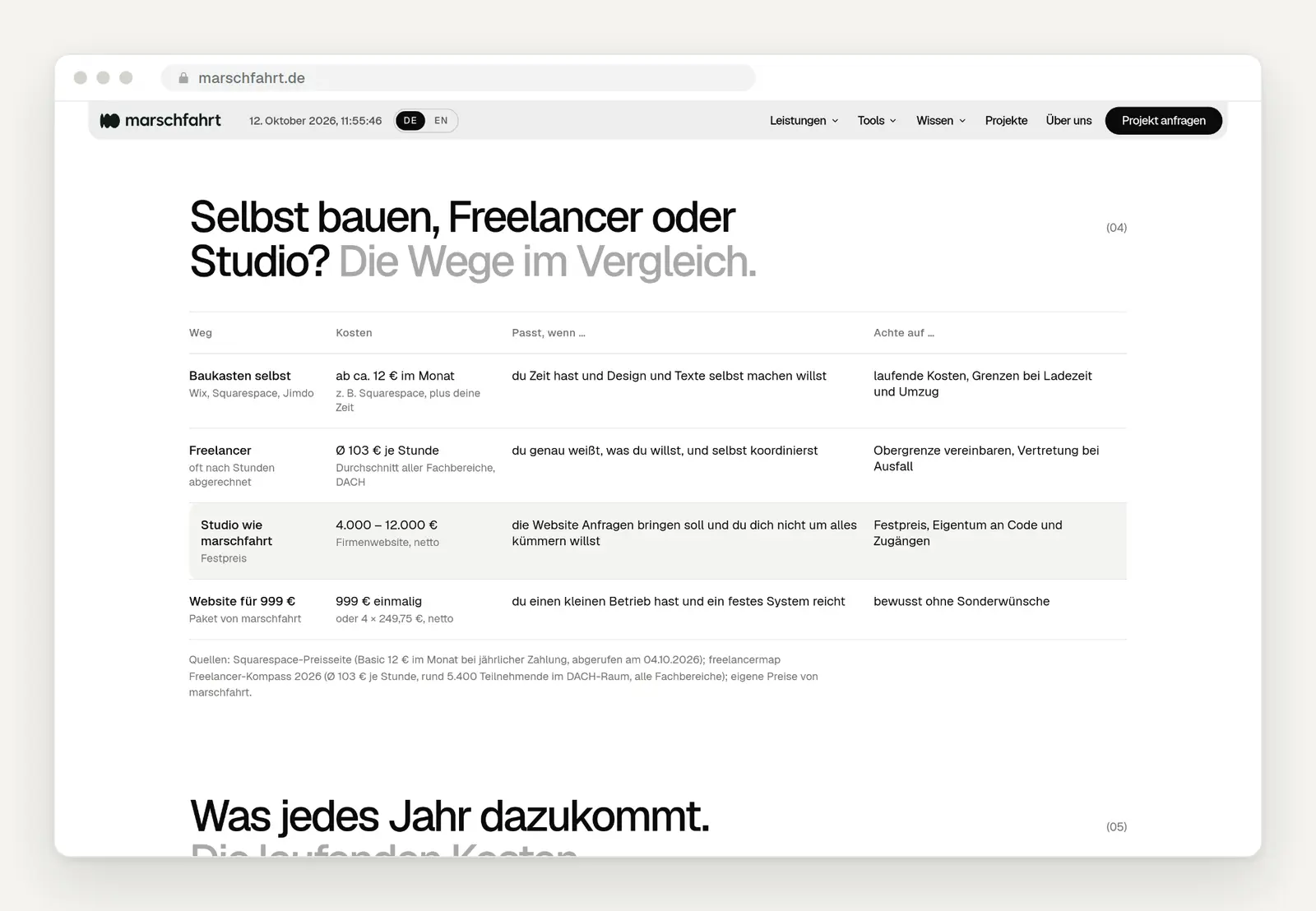
A comparison of the three options, from our page on website costs. We've broken down the costs of the website builder option in detail in a separate post.
A website builder is a good option if you have the time and can write your own content and take your own photos. To find out how much it costs and why it rarely generates leads for businesses, see “Website Builder or AI Website?”.
A freelancer is a good fit if you know exactly what you want and handle the coordination yourself. According to the 2026 Freelancer Compass from the platform freelancermap, self-employed professionals in software and web development charge an average of €91 per hour, while those in design, media, and creative services charge €89. The survey comes from an IT-focused platform and does not represent the market rate for web design, but it does provide a rough estimate. If you’re paying by the hour, make sure to agree on a cap and ask who will step in if the freelancer gets sick.
An agency is the right choice if you want your website to generate leads and you don’t want to handle everything yourself. In that case, you’re not just paying for design and technical work, but also for the concept, project management, and expertise in what works for your customers. Reputable agencies quote a fixed price for a clearly defined scope of work.
The Process in Seven Steps
A website project is a team effort, and you have more responsibilities in it than many people realize. The chart shows who is responsible for what in each step.
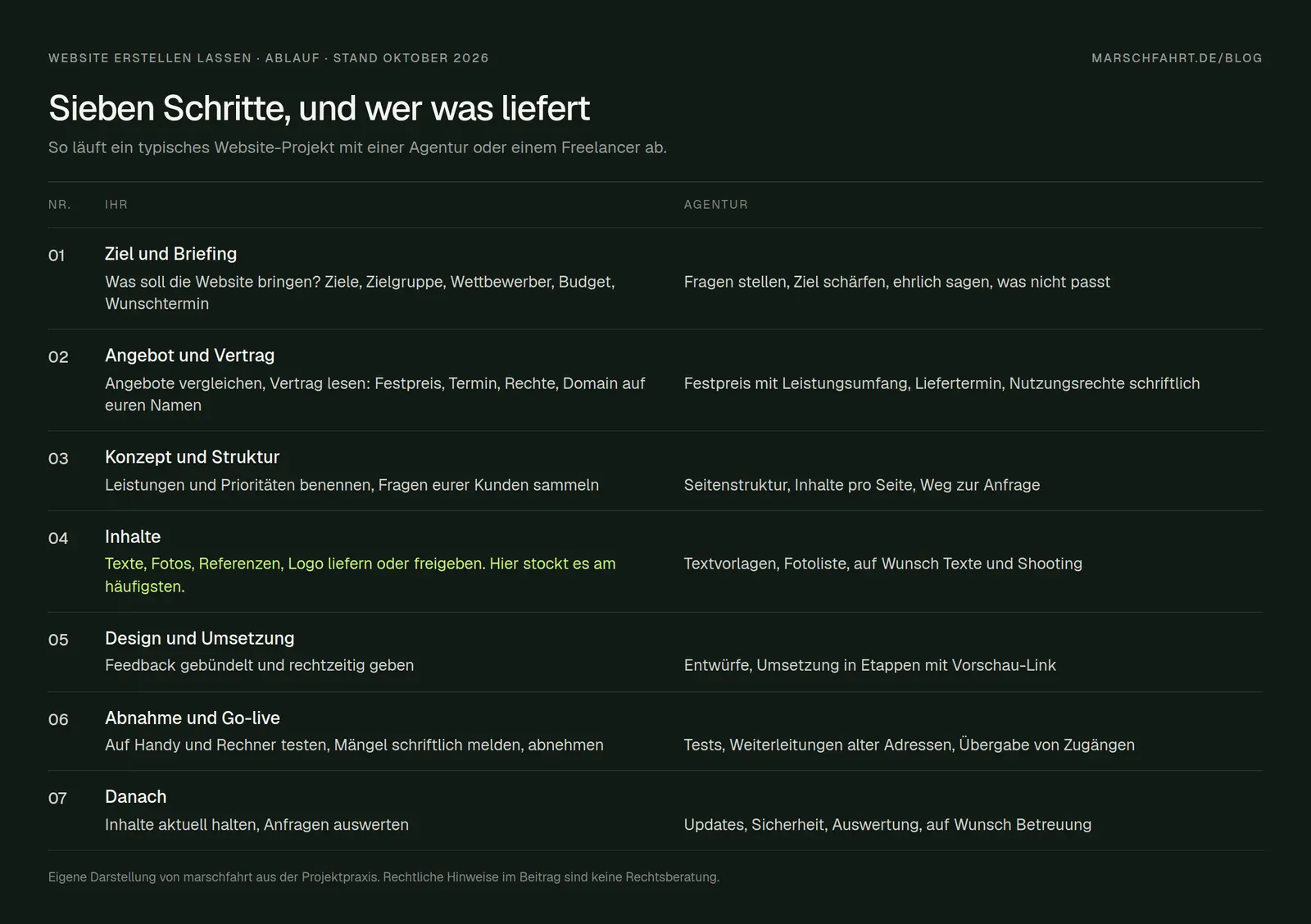
Typical workflow for a website project with an agency or freelancer. The step where projects most often stall is highlighted.
Most of the time, it’s not the development that takes time, but waiting for content. We haven’t found any reliable studies on this, but in our own projects over the past few years, this has been the most common reason why deadlines slip: the text describing the services hasn’t been approved yet, the photos of the team are missing, and the logo is only available as a pixelated file. If you gather these items before you start or include them in the initial scope of work, you’ll go live much faster.
Giving feedback all at once saves weeks. If three people at the company send in change requests one after another—some of which contradict each other—a draft ends up going in circles. Designate one person to collect the feedback and make the final decision.
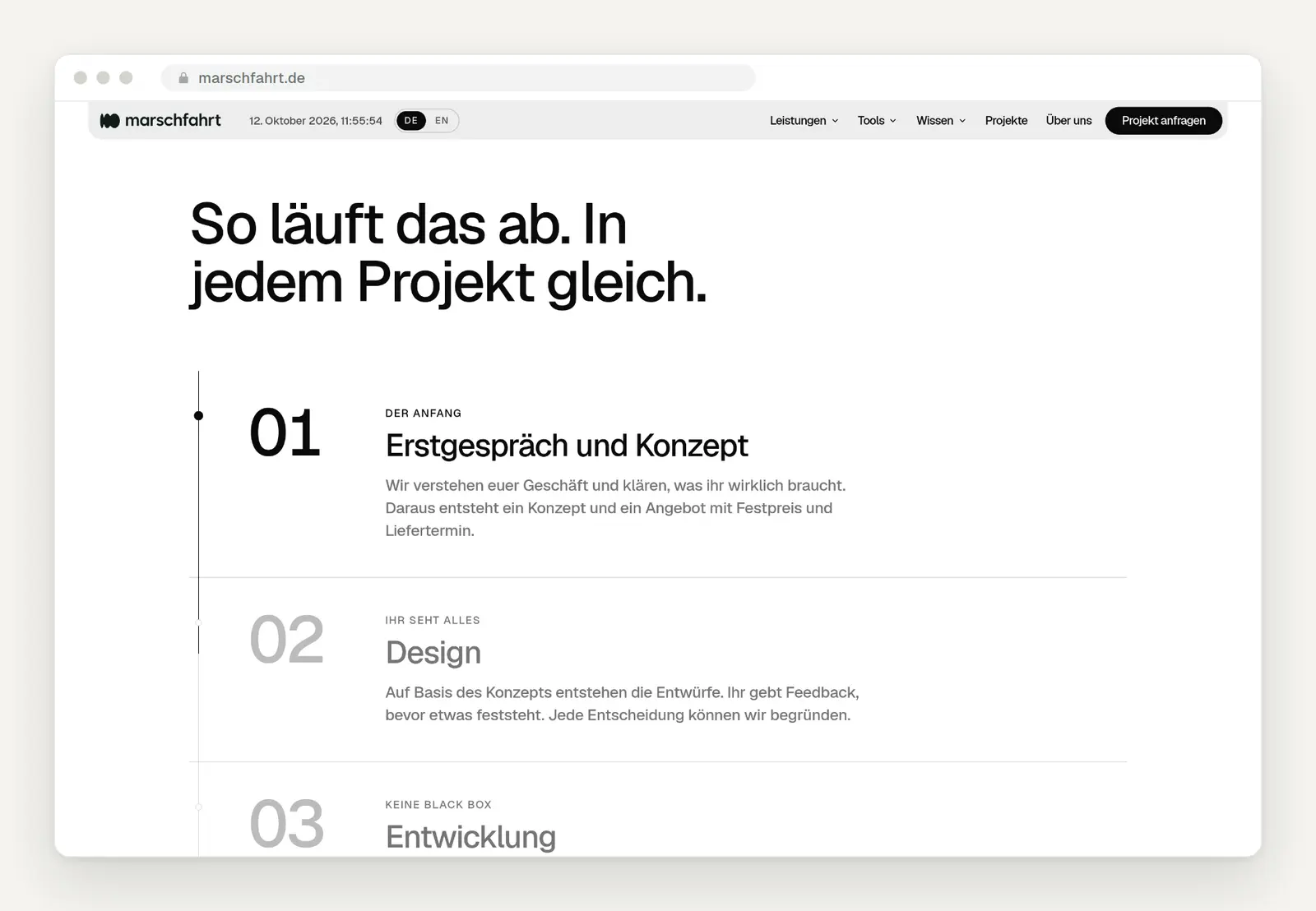
This is how we describe our own process on our web design page. When working with any agency, make sure the process is established in advance and that you’re kept in the loop along the way.
What You Should Clarify Before Your First Interview
The clearer your briefing, the easier it will be to compare proposals. You don’t need to write a detailed specification. One page covering the following points is enough to ensure that every agency is on the same page. Copy the template and fill it out:
Tell us your budget, even if it feels uncomfortable. Without a budget, every agency will give you a different estimate, and you’ll end up comparing apples to oranges. With a budget, a good agency can tell you what makes sense and what doesn’t. Our cost calculator provides an initial estimate.
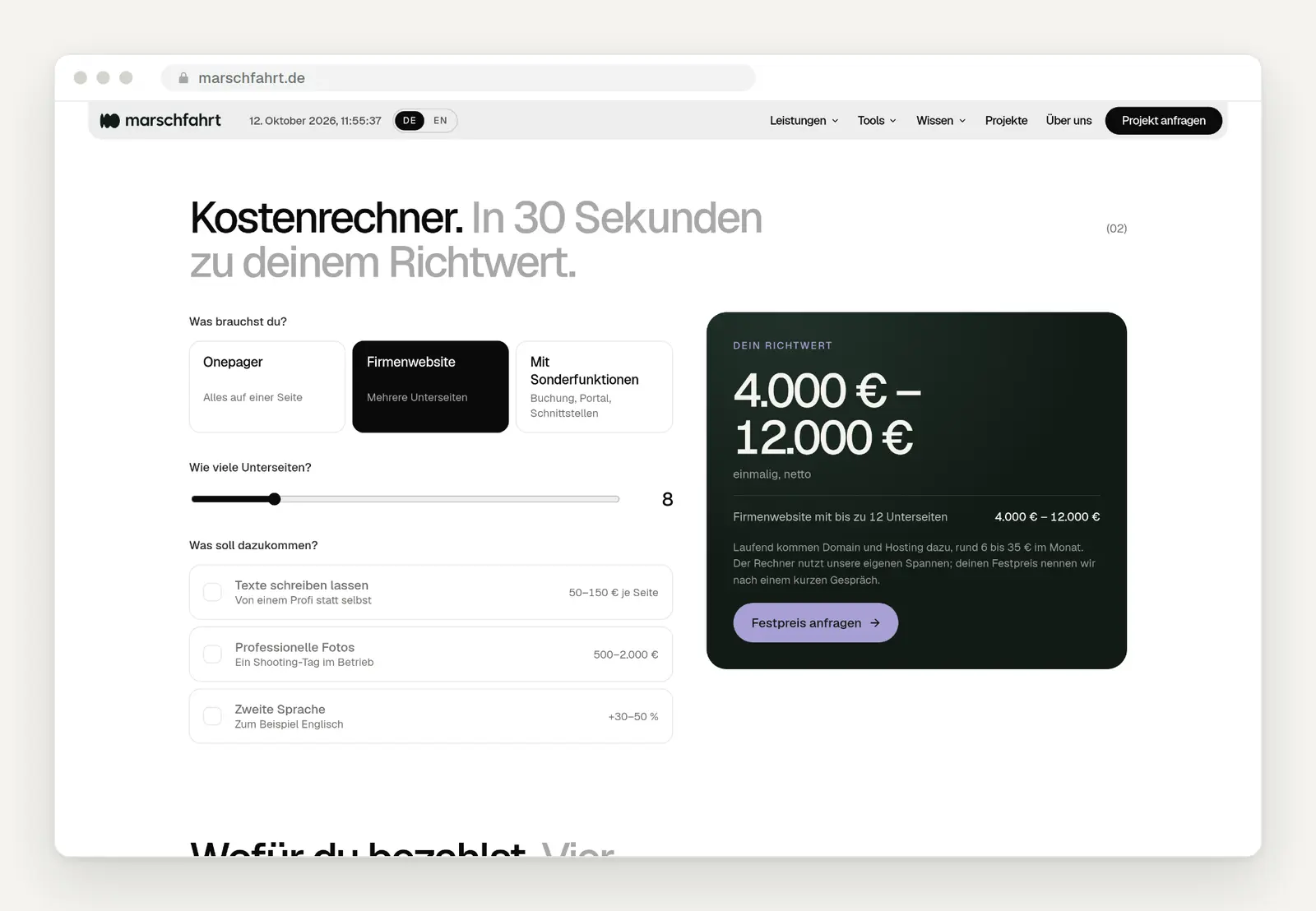
The cost calculator at marschfahrt.de provides an estimate based on our own price ranges in 30 seconds; all figures are net.
Comparing Offers: What Must Be Included
Compare the scope of services, not the total price. A quote for €1,500 that includes a purchased template but no text and no setup of the contact form is not cheaper than one for €4,000 that includes all of those items. For each quote, check whether these points are specifically described:
Be on the lookout for recurring costs that are hidden within a flat-rate fee. Some providers sell websites at a low package price with a 24- or 36-month term, which includes design, hosting, and “maintenance.” In 2011, the Federal Court of Justice ruled that even such a contract for the provision and design of a website with a minimum term of 36 months can be terminated at any time, but the services rendered up to that point must be paid for (Case No. VII ZR 133/10). It is simpler to agree on separate terms for development and support from the outset.
The Contract: Acceptance, Payment, and Termination
According to the Federal Court of Justice (BGH), a contract for a custom website is generally a contract for work and services. The Federal Court of Justice states that such a web design contract “may … generally be regarded as a contract for work and services within the meaning of §§ 631 et seq. of the German Civil Code (BGB)” (Case No. III ZR 79/09). This means that the agency is obligated to deliver a specific result, not merely to provide labor. Different rules may apply to ongoing support, depending on the terms of the agreement.
Acceptance is the most important milestone in the entire project. By accepting the website, you declare that it is essentially in compliance with the contract, and only then is payment due under Section 641 of the German Civil Code (BGB). You cannot refuse acceptance due to minor defects. Section 640(2) is particularly important for businesses: If the agency sets a reasonable deadline for acceptance after completion and you do not respond or do not cite a single defect, the website is deemed accepted. The warning notice required by law in this context applies only to consumers. A trade business placing an order for its own operations is considered an entrepreneur and is not necessarily required to receive this notice.
Test everything thoroughly before acceptance and report any defects in writing. Open every page on your phone and computer, submit the contact form and check whether the message is received, click every link, and read the legal notice and privacy policy. According to Section 640(3) of the German Civil Code (BGB), you can later assert claims for defects that you are aware of but do not reserve the right to contest at the time of acceptance only to a limited extent.
Installment payments are made for services rendered; advance payment is a matter of negotiation. Under Section 632a of the German Civil Code (BGB), the agency may demand installment payments equal to the value of services already rendered. An advance payment prior to each service, however, is a contractual agreement. It is customary and fair to have a payment schedule based on milestones, such as after the concept phase, after design approval, and after final acceptance.
You can withdraw at any time, but you must pay for the work already performed. Under Section 648 of the German Civil Code (BGB), the client may terminate a contract for work and services at any time until completion. The agency then retains its claim to compensation but must allow for any expenses saved. The law presumes that you are entitled to 5% of the compensation for the portion of the work not yet performed. For example: For a contract worth €6,000, of which services valued at €2,000 have been rendered, this presumption would result in €2,000 plus 5% of €4,000, or €2,200. Both parties may provide evidence to the contrary on a case-by-case basis.
Explicitly address defects and deadlines. In the event of defects, under Section 634 of the German Civil Code (BGB), you are initially entitled to rectification; thereafter, you may consider a reduction in price, rescission, or damages. The statute of limitations for these claims regarding a website is less clear-cut than many agency websites claim, because a website is not considered a “thing” under the law. Therefore, specify in the contract how long the agency is liable for defects.
Who Owns the Website in the End?
Just because you’ve paid doesn’t automatically mean you own everything. Designs, text, and photos may be protected by copyright; program code is protected under Section 69a of the German Copyright Act (UrhG). If the contract does not explicitly state which rights you receive, Section 31(5) of the UrhG applies: In that case, the “purpose of the contract as understood by both parties” determines what use is permitted. In case of doubt, you may operate the website, but whether you may modify it, transfer it to another agency, or use the design for flyers remains open.
Make sure you receive your rights and the handover in writing. Good contracts stipulate that you may use and edit the website—and have it edited by third parties—without any time or geographical restrictions, and that you will receive all access credentials, design files, and the code upon completion of the project. The obligation to hand over source files does not automatically follow from the law; it must be agreed upon.
When using photos from image databases, find out who holds the license. If the agency purchases a stock photo through its own account, it is the licensee. According to Section 34 of the German Copyright Act (UrhG), a right of use may only be transferred with the author’s consent; whether this is permitted is governed by the photo agency’s license terms. If the business relationship ends, the rights to continued use may remain unclear, and you, as the website operator, could face claims for copyright infringement.
The domain should be registered in your name
Whoever is registered with DENIC as the owner is the owner of the domain, regardless of what was agreed upon. DENIC, the registry for .de domains, refers to the domain owner as “the person with a material interest in the domain.” In its own FAQ, DENIC specifically addresses the scenario where a domain was registered in the name of an “advertising agency” rather than the business itself, stating: “DENIC, however, cannot do anything for you in this situation, since the registered party has, in fact, become the domain owner.” To obtain the domain, you will then need the agency’s cooperation.
Check the entry yourself—it takes two minutes. Go to webwhois.denic.de and enter your domain. For businesses such as a GmbH, DENIC displays the owner’s name and address directly. For sole proprietors, the data remains hidden for data protection reasons. Then click on “Information about the domain owner” and enter your ZIP code or email address; DENIC will send you a link to your data at the address on file. If you don’t receive this link, that’s a red flag: it likely means someone else’s email address is on file. By the way, DENIC has not been recording the administrative contact (“Admin-C”)—which used to be standard—since May 2018; it’s now solely based on the owner. Our guide to domain transfers explains how to switch to another provider.
When the agency provides hosting services: Data Processing on Behalf of a Client
If the agency handles hosting, forms, or maintenance, you need a contract in accordance with Article 28 of the GDPR. You remain responsible for the data of your website visitors, even if the agency processes it technically. The Data Protection Conference of the German supervisory authorities explicitly lists “managing contact forms or user inquiries” as a typical example of data processing on behalf of a controller, as well as remote maintenance if this involves access to personal data. Reputable agencies will provide this contract on their own initiative. Ask for it if it’s missing.
Legal notices, privacy policies, and consent remain your responsibility. Legal notices are now governed by Section 5 of the Digital Services Act (formerly the Telemedia Act); privacy policies are governed by Article 13 of the GDPR; and, according to Section 25 of the TDDDG, you need consent for cookies and tracking unless they are strictly necessary. A good agency will point out everything to you and set up the technology accordingly; you are responsible for the content. Whether the Accessibility Enhancement Act also applies to your website depends on whether you enter into contracts with consumers via the website and the size of your business. Read more about this in “Accessible Websites: What Companies Must Implement by 2026.”
How to Tell if an Agency Is Good
No one can guarantee you the No. 1 spot on Google. Google itself states this in its guide to choosing search engine service providers: “No one can guarantee you the top spot on Google.” According to Google, anyone who promises this anyway, claims to have a “special relationship with Google,” or offers to “submit a website as a priority” is not a good partner. Google also advises caution when dealing with agencies that send you unsolicited emails.
A mandatory link to the agency does not belong in your contract. Google states: “Don’t let yourself be obligated to include a link on your website that refers to SEO.” A small note in the footer, if desired, is fine, but it should not be a condition. And an agency should initially only be granted read-only access to your Google Search Console for analysis purposes.
A good agency asks more questions than it answers. Google recommends checking whether the provider is “interested in you and your business.” Anyone who, during the initial meeting, only talks about themselves and their tools—and isn’t interested in learning how your customers search—won’t build you a website that suits them. Ask every agency these questions:
Pay attention to the answers regarding separation. The last question may sound rude, but it’s the most revealing. An agency that casually says, “Then you’ll get everything, and we’ll help with the move,” has nothing to hide.
Funding in 2026: What's Still Available
The go-digital program has ended, even though some providers are still advertising it. The project management agency of the Federal Ministry for Economic Affairs states: “The go-digital funding program expired on December 31, 2024. Funding applications can no longer be submitted.” We have not found a nationwide successor program for website development.
In North Rhine-Westphalia, the “Mittelstand Innovativ & Digital” program is underway, but it operates on a lottery basis. NRW.BANK has been administering the program since 2026. It offers up to €15,000 for investments in digital products, security, and processes. For the “Digitalization” and “Digital Security” components, a lottery is held first; only after that can you submit your application. According to NRW.BANK, applications for the “Digital Processes” component will no longer be accepted in 2026. Important: Work on the project may not begin before approval is granted, so you may not hire the agency until after you receive the approval notice. The program page does not specify whether a standalone company website is eligible for funding. Please check with NRW.BANK beforehand.
BAFA provides funding for consulting services, not for construction. The funding program for management consulting services for small and medium-sized enterprises runs through December 31, 2026. It subsidizes consulting services—for example, regarding your digital strategy—but not the actual creation of the website itself.
What Has Changed and What That Means for You
In 2026, getting a website is easier than ever—but getting the right one isn’t. Website builders and AI can deliver a presentable site in minutes, and there’s a correspondingly wide range of low-cost packages available. At the same time, the regulations have become stricter: Since May 2024, legal notices have been governed by the Digital Services Act, cookies by the TDDDG, and since June 2025, the Accessibility Enhancement Act has applied to many online services offered to consumers. And the most popular federal grant program has expired. For you, this means: Focus less on the price of the initial version and more on who will support you with content, the contract, and in the years to come.
Date of this version: October 12, 2026. The legal notices do not constitute legal advice. We regularly review the legal landscape and funding programs.
Are you looking to have a website built?
We build websites for businesses looking to attract customers, with a fixed price, a delivery date, and a full handover: the code, design files, login credentials, and documentation are all yours. For small businesses, we offer a ready-made one-pager at a fixed price. Related: How much will a website cost in 2026? · Website builder or AI-powered website? · Service: Web Design · Website for 999 euros
Send us your completed briefing or just a few sentences about your project via our contact form. We’ll respond within 24 hours—personally and without a sales pitch.
More Articles
© Marschfahrt Studio
Practical knowledge on web design, SEO, AI, and conversion optimization. Based on real projects, without any marketing spin.

