Choosing an Agency for a Website Relaunch: Request Proposals, Compare Pitches and Quotes
How many agencies to approach, when a pitch is worth it, and how to fairly compare bids: using the guidelines from agency associations, the evaluation method for public IT procurement, twelve real-world requests for proposals, and an Excel template for comparing bids.
Date
Category
Author
How can a company find the right agency for a website relaunch without relying solely on a gut feeling after a pleasant meeting? Many guides list the qualities a good agency should have. What’s often missing, however, is the process: how many agencies to approach, whether a pitch is worth it, how to fairly compare proposals with different prices and services, and what to check before signing the contract.
For this guide, we reviewed the pitch recommendations from agency associations in Germany, Austria, and Switzerland, analyzed the evaluation methods for public IT procurement outlined in the 2018 UfAB, and evaluated the award criteria from twelve actual website tenders issued between 2024 and 2026. We’ve also included the relevant laws and court rulings regarding pitch fees, contract terms, and usage rights. At the end, you’ll receive an Excel template that compares proposals using this method—both a blank version and a completed example.
In a nutshell (as of October 2026)
Send out a request for proposals to three to five agencies, define the evaluation criteria before opening the proposals, and compare costs over three years rather than just the project price. You only need a pitch for large budgets; industry associations cite thresholds ranging from 100,000 euros to half a million Swiss francs. For smaller budgets, we recommend requesting proposals plus a paid workshop with two to three agencies. If you hold a pitch, you pay a fee and leave the rights to the unselected proposals with the agencies. The Excel template for comparing proposals calculates performance points, three-year costs, and the performance-to-price ratio for you.
Step 1: First the specifications, then the agencies
Bids can only be compared if all agencies respond to the same description. This is not just a feeling; it is a fundamental principle of public procurement. According to Section 121(1) of the German Act Against Restraints of Competition (GWB), the subject matter of the contract must be described “as clearly as possible” so that the description “is understood in the same way by all companies and the bids can be compared with one another.” The law does not apply to private companies, but the underlying principle does.
If you ask three agencies “How much does a new website cost?” without a requirements specification, you’ll get three quotes for three different projects. One includes text and redirects, one doesn’t, and the third charges for hosting by the hour. Our guide, “Requirements Specification for a Website: With Template and Example,” explains in detail how to create a requirements specification for a corporate website. To make your selection, you’ll need four key things from it:
Set goals with specific numbers so that the agencies know how you measure their success.
Page types and quantities, so that everyone calculates the same total.
Who provides the text, images, and translations? That can make a difference of thousands of euros in the quotes.
A budget range and the criteria you'll use to make your selection.
Our guide to the website relaunch process describes how the relaunch proceeds from there—from the initial assessment to the redirects. This post focuses solely on choosing an agency.
Step 2: Long list and short list—in other words, how many agencies you’ll reach out to
Start with seven to ten names and narrow it down to three to five agencies. That’s how the advice platform die-richtige-agentur.de—run by the General Association of Communications Agencies (GWA), in partnership with the Federal Association of the Digital Economy (BVDW) and the GPRA—describes the process. The purpose of the long list is to “identify the seven to ten candidates you’ll contact for further information.” The short list includes “the three to five agencies that are on your shortlist”; from among them, you’ll make your decision based on a meeting, a trial assignment, a workshop, or a pitch.
Public procurement law also specifies three as the minimum. In a negotiated procedure, public contracting authorities must “as a general rule, invite at least three companies” to submit a bid (Section 12(2) UVgO). Above the EU thresholds, a minimum of three also applies in the negotiated procedure, and a minimum of five in the restricted procedure (Section 51(2) VgV). The law does not specify an upper limit. However, industry associations clearly recommend having few participants in the final round, because each additional agency increases your workload in terms of reading, comparing, and rejecting bids.
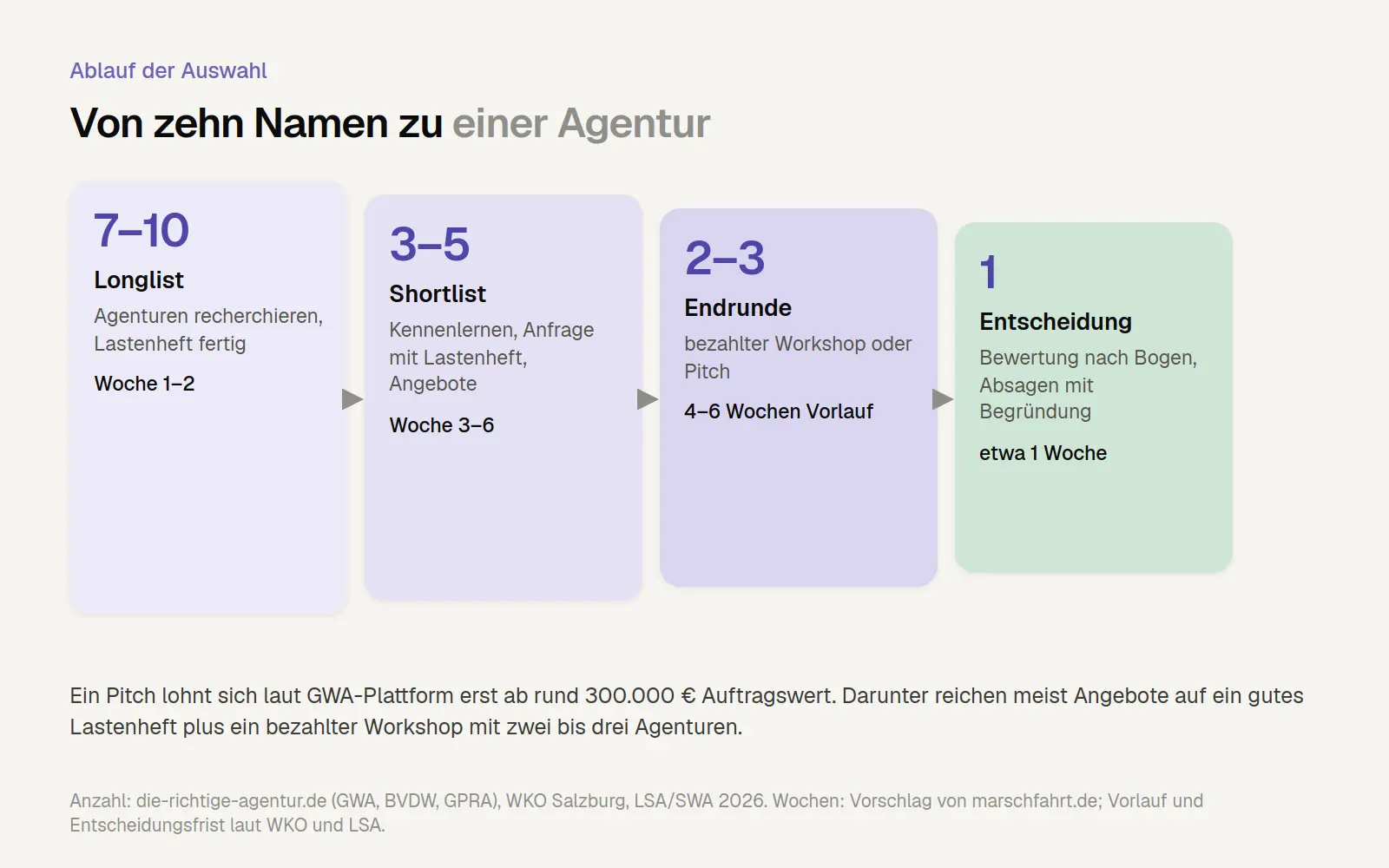
The typical four-step process. The number of agencies is based on the associations’ recommendations; the number of weeks is our suggestion for a medium-sized business project.
Where to Find Candidates
We haven't found any reputable studies on how companies find agencies. A 2022 survey by the Düsseldorf-based agency stay golden, conducted among 109 marketing decision-makers, concluded that, in addition to Google searches, personal networks are the most important factor. Awards, revenue, and the agency’s location, on the other hand, had only a minor influence. While this is an agency study with a small sample size, its findings align with what we’ve learned from our conversations.
When it comes to corporate websites, the following has proven effective for the longlist:
Websites from your industry or from companies of a similar size that you like. The legal notice or source code often lists who built them.
Recommendations from the network, but with the question of whether the project is similar to yours.
Agencies that are proficient in the system—you’ll want to keep them on if there are good reasons to do so.
In the case of public tenders, the award notices show who has won similar projects.
Step 3: Proposal, Workshop, or Pitch?
A pitch with design proposals is only worthwhile for large budgets; for most corporate websites, proposals based on a well-defined scope of work plus a paid workshop are sufficient. The associations set the threshold differently, but all set it high. The GWA platform states: “As a rule of thumb, pitches are only appropriate for budgets of 300,000 euros or more.” In its guide for clients, the Salzburg Chamber of Commerce recommends a competitive presentation for net budgets of 100,000 euros or more, and direct award for budgets below that. The Swiss association LSA considers a pitch to be worthwhile in its agency evaluation checklist only for annual budgets of half a million Swiss francs or higher, or for longer-term mandates. These thresholds are derived from guidelines for advertising and communications agencies; we have not found any specific thresholds for website projects.
The reason is the effort involved on both sides. According to a 2019 GWA survey, agencies spend an average of between nearly 18,000 and more than 71,000 euros per pitch. Marco Zingler, then vice president of the BVDW, calculated in a guest article that a website pitch for a project with 250 days of implementation “easily results in an effort of 40 to 80 project days.” On the client side, the GWA platform estimates, in an example from Cherrypicker, 74 person-days and costs of over 116,000 euros, including pitch fees. The figures come primarily from advertising and communications, but they illustrate the order of magnitude.
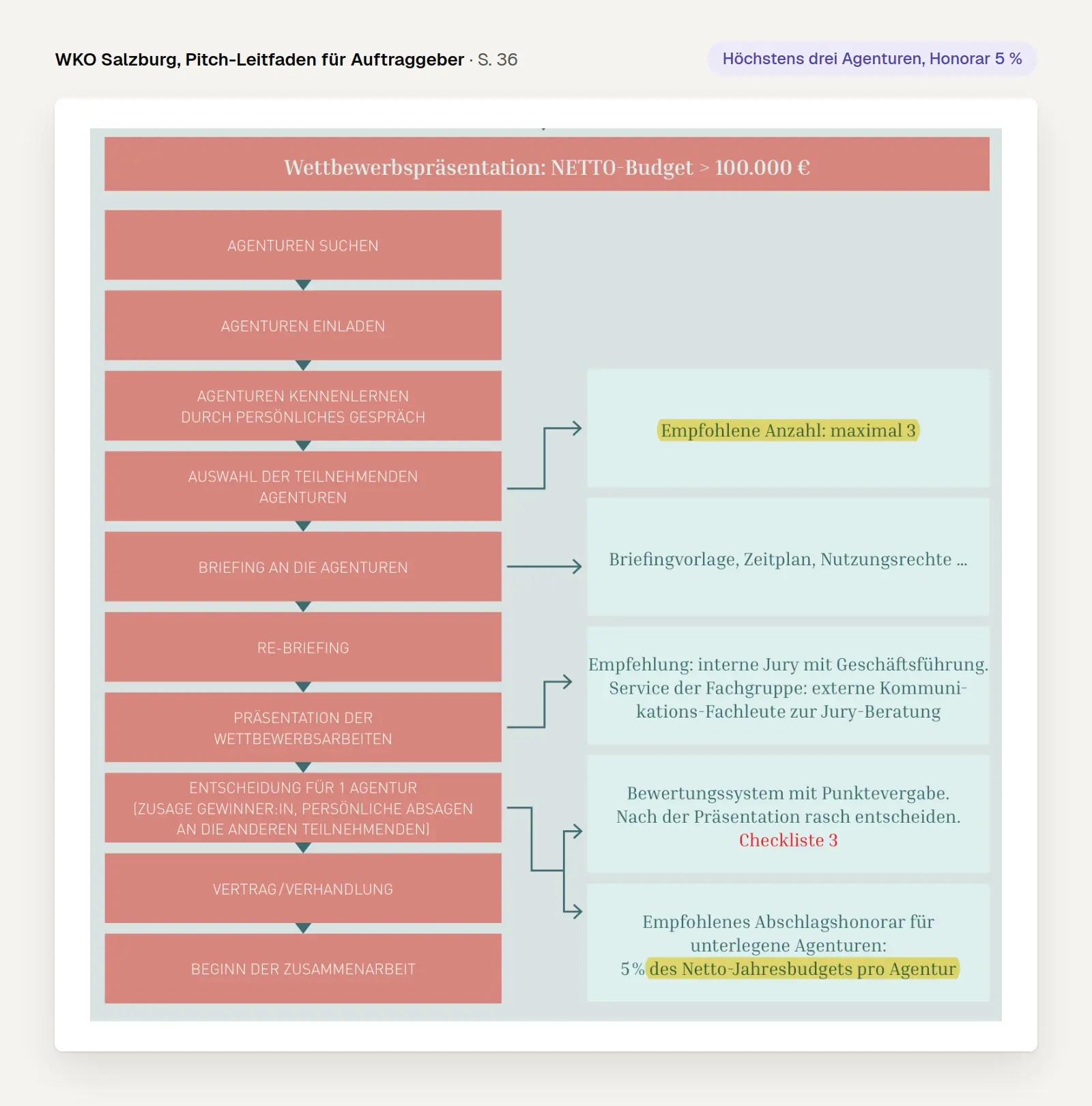
Salzburg Chamber of Commerce schedule for competitive presentations: a maximum of three agencies; evaluation based on a point system; a discount fee for the losing agencies.
Alternatives to the Pitch
Between “just proposals” and “major pitches,” there are formats that cost less and reveal more about the collaboration. The LSA checklist for agency evaluation describes six procedures, ranging from direct award to competitive presentations. Three of these are particularly useful for corporate website projects:
Request for Proposal: free of charge, based on the requirements specification. The LSA recommends sending it to no more than three agencies; the GWA platform suggests three to five for the shortlist. You’ll receive pricing, the proposed approach, the team, and references, but no drafts.
Introductory meeting: The associations call it a “chemistry meeting.” We recommend spending about an hour with the team that would actually be working on your project—not with the sales team.
Paid Workshop: Two to three agencies will spend half a day working with you on a real-world challenge, such as the homepage or product search. Zingler suggests this as an alternative to a website pitch. The GWA platform notes: “It is also common practice in workshops to pay the participating agencies a fee.”
In the workshop, you'll see how the agency asks questions, listens, and handles objections. That often says more about a project spanning several months than a polished layout created under competitive pressure without your input.
If this is to be a pitch: Fee and Rights
All three associations recommend a pitch fee and agree that the rights to unselected designs should remain with the agencies. Their opinions differ, however, on the amount:
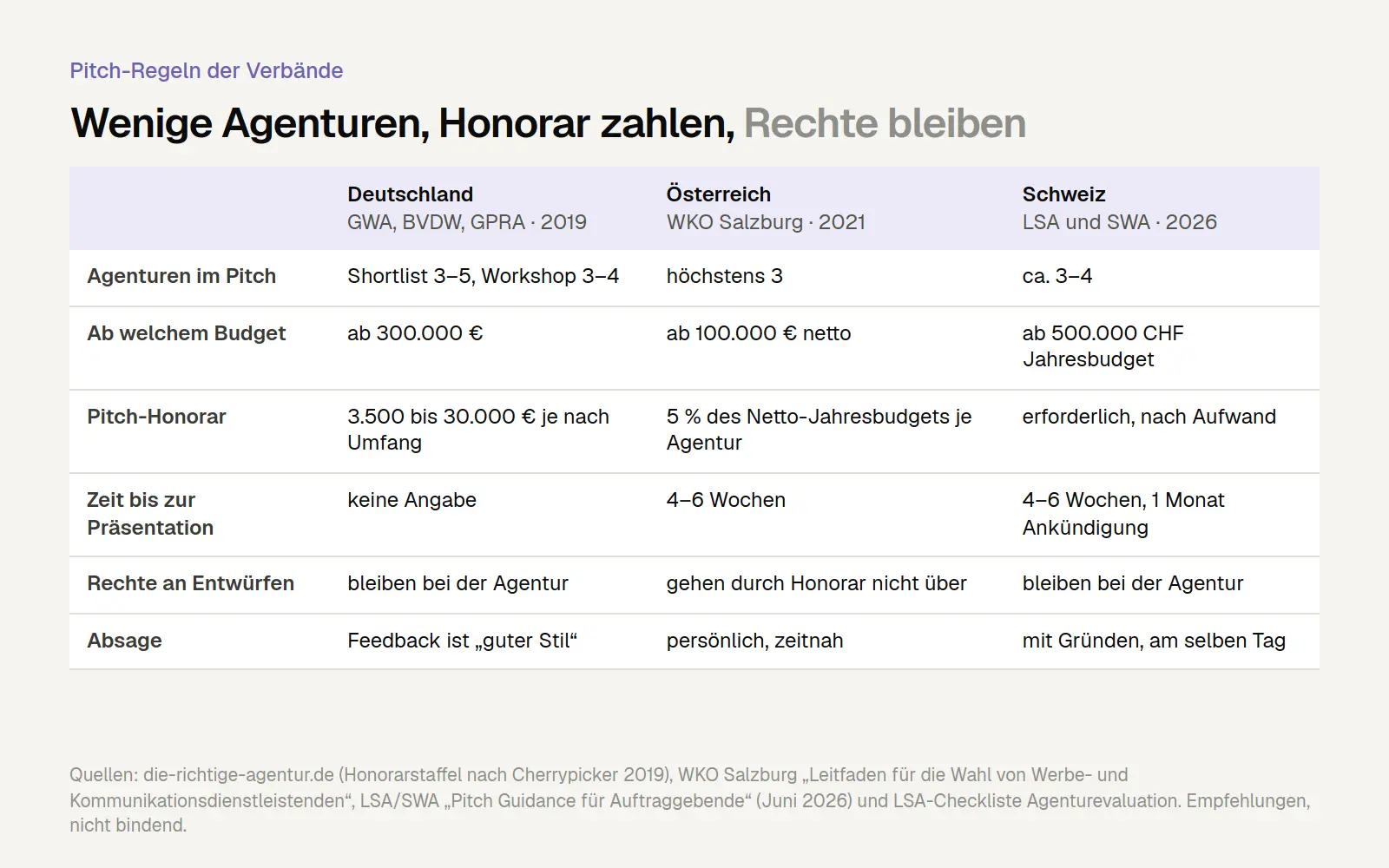
A comparison of pitch recommendations from Germany, Austria, and Switzerland. These are recommendations, not binding rules.
Germany (GWA Platform): Shortlist of 3 to 5 entries, pitch starting at 300,000 euros, fee ranging from 3,500 to 30,000 euros depending on scope; no deadline specified.
Austria (WKO Salzburg): a maximum of 3 agencies, pitch starting at 100,000 euros net, fee of 5% of the net annual budget per agency, 4 to 6 weeks.
Switzerland (LSA/SWA): approximately 3 to 4 agencies, pitch starting at an annual budget of 500,000 Swiss francs, fee required (LSA checklist: starting at 20,000 Swiss francs), 4 to 6 weeks.
According to the GWA platform, the German fee scale is based on “How to Pitch Better” by Cherrypicker (2019) and ranges from “at least 3,500 to 5,000 euros” for a basic concept with two to three layouts to “18,000 to 30,000 euros” for complex, international projects. The Salzburg Chamber of Commerce (WKO Salzburg) cites “5% of the net annual budget per participant” as a guideline. The Pitch Guidance from LSA and SWA explicitly states that a fee does not cover the agencies’ costs but demonstrates the client’s appreciation.
Legally, the following applies in Germany: Without a written agreement, an agency generally has no claim to a fee. In 2004, the Federal Court of Justice dismissed a lawsuit filed by an advertising agency that had demanded 130,000 DM following a presentation (BGH, judgment of June 8, 2004, X ZR 211/02). According to this ruling, a claim for compensation is ruled out if there are substantial doubts that the work was expected to be performed only in exchange for payment. The courts viewed the presentation as the basis for a hoped-for long-term collaboration. However, the Federal Court of Justice also made it clear that preliminary work is not generally unpaid; this depends on the individual case. For you, this means: If you want to pay a fee—and you should—agree to it in writing, specifying the amount and what you’ll receive in return.
When it comes to rights, caution is warranted in the opposite direction. Since the “Geburtstagszug” ruling (Federal Court of Justice, Nov. 13, 2013, I ZR 143/12), the Federal Court of Justice no longer imposes higher requirements on works of applied art than on fine art. Elaborate screen designs or illustrations from a pitch may therefore be protected by copyright, but the mere idea behind them is not. Anyone who later implements parts of a rejected design with another agency is on shaky ground. In this case, the LSA recommends discussing a concept fee with the agency. This is not legal advice.
What a Fair Pitch Covers
Based on these three guidelines, here is a short list of things to clarify before sending out the invitation:
Participating agencies: a maximum of three (WKO) to four (LSA/SWA), and everyone knows exactly how many there are.
Fee: the same for everyone, agreed upon in writing in advance.
Timeframe: four to six weeks between the briefing and the presentation, with at least one meeting to address questions.
Decision-makers: Who is on the jury, and is the management team included?
Evaluation: The criteria and weightings have been determined and will be communicated to the agencies.
Confidentiality: a two-way agreement. According to Section 2 of the Trade Secrets Act (GeschGehG), information is protected as a trade secret only if “appropriate confidentiality measures” are taken.
Rejections: in person, promptly, and with an explanation. The GWA platform calls it “extremely disappointing” to have to inform an agency about the results through the press.
Step 4: Determine the evaluation criteria before opening the bids
If you wait until after reading the bids to define the criteria, you’ll end up evaluating the bid that you liked best anyway. For this reason, public IT procurement has been using a fixed matrix for years. Its methods are outlined in the “Guidelines for the Tendering and Evaluation of IT Services” (UfAB 2018) published by the Procurement Office of the Federal Ministry of the Interior. Companies are not required to follow these guidelines, but they can use the method voluntarily, and it works surprisingly well for website projects.
Exclusion Criteria and Evaluation Criteria
The UfAB distinguishes between two types of criteria. An A-criterion is an exclusion criterion: Failure to meet it “necessarily leads to the exclusion of the bid.” A B criterion is evaluated on a point basis. For a corporate website, suitable A criteria include a few hard-and-fast requirements, such as a confirmed launch date, a migration plan included in the bid, or ensuring that the domain and accounts remain with the company. The UfAB itself warns that many A criteria narrow the pool of bidders and that each one requires an objective justification.
Weighting with 1,000 points
The B criteria are assigned weighting points, distributed from top to bottom: first to groups such as concept, implementation, team, and operations, then to individual criteria. The UfAB uses a total of 1,000 weighting points. Each proposal receives evaluation points for each criterion, on a scale of 0 to 5, for example. Evaluation points multiplied by weighting points yield performance points; their sum is denoted by L. The price is explicitly excluded from this matrix; it is added in the next step.
Describes for each criterion when full points are awarded. A general scale ranging from “unsatisfactory” to “very good” for all criteria sounds reasonable, but it invites subjective grading. The UfAB now expressly advises against this:
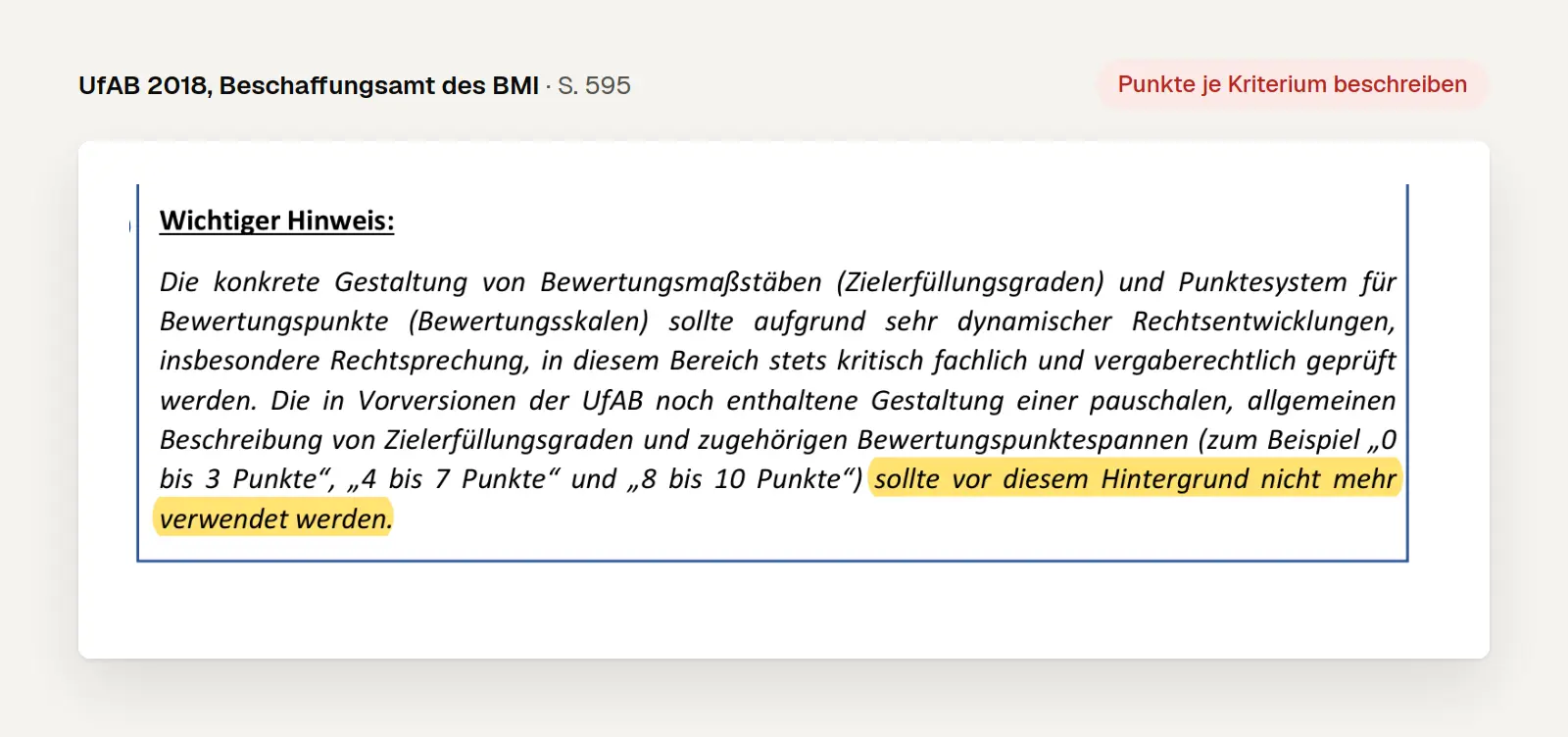
According to the 2018 UfAB, flat-rate point ranges for all criteria should no longer be used. While this is not a requirement for companies, it is a good reason for them to specify, for each criterion, what constitutes a perfect score.
For “SEO Migration and Redirect Plan,” for example, this means: Full points are awarded if the proposal includes a complete mapping of all old URLs to new ones, server-side 301 redirects, and a post-launch review. The Swiss fact sheet on award criteria for public procurement recommends a scale from 0 to 5, with enough—but not too many—grades.
What the Association Questionnaire Assesses
The example of GWA and OWM, the association of advertising clients, illustrates how differently an agency scorecard in the advertising industry assigns weight to various criteria. In their system, the agency’s overall impression accounts for up to 40 points, performance and creativity for up to 60, and terms and conditions for only up to 20 points.
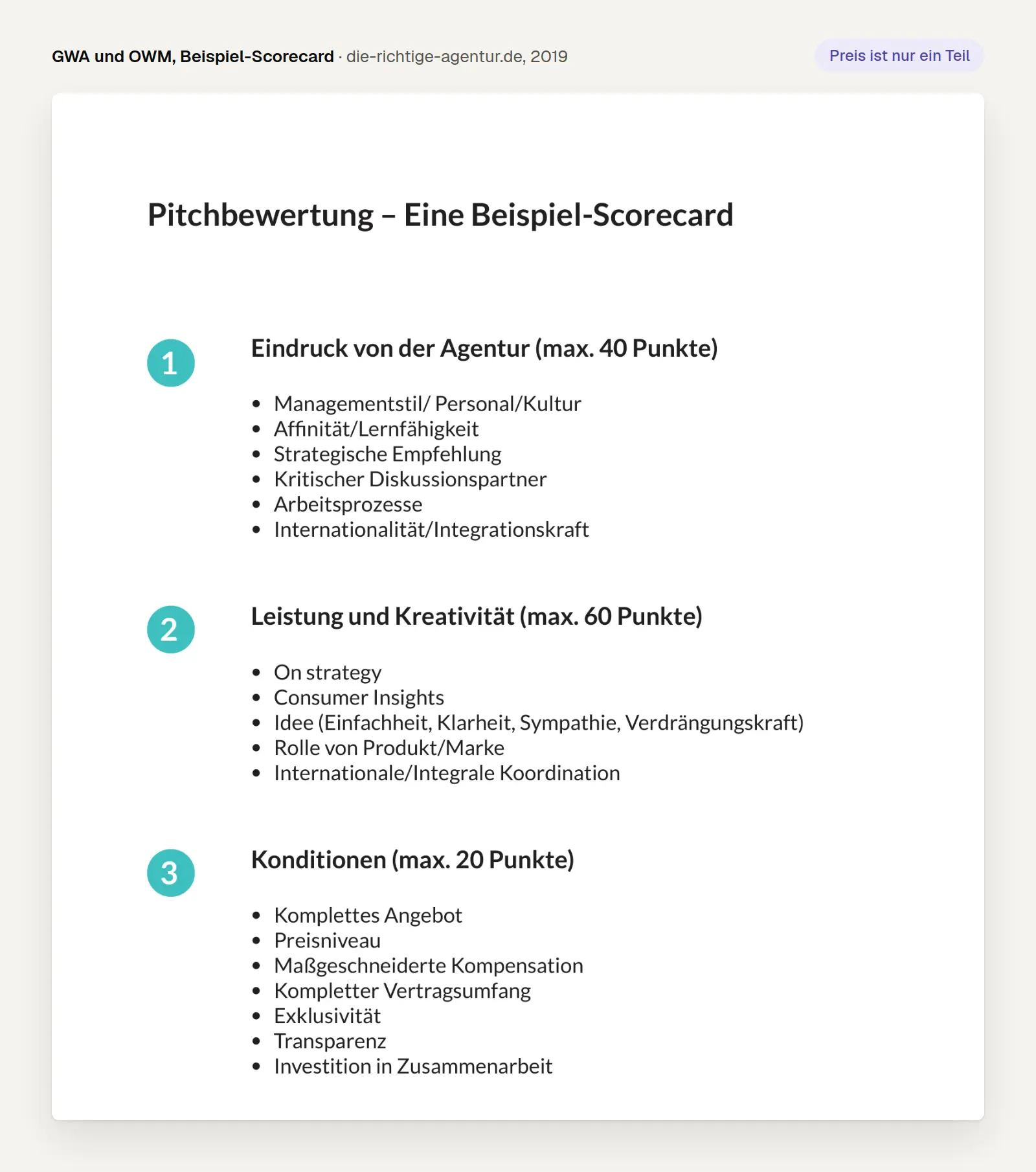
Sample scorecard from GWA and OWM: Price is just one subitem under “Terms and Conditions.” The form does not specify a scoring scale for each subitem.
How Public Contracting Authorities Evaluate Website Relaunches
In real website tenders, price typically accounts for 30 to 40 percent, with the concept, team, and technology making up the rest. We analyzed the award criteria from the EU notices published in the Official Journal (TED) for twelve website tenders—eleven of which were relaunches—ranging from the Leopoldina to the Hesse Economic and Infrastructure Bank to the Magdeburg University Hospital.
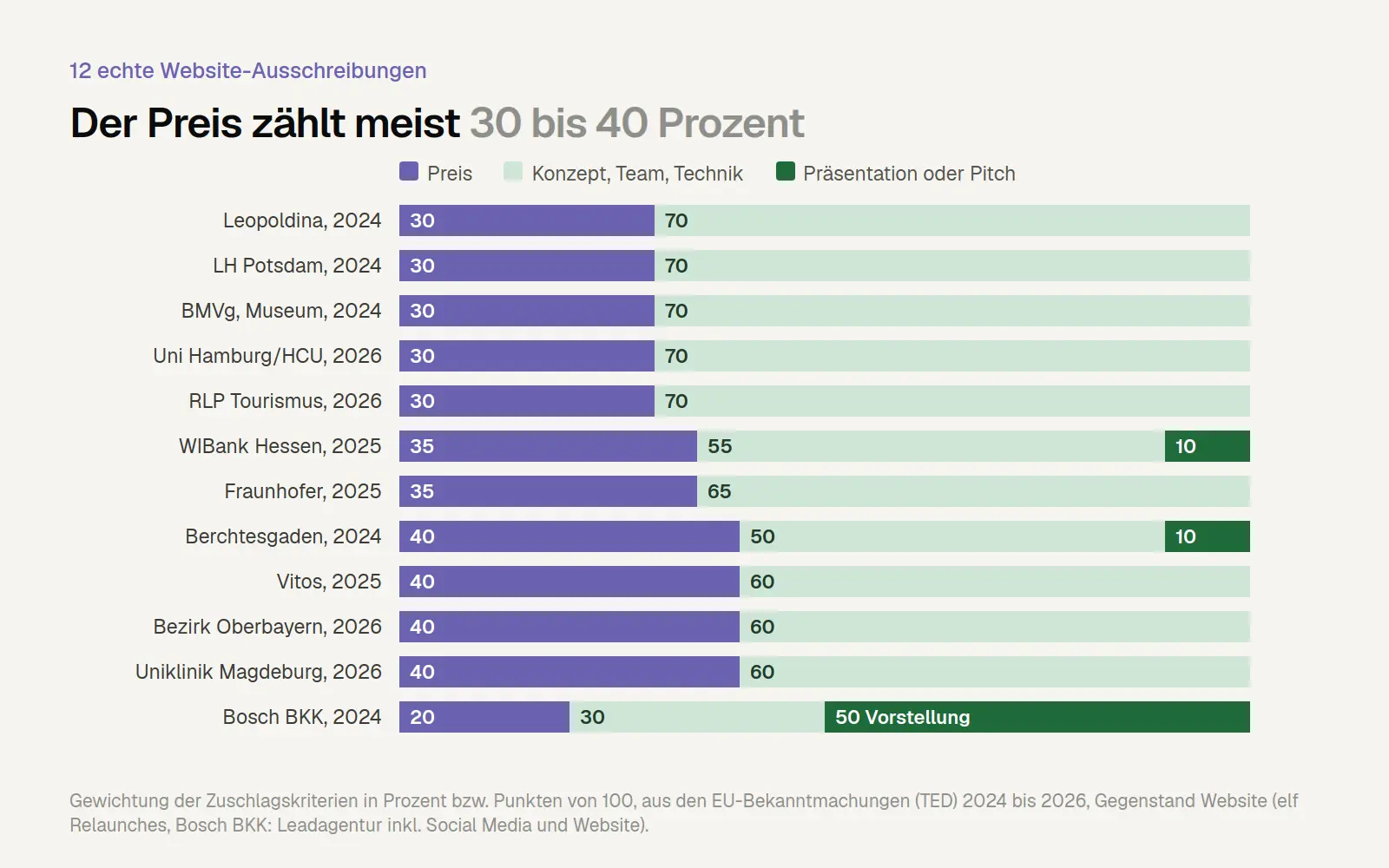
Weighting of price and quality in twelve website tenders from 2024 to 2026. In three cases, a presentation is explicitly factored into the evaluation; at Bosch BKK, the agency presentation is worth 50 points.
Of particular note are the cases in which a presentation is included in the evaluation. According to Notice 445801-2024, the Berchtesgaden Mountain Experience Special-Purpose Association included a pitch assignment with its invitation to the negotiation rounds. A project team evaluates the proposals “individually, anonymously, and independently of one another”; the evaluation forms are sealed and evaluated only after the final bids have been opened:
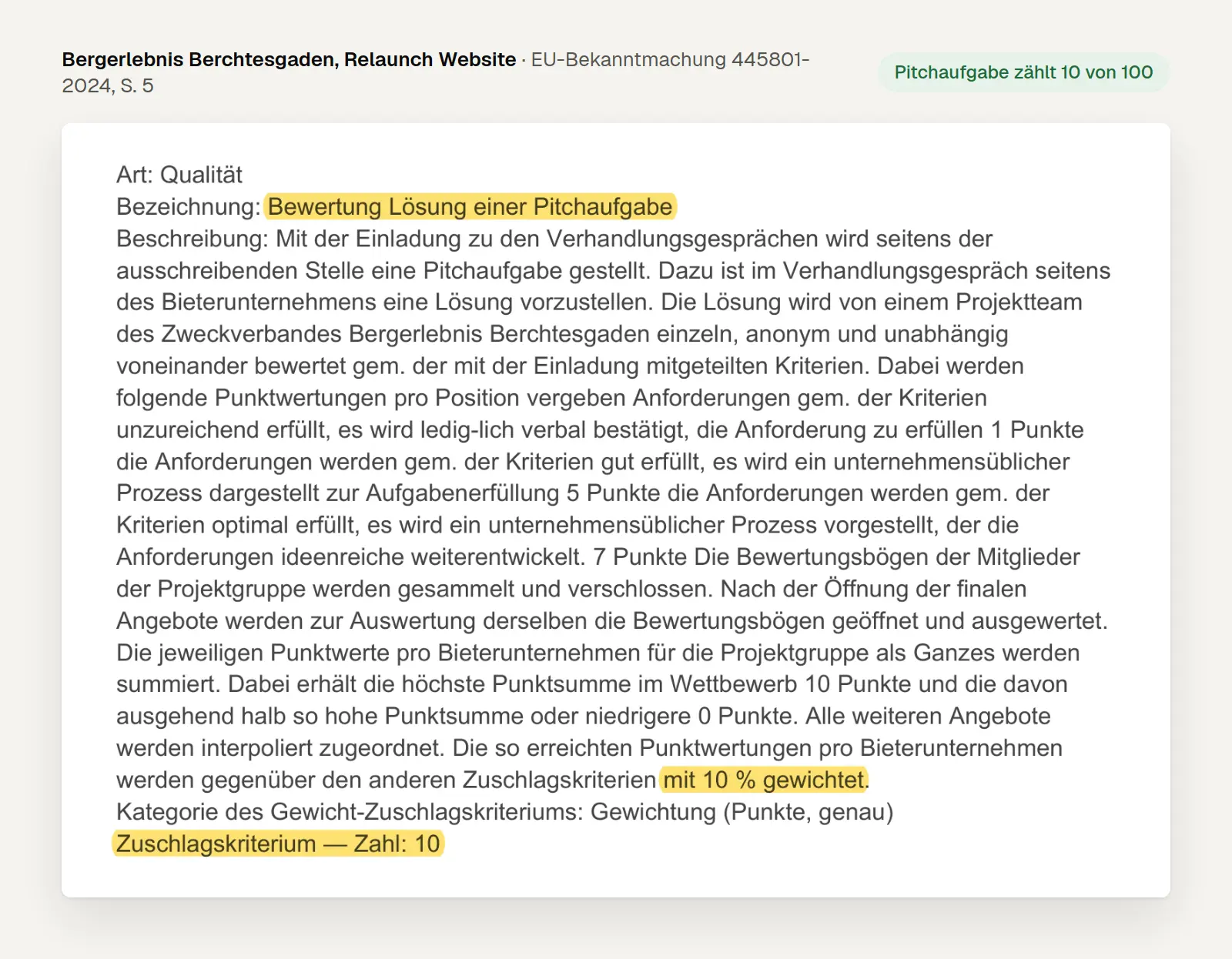
EU Notice 445801-2024, Berchtesgaden: The pitch assignment is worth 10 out of 100 points and is evaluated using individual evaluation forms completed by the project team.
Here's a good tip for companies: Let each person on the panel evaluate the entries on their own first, and only then discuss the results. Otherwise, the group will quickly adopt the opinion of the highest-ranking person in the room.
Step 5: Calculate Price and Performance Using the Benchmark Method
Divide the performance points by the price; the offer with the highest value offers the best value for money. The UfAB calls this the simple benchmark method. It is recommended when performance and price are to be given equal weight:
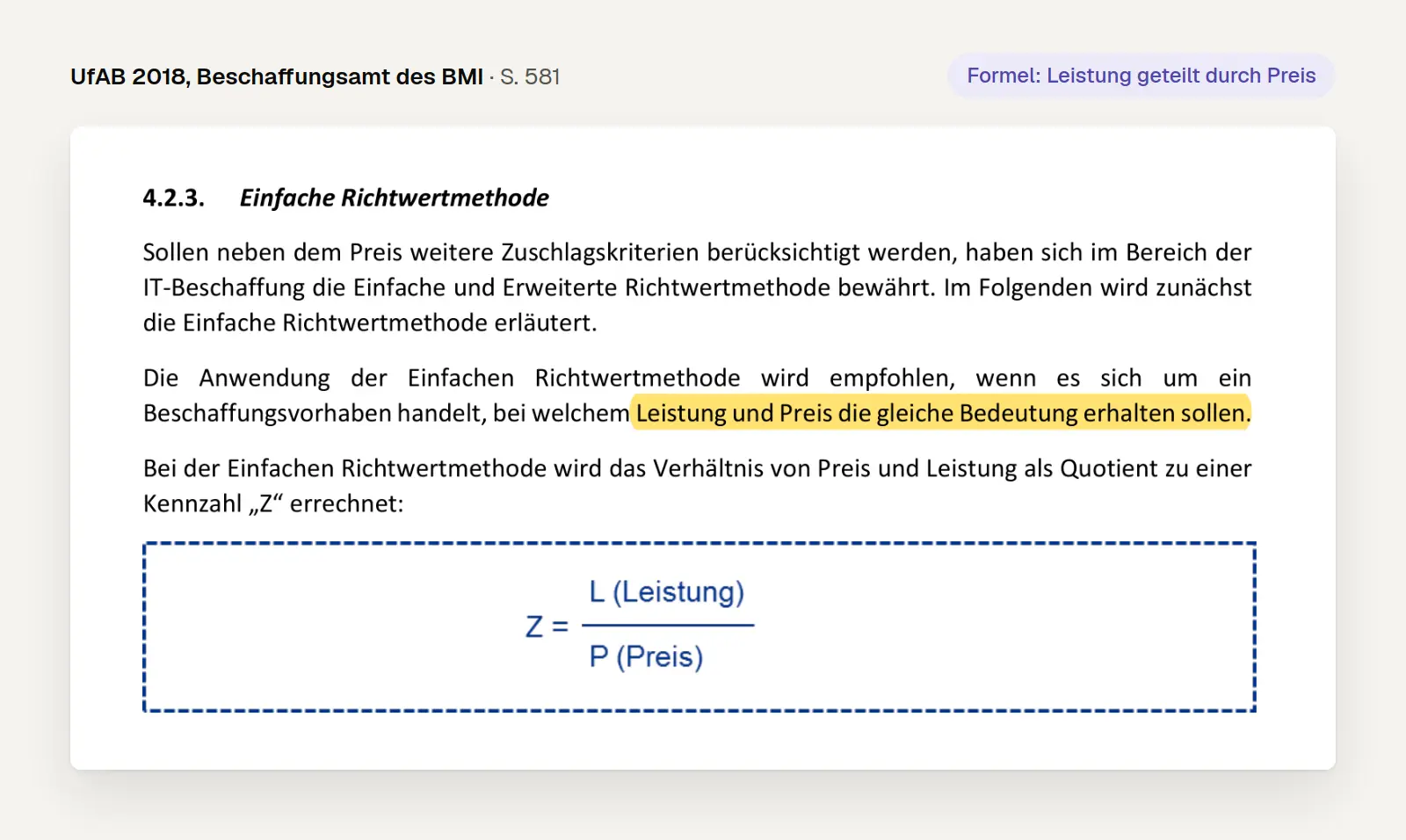
The formula for the simple benchmark method: Key figure Z equals performance points L divided by price P.
The UfAB's sample calculation shows why the lowest bid does not automatically win. Bidder 4 is the lowest at 98,000 euros. Bidder 3 costs 2,000 euros more but has 400 more performance points, thereby achieving the highest score:
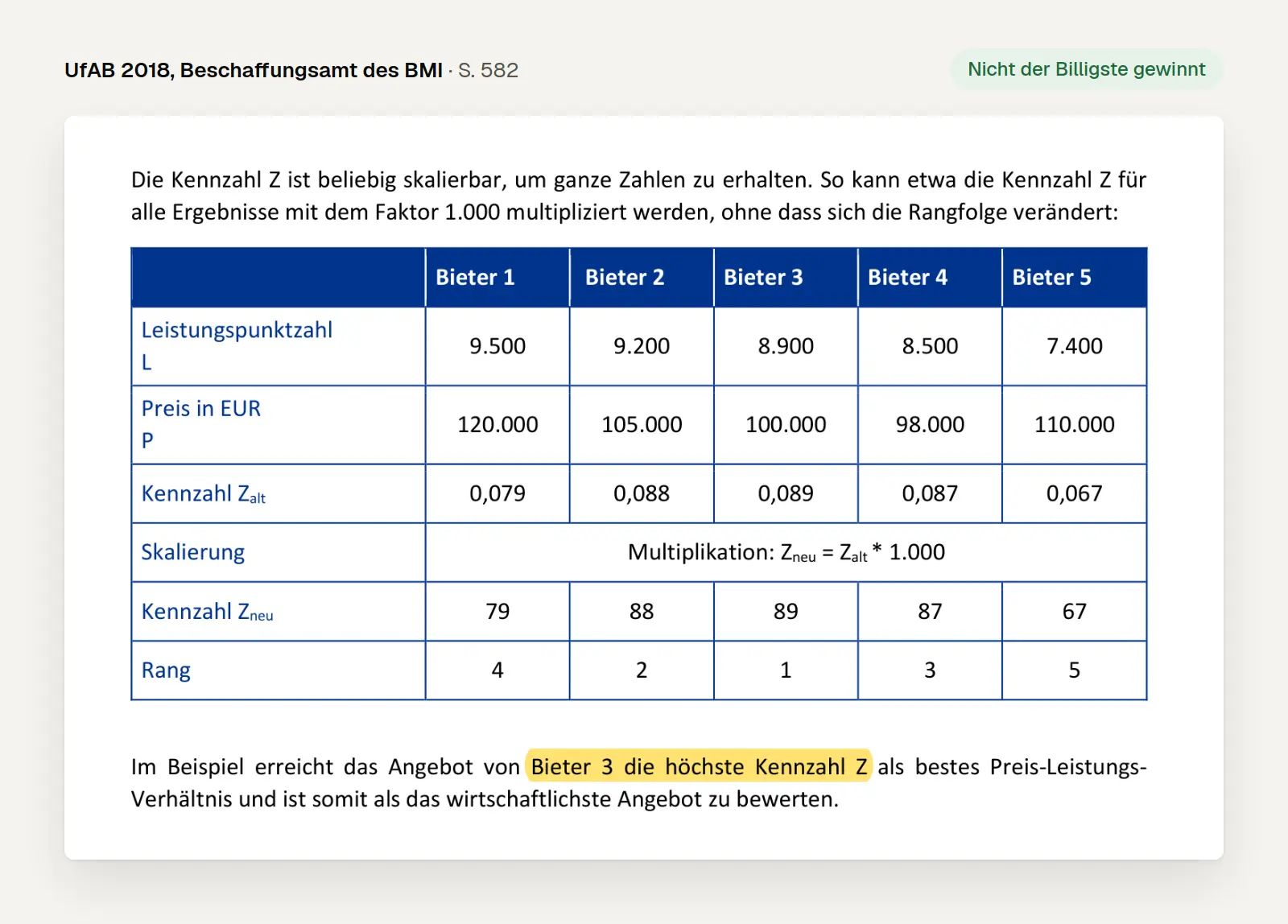
Sample calculation from the UfAB 2018: Bidder 3 has the best price-to-performance ratio at Z × 1,000 = 89, even though Bidder 4 is cheaper.
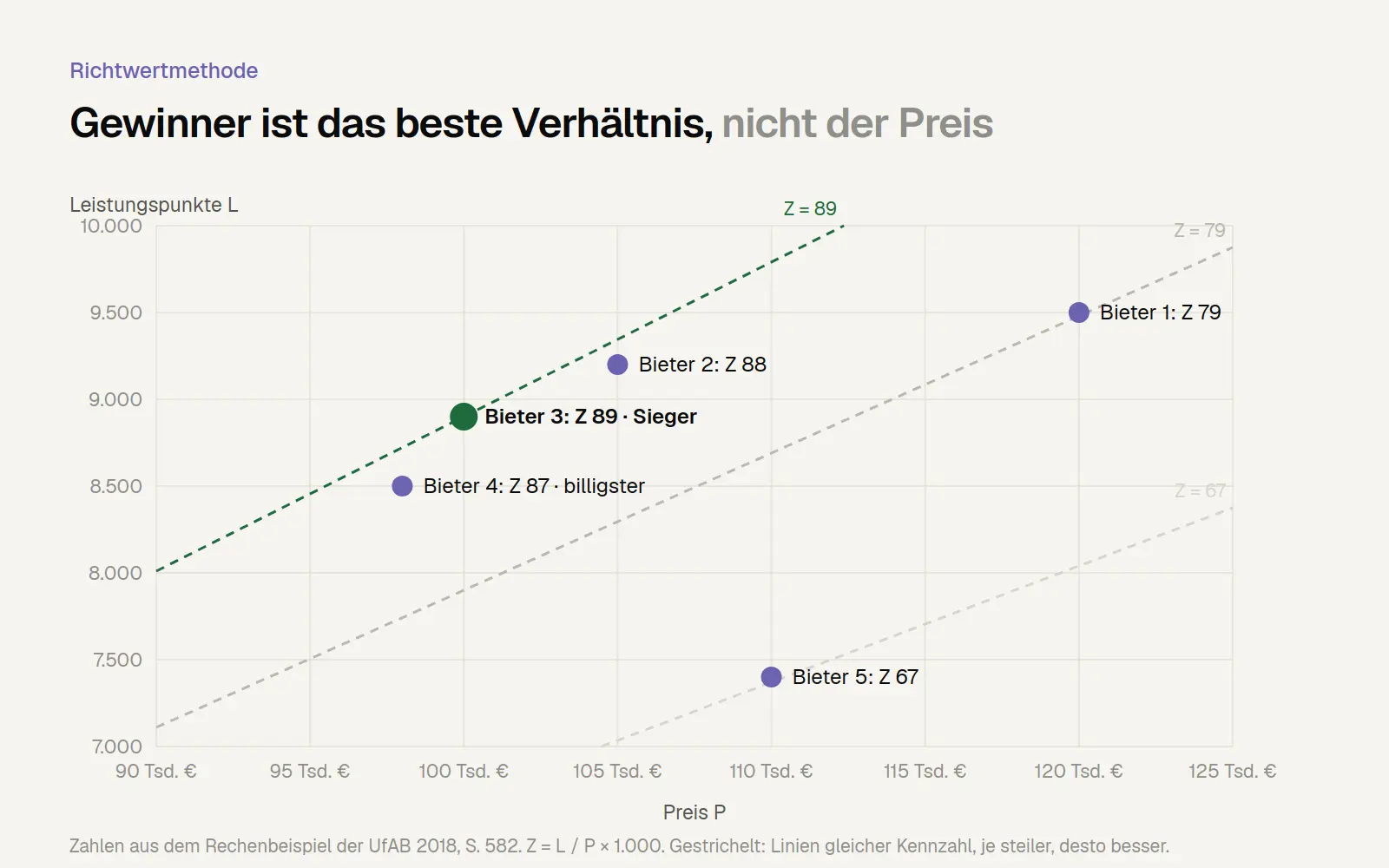
The same five offers, shown as a chart. All points on a dotted line have the same metric; the further up and to the left an offer is, the better.
Incidentally, it is a matter of debate among public procurement law experts whether the simple benchmark method truly weights performance and price in a 50-50 ratio. The Lüneburg Public Procurement Chamber assumed this to be the case in 2023, while the expert author W. Bartsch disputed this on the Vergabeblog. This is of secondary importance for your selection. What matters is that you determine the method in advance and apply it consistently to all bids.
When Bids Are Almost Tied: The Advanced Method
If several bids are very close to one another, a predetermined criterion is used to make the decision, and that criterion may also be the presentation. The expanded benchmark method establishes a range for this, approximately 6 percent below the best metric. All bids within that range form the leading group. Among them, the decision is based on a criterion you have previously determined: price, performance points, or, according to the UfAB, “the result of any evaluative test or presentation.”
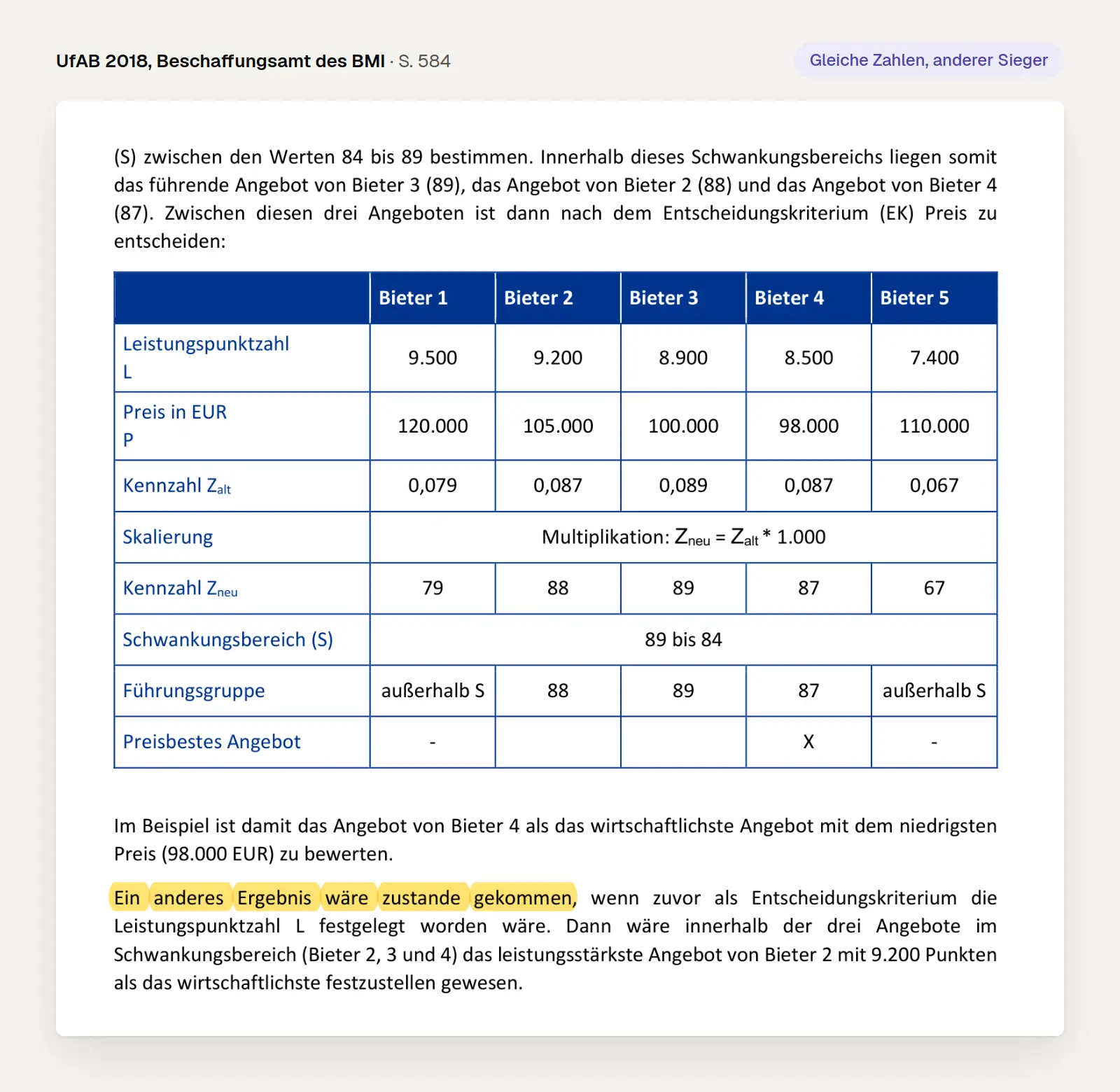
Same numbers, different result: When price is the deciding factor, Bidder 4 wins; if performance points were used, Bidder 2 would have won.
That is exactly how the Federal IT Cooperation FITKO 2025 (Notice 731578-2025) proceeded with its website relaunch. In the first stage, all bids were evaluated using the benchmark method, with a tolerance range of 15 percent. A maximum of three bidders advanced to the second stage and were invited to give a pitch presentation:
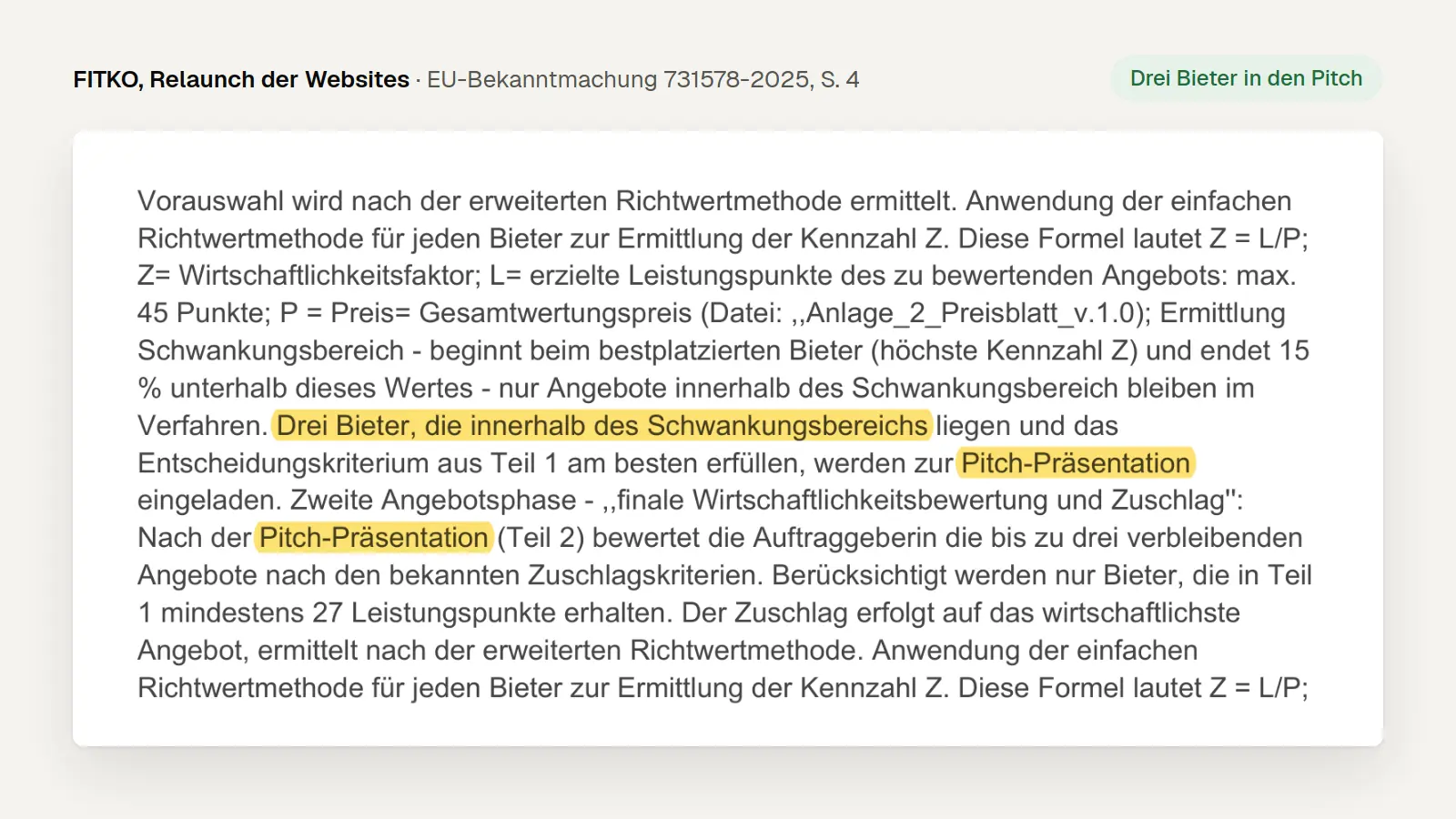
FITKO 2025: Do the math first, then present. At most three bidders from the target range will advance to the pitch.
This is a very good approach for companies. It saves you from having to go through presentations with agencies that are out of the running based on the numbers anyway, and the final round carries clear weight. The UfAB also recommends running through the matrix in advance using hypothetical proposals. That way, you can tell whether a criterion carries too much or too little weight before actual proposals are on the table.
Step 6: Make Offers Comparable
Before you start calculating, make sure all quotes are in the same format: identical items, separate one-time and recurring costs, and the same time period. Hardly any two agencies structure their quotes the same way. Therefore, specify in your request the items that each quote must include. A good public example is the 2026 request for proposals from the German Center for Aging Issues: It required costs to be “broken down by individual modules” and, in the sample contract, separated the work performed from ongoing support:
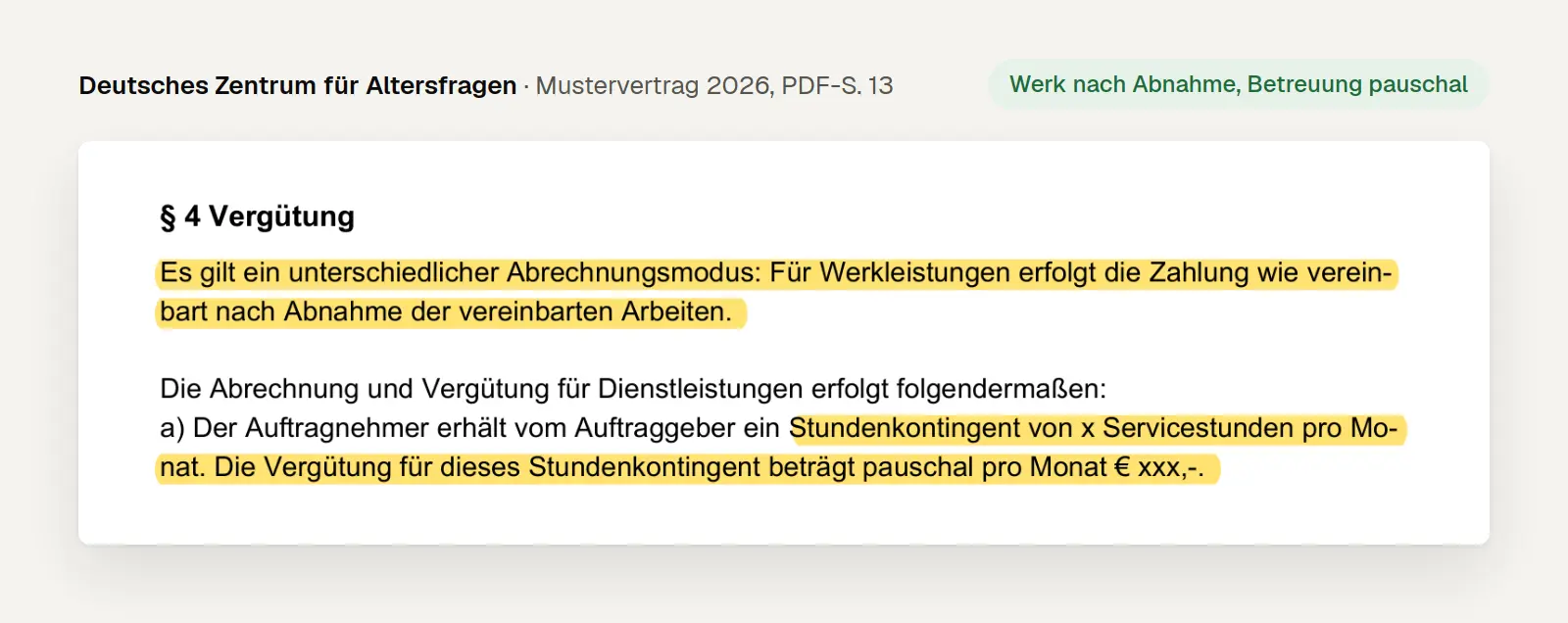
Sample contract from the German Center for Aging Issues: Payment for work performed is made upon acceptance; care services are billed as a monthly quota of hours at a flat rate.
For a business project, this means that every proposal should include at least the following lines:
Concept and design, including the number of drafts and rounds of revisions.
Implementation and content migration, preferably by page type.
SEO migration with a redirect plan.
Hosting, licenses, and maintenance per year, including response times.
Hourly rate for changes and services not included in the scope.
Term and notice period of current contracts.
Fixed Price, Time and Materials, or a Hybrid Model
A fixed price protects your budget only if the scope of work is clearly defined; otherwise, the dispute will center on what is included. With pure time-and-materials quotes, you bear the risk that more hours will be required. A time-and-materials estimate may legally constitute a cost estimate. If a significant cost overrun becomes apparent, the agency must notify you immediately (Section 649(2) of the German Civil Code [BGB]); if you terminate the contract for this reason, you are only required to pay for the work performed up to that point and any expenses incurred (Section 645(1) BGB). The law does not specify the percentage at which an overrun is considered “significant.”
There is no legally prescribed procedure for making changes to websites during the project. The contractor’s obligation to provide a supplementary quote in response to change requests is set forth in § 650b of the German Civil Code (BGB), but applies only to construction contracts. Even the federal government regulates changes in software development through its own template in the EVB-IT. Therefore, specify in the proposal how changes will be handled: who requests them, by when the agency estimates the effort required, who approves them in writing, and at what hourly rate they will be billed.
What an Hourly Rate Tells You
We were unable to find reliable, up-to-date figures on daily rates for German web agencies. The BVDW’s annual rankings include revenue figures, but not rates. Figures are available for freelancers: According to the Freelancer Compass 2026 from the freelancermap platform, the average hourly rate in the DACH region is 103 euros, and 91 euros for software and web development—based on self-reported data. In our experience, agencies also factor in project management, quality assurance, and downtime, so a direct comparison with freelancer rates is not entirely accurate. For your comparison, it’s not just the rate that matters, but the rate multiplied by the number of hours per position. A lower rate with twice as many hours isn’t necessarily cheaper.
Compare costs over three years
Don't compare just the project cost; compare the project cost plus ongoing expenses over the same time period. The Federal Administration’s cost-benefit analysis (WiBe 5.0) requires that development and operating costs be reported separately and uses the same analysis period for all alternatives. At the same time, it warns that the length of the period significantly influences the result. We recommend three years; WiBe does not prescribe a fixed period—the only important thing is that it be the same for all bids.
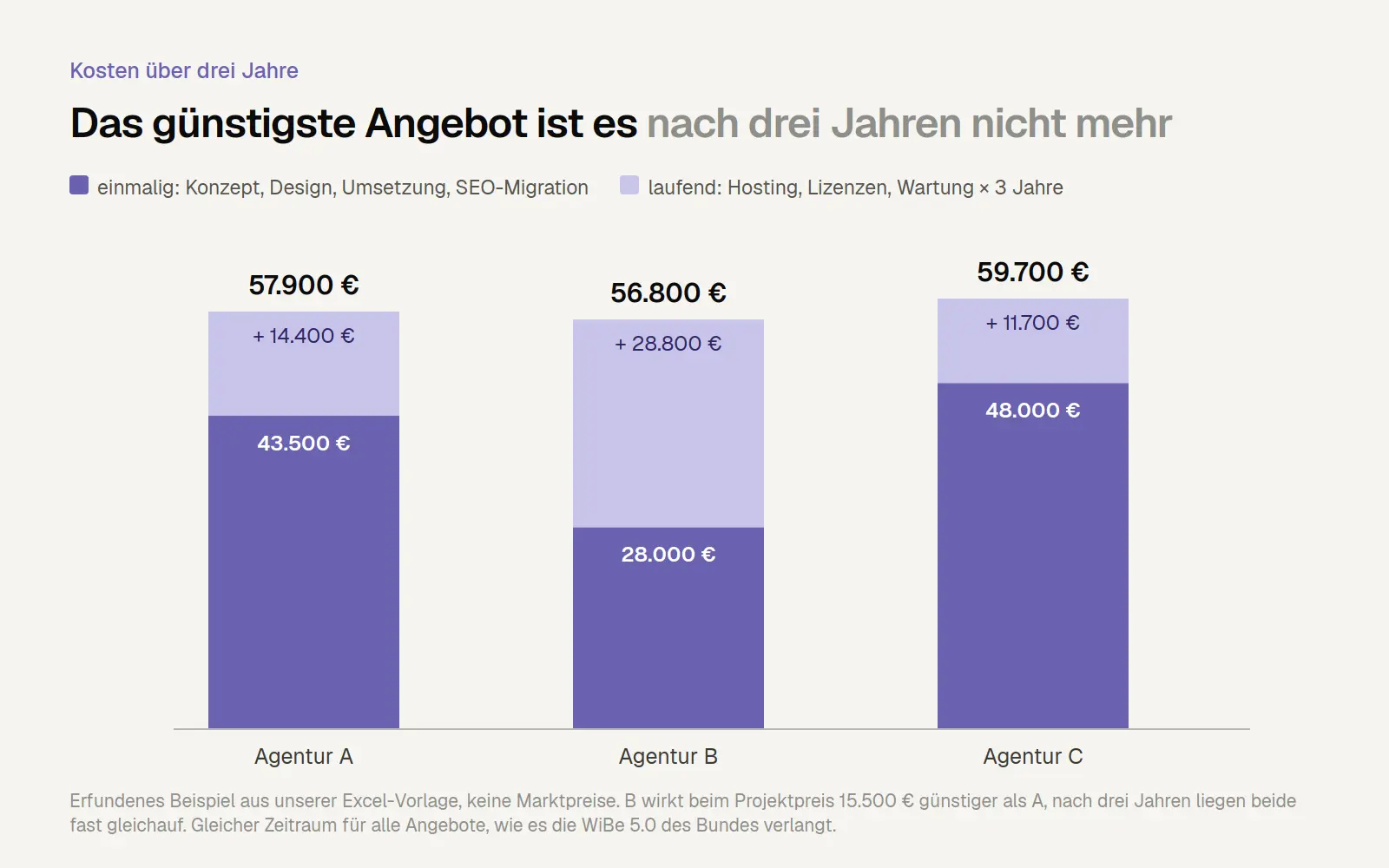
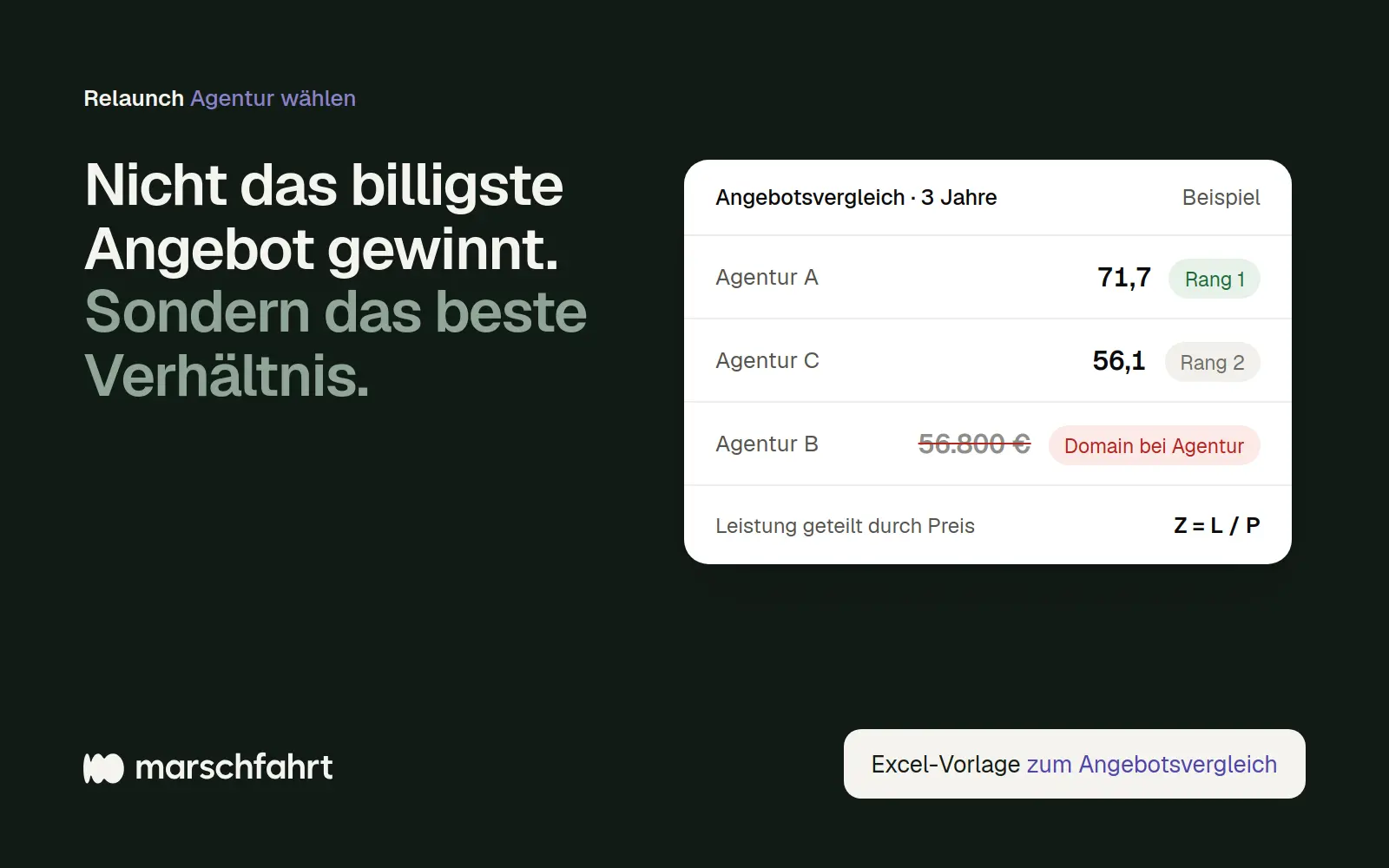
Fictitious example: Agency B is 15,500 euros cheaper than Agency A for the project, but charges more for hosting, licenses, and maintenance. After three years, the two are almost neck and neck.
The Excel Template for Comparing Quotes
So you don’t have to calculate this by hand, we’ve transferred the method into an Excel file. It has five sheets: instructions, the criteria with weightings and a description of the full point total, the evaluation for each agency with columns explaining the reasoning, the costs over three years, and the results, including exclusions, performance points, costs, key metrics, and rankings. Download the blank template or the completed example. The file uses only standard formulas such as SUMPRODUCT and SUMIF, with no macros.
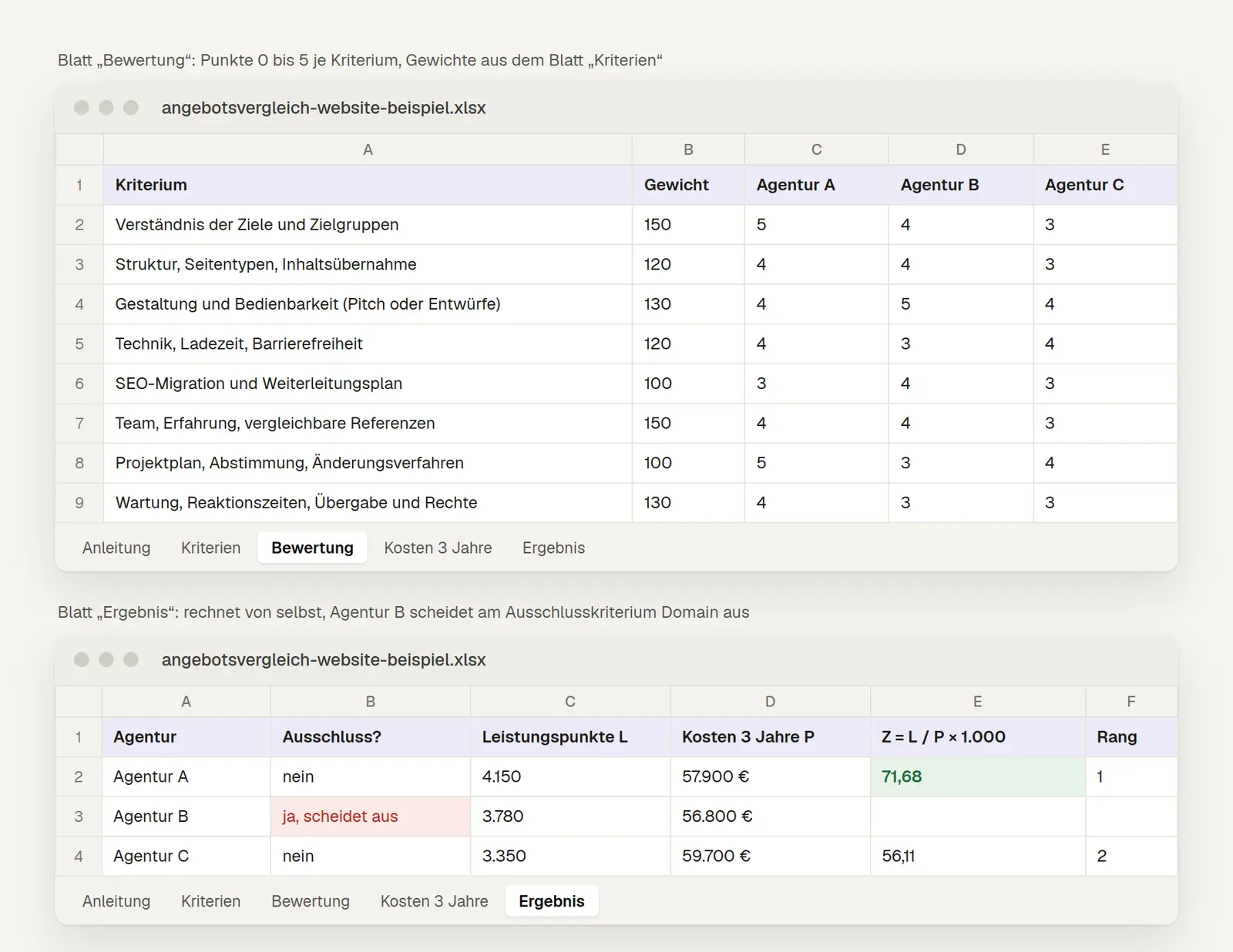
Excerpt from the completed example featuring fictional agencies: Agency A wins with the highest score; Agency B is eliminated because the domain is not supposed to remain with the client.
Adjust the criteria and weights to fit your project. The total of the weights should add up to 1,000; the file will highlight any deviation in red. And fill out the column “How you recognize 5 points” before the first proposal arrives.
Step 7: Evaluate the agency using references, records, and your own assessments
References, records, and a look at the technology behind the reference websites reveal more in an hour than any presentation ever could. Under Section 46(3)(1) of the VgV, public contracting authorities may request a list of major projects completed within the last three years at most, including the value, date, and recipient. This also serves as a good benchmark for companies: two to three references of similar scope, no older than three years, with contact persons.
Conducting Reference Interviews
We haven't found any reliable guidelines for reference interviews, only advice from agencies. In our experience, these questions yield the most useful information when asking reference clients:
Were the deadline and budget met, and if not, how did the agency handle it?
Did the team from the proposal actually work on the project?
How were requests for changes handled, and how quickly does the agency respond today?
Would you hire the agency again for your next project?
Commercial Register and Insolvency Notices
Access to the commercial register has been free of charge since August 2022. In 2022, the federal government confirmed that, as of August 1, 2022, registry extracts and submitted documents are available free of charge. There you can view the legal form, registered office, management, list of shareholders, and previous changes, such as frequent changes of registered office or a liquidation. Enter the company name in the “Company or Keywords” field on the registry portal:
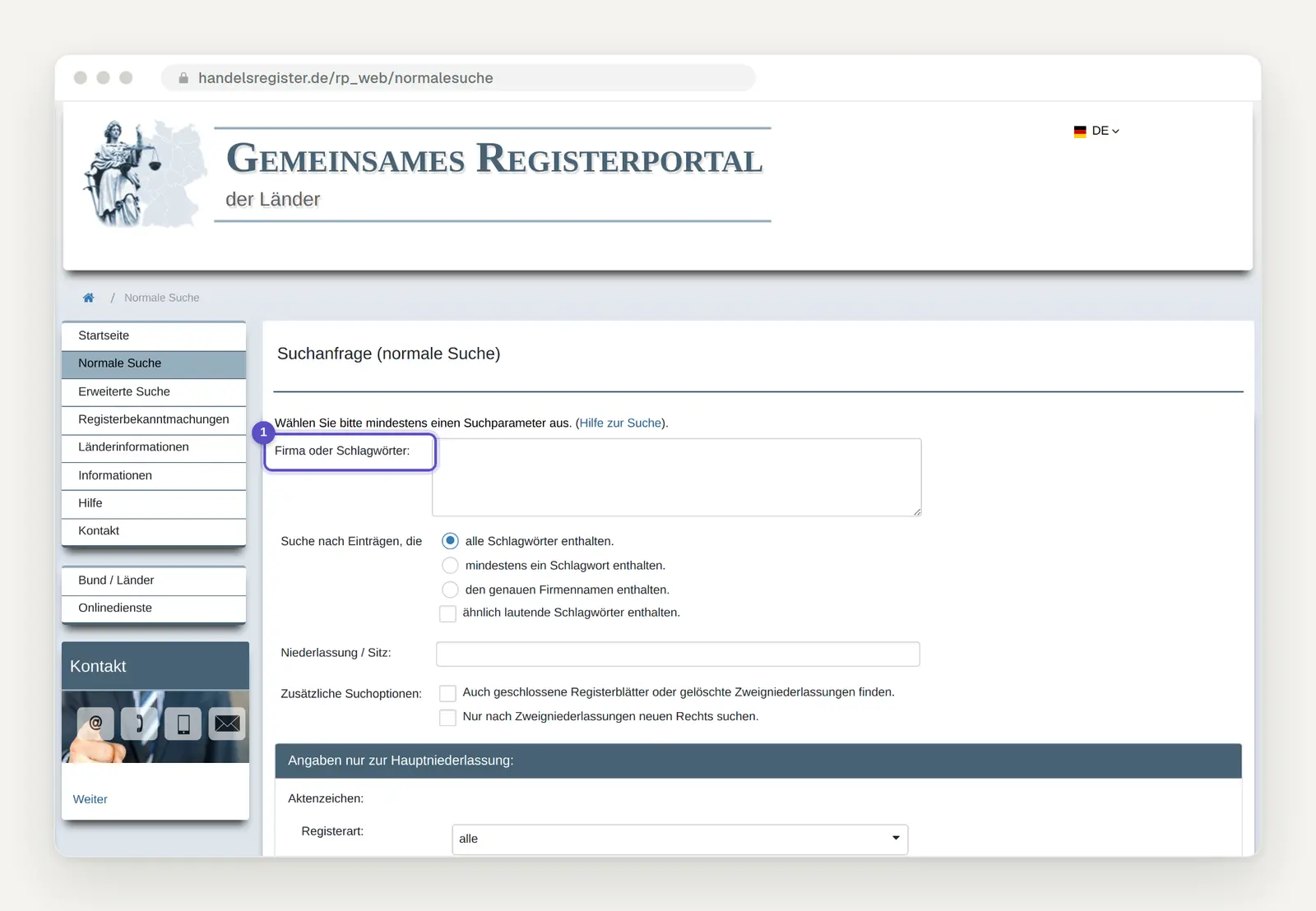
The standard search on the states' joint registry portal. You won't find sole proprietors or freelancers who aren't listed here.
Annual financial statements or balance sheets of GmbHs are filed with the commercial register. Micro-capital companies may file their balance sheets instead of disclosing them (Section 326(2) of the German Commercial Code (HGB)), in which case the figures are not publicly accessible. This is normal for small agencies and is not a red flag. A red flag is more likely to be a GmbH that has not disclosed any information for years.
You can find ongoing insolvency proceedings involving companies and self-employed individuals for free at insolvenzbekanntmachungen.de. The two-week search limit applies only to consumers, not to companies or self-employed individuals. Please note, however, that the data is deleted no later than six months after the end of the proceedings (Section 3(1) InsoBekV), so you will no longer be able to view older insolvency cases there.
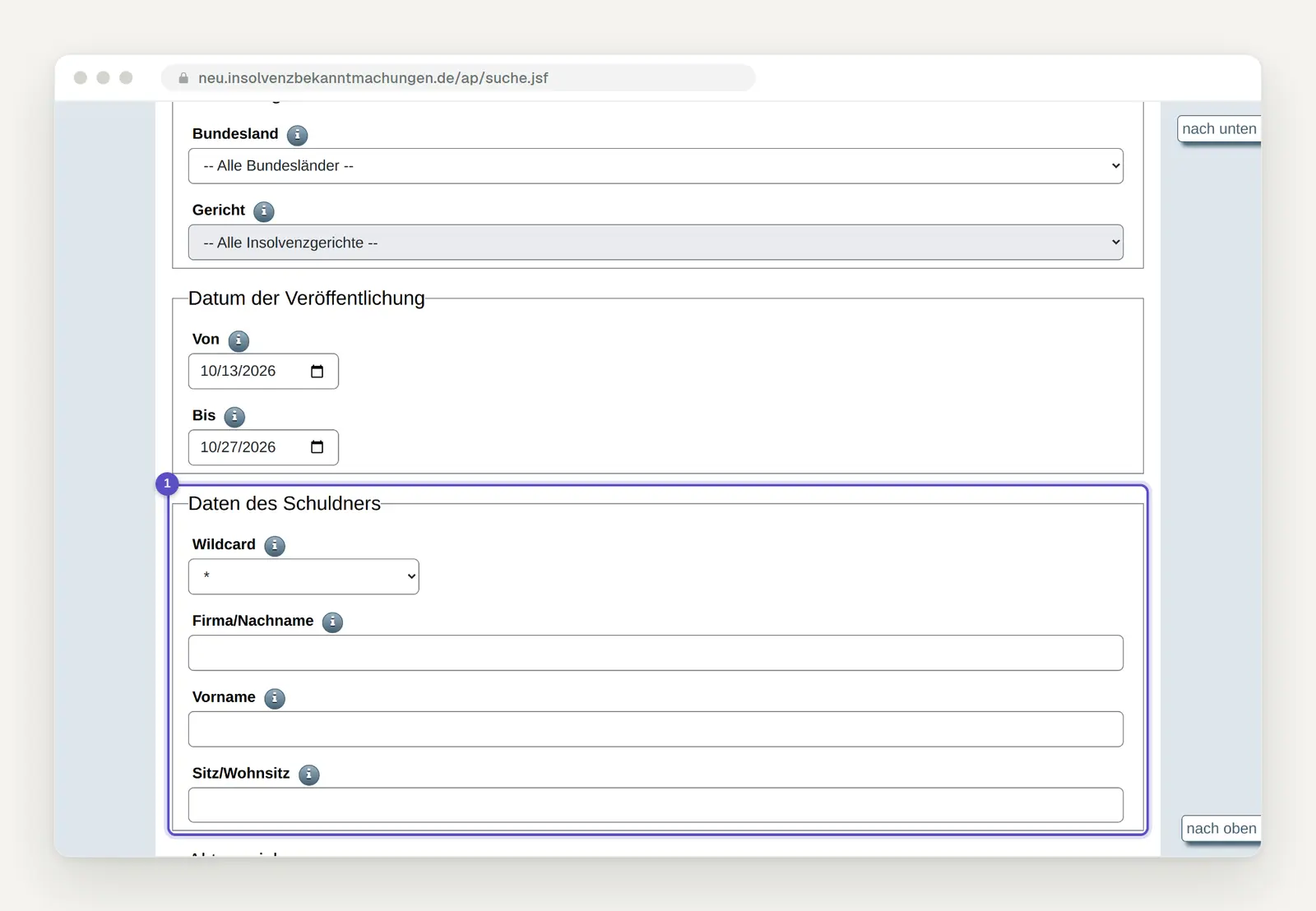
The search form for insolvency notices: Company name and registered office are sufficient; date fields for the publication period.
Check the technical aspects of the reference websites yourself
An agency's portfolio is public, so you can assess its quality using freely available tools. In ten minutes per website, you can check:
Load time: PageSpeed Insights displays field data from real visitors over the past 28 days. “Good” means LCP up to 2.5 seconds, INP up to 200 milliseconds, and CLS up to 0.1. Small websites often have too few visitors to generate field data; in such cases, the lab data serves only as a guideline. Our article “ How to Read PageSpeed Insights Correctly” explains how to interpret the report.
Accessibility: The WAVE browser extension from WebAIM runs entirely within the browser and highlights missing alternative text or low contrast. The W3C makes it clear that such tools cannot determine accessibility, but can only support it. Therefore, when reviewing references, ask for an audit report.
Security: Mozilla's HTTP Observatory evaluates a website's security headers.
Legal Information and Consent: Links to the Legal Notice and Privacy Policy on every page; no tracking requests before consent is given via the cookie banner.
Domain: DENIC's Whois lookup shows the owner of a .de domain for companies. If the agency is listed there instead of the client, follow up.
Step 8: Warning Signs in the Proposal and Contract
The most costly mistakes when choosing an agency aren't related to price, but rather to the domain, accounts, contract term, and usage rights. You should clarify these points before signing the contract.
The domain and accounts belong to the company
The owner of a .de domain is the person registered with DENIC, and only that owner can transfer the domain. If the agency has registered the domain in its own name, DENIC states that it “cannot do anything for you.” The same principle applies to hosting, Google Search Console, analytics tools, Tag Manager, and cookie banners: The accounts are in your company’s name, and the agency is granted access as a user. If the agency processes personal data on your behalf—for example, through hosting or forms—a data processing agreement is required; it may only engage additional subprocessors with your authorization (Art. 28 GDPR).
Modular Systems and Platforms: What Can You Take With You?
For every system, ask what you can take with you if you switch: content, design, code, and redirects. With open-source systems like WordPress or TYPO3, you can usually take your files and database with you if you have access to the hosting. The situation is different for hosted platforms. Wix states that a website must run on Wix’s servers. Webflow only allows code export on certain plans, and CMS content, user accounts, and store data are not included in the exported code; however, CMS collections can be exported as CSV files.
We build many websites ourselves using Framer, so we’ll be blunt: Framer’s own help documentation is contradictory on this point. One article answers the question about HTML export with a clear “No” and states that Framer does not offer HTML export for self-hosting:
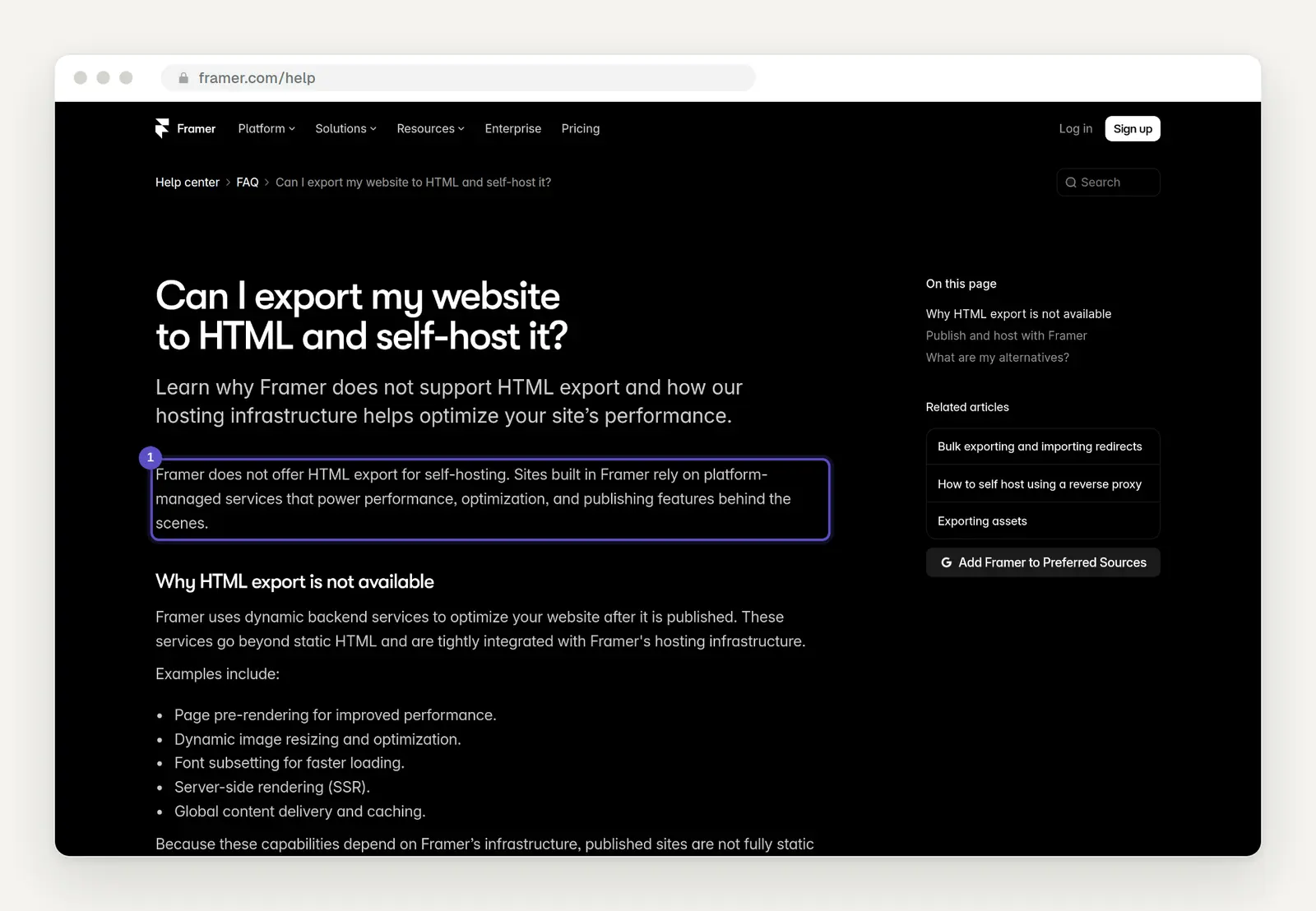
Framer Help: “Can I export my website to HTML and self-host it?”, updated on September 15, 2026.
A second article with the same update date, however, states that every Framer website is published as standard HTML; you can download these files “at any time” and host them with any provider. According to this second article, CMS content can be exported as CSV or JSON using plugins.
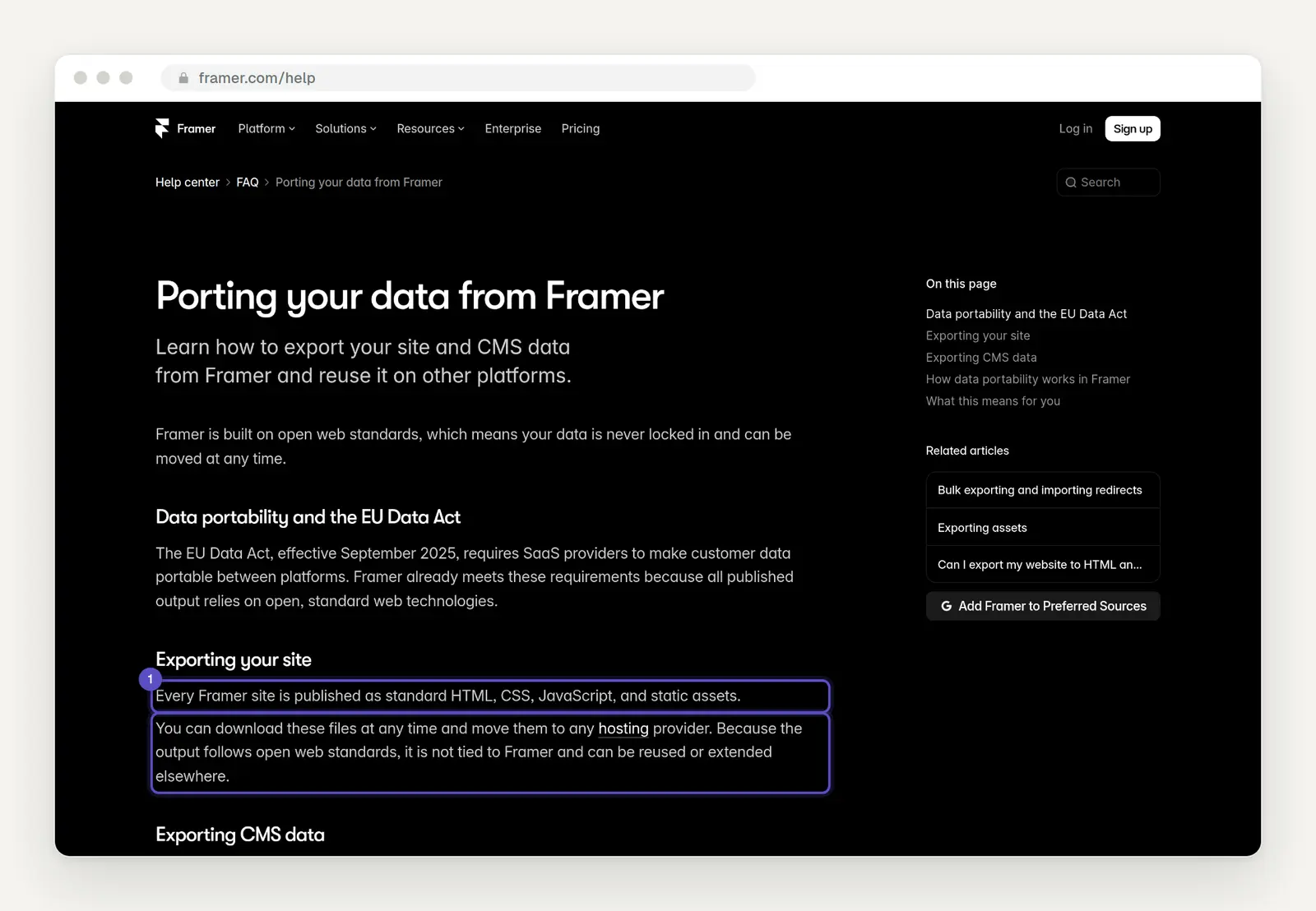
Framer Help article “Porting your data from Framer,” also dated September 15, 2026, which makes the opposite claim.
When making your decision, the objection itself is less important than the question it raises. Before signing a contract, ask each agency to provide a written explanation of how the switch would work in practice: what content will be transferred and in what format, what would need to be rebuilt, and who owns the domain and accounts. Since September 12, 2025, the EU Data Act has provided guidance on this matter. Providers of cloud and software services may require a maximum notice period of two months to initiate a switch; as of January 12, 2027, they may no longer charge switching fees. However, fixed-term contracts with reasonable fees for early termination remain permitted. Based on our interpretation, the provider’s protected templates and platform code are not included in the data that must be transferred, and it remains unclear whether an agency with its own hosting falls under these rules.
Term: Separate the work and the supervision
Be wary of contracts that bundle creation, hosting, and support into a single package spanning many years. The Federal Court of Justice has classified two such “Internet system contracts”—with minimum terms of 36 and 48 months—as contracts for work and services, which the customer may terminate at any time (BGH, Jan. 27, 2011, VII ZR 133/10, and Mar. 24, 2011, VII ZR 146/10). However, the agency generally retains its claim to the agreed-upon compensation, minus any expenses saved. For the portion of the work not yet performed, the law presumes a 5 percent claim by the agency (Section 648 of the German Civil Code (BGB)). If the agency can demonstrate lower savings, the amount may be significantly higher, approaching the full remaining compensation.
A better approach is the separation outlined in the DZA’s model contract: The website is a project that is paid for upon acceptance. Support services constitute a separate part of the contract, with a set number of hours at a monthly flat rate, a 12-month term with tacit renewal, and a three-month notice period at the end of the term. The statutory two-year limit on contract terms in general terms and conditions (§ 309 No. 9 BGB) does not apply directly between businesses (§ 310(1) BGB). This means you must negotiate long contract terms yourselves.
Rights of Use, Warranty, Subcontractors
Rights of Use: Unless otherwise expressly stipulated, the scope of these rights is determined by the purpose of the contract (Section 31(5) of the German Copyright Act (UrhG)). Make sure the rights to the design and to custom-made parts are granted to you in writing and without any restrictions in terms of time or territory, as specified in the DZA contract. Also clarify under whose license the fonts and stock photos are used.
Warranty: The statute of limitations for defects in a website depends on its legal classification. Therefore, a clear time limit is set from the date of acceptance; the DZA contract specifies 12 months.
Subcontractors: Ask who is actually working on the project—your own team, freelancers, or a subcontractor—and where they are located.
For a list of other clauses a website contract should include—from acceptance to installment payments—see our article “Hiring Someone to Build a Website: Process, Contract, and Agency.” None of this constitutes legal advice; for larger contracts, it’s worth having a lawyer review them.
Template: Inquiry to the Agencies
A good request specifies the scope, deadlines, budget, and evaluation criteria so that all agencies are responding to the same question. You can copy and customize this text:
Frequently Asked Questions
Common Questions About Choosing an Agency, Answered Briefly.
How many agencies should you contact for a website relaunch?
Three to five on the shortlist (GWA platform); in the final round, with a pitch or workshop, no more than three to four (WKO, LSA/SWA). The Swiss LSA even recommends a maximum of three, regardless of the procedure. Three is also the minimum number required by public procurement law for most competitive bidding procedures.
Do you have to pay a pitch fee?
Generally not, unless otherwise agreed; in a 2004 ruling, the Federal Court of Justice denied such a claim. However, professional associations and chambers in Germany, Austria, and Switzerland recommend a fee; the Swiss LSA describes it as “required” for pitches involving its members. It is not customary to charge a fee for proposals that do not include drafts. This is not legal advice.
Is it okay to implement ideas from a pitch with another agency?
Mere ideas are not protected, but detailed designs may be. The associations agree that the rights to unselected designs remain with the agencies, even if you pay them a fee. If you want to use something, reach an agreement with the agency. This is not legal advice.
How long does it take to select an agency?
Once the requirements specification is finalized, we estimate six to ten weeks for research, inquiries, getting to know each other, and making a decision. According to the WKO and LSA, if a pitch is involved, agencies need an additional four to six weeks of preparation time, and the decision-making process takes about one week.
Fixed price or billing based on actual hours worked?
A fixed price is appropriate when the specifications clearly define the scope of work. If there are many unresolved issues, a hybrid approach is fair: a fixed price for the concept and design, followed by a fixed price for implementation, with changes billed at an agreed-upon hourly rate and subject to prior approval.
Does public procurement law apply to companies?
Generally, this does not apply to private companies. It applies to public contracting authorities and sectoral contracting authorities—such as government agencies, municipal utilities, or publicly owned companies. You can still use the UfAB methods on a voluntary basis.
How can you tell if an offer is unreliable?
Focus on missing elements rather than high prices: no implementation plan, no ongoing costs, the domain registered to the agency, lengthy packages combining website development and hosting, no clarification on usage rights, and no designated team. In our experience, a quote that is significantly lower than all others usually omits one of these points.
Conclusion
You won’t find the right agency through the most impressive presentation, but rather through a process that you define in advance. Write a request for proposal, solicit bids from three to five agencies, establish an evaluation form with weightings, compare costs over three years, calculate value by dividing price by performance, and review the domain, accounts, contract term, and rights before signing. A pitch only makes sense for large budgets—and even then, only with a fee and clear rules.
Download the Excel template for comparing quotes and fill in the criteria before sending out your first request. If you want to know roughly how much a website relaunch on your scale would cost, our website cost calculator can help you determine a budget range for your request.
More Articles
© Marschfahrt Studio
Practical knowledge on web design, SEO, AI, and conversion optimization. Based on real projects, without any marketing spin.

