Hiring Someone to Write Website Content: Costs, the Process, and How to Spot Content That Generates Leads
How much does it cost to have website copy written, and isn't AI enough? We compare actual prices—from freelance platforms to agencies—examine Google's guidelines and AI regulations, and use before-and-after examples to show you how to recognize copy that generates leads.
Date
Category
Author

“How much does it actually cost to have someone write our website content? And why should we pay for it when ChatGPT can do it in two minutes?” That’s the kind of question a business might ask when planning a new website. The honest answer goes beyond just a price per word. After all, the content plays a key role in determining whether a visitor will call us or click back to Google.
In this post, we compare the different approaches to creating website content using actual prices from public price lists. We’ll show you what Google literally says about AI-generated content, what matters legally when it comes to copywriting, and how to recognize content that drives inquiries. We’ll also share data from our own analysis of 734 trades websites in the Cologne area. First, a quick definition: SEO stands for search engine optimization—in other words, everything that helps a website get found on Google.
In a nutshell (as of October 23, 2026)
If you're short on time, here are the key points. The supporting documents are listed further down in the text.
According to their price lists, content marketplaces such as content.de and Textbroker charge between 1.6 and 8.0 cents per word (net), plus small fees per text. Briefings, consultations, research, and integration are not included in these rates.
Copywriters and agencies publicly quote prices ranging from about 500 to 1,200 euros for a subpage, some net, some without specifying. These are examples from providers, not a market study. We were unable to find a recent, publicly available survey of copywriting rates in Germany.
Google explicitly allows AI-generated text. Anyone who creates a large number of pages with no added value—regardless of whether they are written by a human or a machine—is in violation of the guidelines.
There is no general requirement to label AI-generated website content. Standard operational texts generally do not involve the public interest, and human review eliminates the requirement in any case.
Texts that generate inquiries mention the service and location in the first sentence, answer questions about price, process, area, and duration, and end with a clear call to action that includes a clickable phone number.
Make sure you obtain the rights to use the texts in writing: exclusively, with no time or geographical restrictions. Otherwise, you may not be allowed to use the texts the way you intend to.
Why Copy Is Key to Winning Bids
A website doesn't sell based on its design alone. The design catches the eye. The text explains what you do, where you work, and why someone should call you specifically. If any one of these three elements is missing, the visitor will quickly leave, and the next company on the search results list will get the call.
Visitors read very little and skim a lot
The best-known statistics on online reading behavior come from the Nielsen Norman Group (NN/g for short), a U.S. user research institute. It’s important to note that these figures are outdated. In the report “How Little Do Users Read?” published in May 2008, Jakob Nielsen wrote: “On the average Web page, users have time to read at most 28% of the words during an average visit; 20% is more likely.” In other words: On an average page, users read at most 28 percent of the words; 20 percent is more likely.
The data behind this was collected in 2005: 25 users, 45,237 page views. That was over 20 years ago, before the rise of the smartphone. We therefore do not consider this figure to be an exact representation of today’s situation. However, it does reveal a pattern: People read selectively online.
More recent is the study on the F-pattern in reading. NN/g described the pattern in 2006 and confirmed it on mobile devices in 2017. According to NN/g, this is the norm “when there are no strong cues to attract the eyes toward meaningful information”—that is, when nothing specifically directs the reader’s gaze to what’s important. The recommendation based on this finding is: “Start headings and subheadings with the words that convey the most information.” Headings should begin with the words that convey the most meaning.
For your website, this means: The most important information should be included in the first two paragraphs and at the beginning of each heading. If you don't mention that you renovate bathrooms until the fourth paragraph, you've already lost many visitors before they even get that far.
What We Found on 734 Crafts Websites in the Cologne Area
On September 11, 2026, we analyzed 734 websites of small businesses in the Cologne area using Google Lighthouse. Lighthouse is a Google audit tool that evaluates load time, accessibility, and basic technical SEO factors. In addition, we searched 752 accessible pages for contact information. The complete results are available in our Cologne Small Business Website Report. Several findings directly pertain to the text content:
36.1 percent are missing a meta description. The meta description is the short piece of text that Google often displays below the page title in search results. The page title is the blue, clickable line that also appears as the name in the browser tab. If the description is missing, Google selects a snippet from the page itself, and it doesn’t always fit.
In 39.4 percent of cases, the order of the headings is incorrect. For example, the hierarchy jumps from the main heading directly to the third level. This makes it particularly difficult for screen readers (programs that read text aloud for blind people) to navigate the content.
In 50.3 percent of cases, there are links without a recognizable name. These include, for example, linked icons or images without text. This, too, is a text-related issue—albeit a very minor one.
Only 43 percent of the 752 pages we were able to access had the phone number as a clickable link. In the top third of the page, the number appeared on only 37 percent of the pages. We found a contact form on 31 percent of the pages.
There were significant differences among the various business sectors. For plumbing and heating companies (53 pages), 57 percent of the phone numbers were clickable. For bakeries (42 pages), the figure was 24 percent.
The limitations of the measurement are part of the picture. The sample comes from OpenStreetMap, a freely editable online map, and includes only entries with a listed website. It is not representative of all businesses. The measurement was a one-time test conducted on a simulated cell phone. We identified phone links and forms by looking for patterns in the source code. For pages that are built in the browser using JavaScript (a programming language for websites), this method tends to underestimate the values.
Why a Good SEO Score Says Nothing About the Content
The median SEO score from Lighthouse was 92 out of 100 points. The median is the middle value: half of the pages scored above it, and half below it. 76.2 percent of the pages scored 90 points or more. That sounds good. However, Lighthouse only checks technical aspects—such as whether a meta description is present—not whether it’s effective. No automated tool can measure whether a visitor knows who to call after a few seconds. That’s why we didn’t measure the quality of the text itself.
That’s exactly where the key lies. Many websites are technically sound but still don’t say enough. We explain why your contact form isn’t getting any inquiries in “Why You’re Not Getting Any Inquiries Through Your Contact Form.”
How Much Do Website Texts Cost? A Comparison of Six Options
There are roughly six approaches to website copy. They differ less in price per word than in who handles the work before the actual writing begins: figuring out what your customers want to know, what terms they use to search, and what sets you apart from other businesses. Prices on content marketplaces are net, meaning they exclude sales tax. For the other providers listed, it is specified whether the price is net or not indicated. As of October 23, 2026.
1. Write it yourself
On paper, this is the most cost-effective approach. You know your business, your customers, and your prices better than any copywriter. That’s a real advantage that no one from the outside can replace.
The catch is professional blindness. Anyone who’s been installing heating systems for 20 years will quickly type in “condensing boiler technology” and “hydraulic balancing.” But the customer might be searching for “new heating system” or “heating system isn’t getting warm.” Technical terms are fine, but they need to be explained.
It’s worth writing the text yourself if you enjoy putting thoughts into words and are willing to really take the time to do so. Be honest with yourself: Every hour you spend on the text is time you’re not spending on the construction site or in your practice. Then have someone who isn’t familiar with your work read it. Where that person gets stuck, a client will get stuck too.
2. Write with AI and proofread your own work
With ChatGPT, Claude, or similar tools, you can create a first draft in minutes. This is useful for outlines, different phrasing options, and polishing your own bullet points. But without your specific input, AI will just write what’s already on many other websites: “Quality, reliability, and customer satisfaction.” That’s not wrong. It just means you won’t stand out from the crowd.
The costs involve a subscription and, above all, the time you spend fact-checking. Fact-checking means verifying every number, every promise, and every statement about legal matters or technology yourself. Google’s take on AI-generated text is provided below. We’ve described where AI really saves time when writing—and where it falls short—in “AI Writes Faster, but Not Necessarily Better.”
3. Content Marketplaces: content.de and Textbroker
Freelance writing platforms are places where you post assignments and freelance writers complete them. Payment is calculated per word, and you select the quality level. The prices are publicly available online, making them the most well-documented figures in this article.
At content.de, according to the price list, a word in an “Open Order”—that is, an open assignment for all authors at a given level—costs:
2 stars: 1.6 cents
3 stars: 2.2 cents
4 stars: 3.0 cents
4 stars +: 4.5 cents
4 stars ++: 6.0 cents
5 stars: 8.0 cents
In addition, there is a base fee of 0.80 euros per text. According to the website, the contribution to the Artists’ Social Security Fund—through which freelance writers are covered by social security and for which clients pay a fee—is already included. Anyone who commissions a specific author directly pays that author’s own rate. According to content.de, this is at least “2 cents per word (including 40% network fees).” The sample authors listed on the “Have Texts Written” page charge between 4.70 and 6.00 cents per word.
Textbroker specifies three tiers for open jobs in the self-service section, where you post the job yourself. Tier 1 costs 2.2 cents per word and is described as “Virtually error-free, fast turnaround on jobs.” Level 2 costs 3.0 cents for “Good, fluent, readable texts for high standards.” Level 3 costs 8.0 cents for “Professional texts of journalistic quality …”. According to the website, direct assignments to a specific author and team assignments are available “starting at 3.1 cents per word,” with a flat processing fee of 0.50 euros per assignment. According to the overview of assignment types, Textbroker offers a managed service “starting at a project budget of 2,500 euros.”
Content marketplaces are great if you need a lot of similar texts, such as product descriptions. But for a website designed to generate leads, the most important element is usually missing: no one is talking to you. The writer creates the content based on your briefing. A briefing is a written description of the task—that is, what the text is supposed to achieve, who it’s for, and what it needs to include. The more sparse the briefing, the more interchangeable the text becomes.
4. Freelance Copywriters
Freelance copywriters typically charge by the hour, by the page, or as a package. Reliable, up-to-date market figures are hard to come by. The professional association Text und Konzept publishes a market report with sample rates for over 70 services, as of 2024, based on surveys of its members. However, the figures are only available in the print edition, not online. We were therefore unable to verify them ourselves and do not cite them here.
A guide on website copywriting published by the accounting software provider Lexware (as of May 20, 2026) states: “Depending on their experience and area of specialization, copywriters’ hourly rates can range from 60 to 120 euros.” Lexware does not cite a source for this range. Consider it a rough guideline, not a verified market price.
5. Copywriting Packages and Agencies
Publicly listed prices from individual copywriters and agencies range from about 500 to 1,200 euros for a single subpage, some net, some without specifying. For a package consisting of a homepage and five subpages, one copywriter quotes just under 3,000 euros net, while an agency quotes 3,500 to 7,000 euros for ten pages. This usually includes a questionnaire, an initial consultation, keyword research, page titles, and meta descriptions, as well as a feedback session. One agency reports having received quotes of 45, 390, and 1,400 euros for the same 1,200-word article. There is no way to verify this.
Keyword research means finding out which terms your customers enter into Google and how often. These search terms are called keywords. The wide range of prices for the same job shows just how much variation there is in what’s included in a quote. A quote is only as good as the list of what it includes.
6. Text as Part of the Web Design Project
The sixth option: The agency that builds your website also writes the copy. The advantage is that the layout and text are developed together. A headline can then be exactly as long as the layout (the arrangement of text and images on the page) allows, and the call to action is placed exactly where the visitor needs it. In contrast, text added to a finished layout after the fact doesn’t always fit in.
With our package for small businesses—the website for 999 euros plus VAT—we write the content based on a questionnaire that you can fill out in about 15 minutes. We’ve intentionally left out a consultation. The questionnaire is usually sufficient for a one-pager; for websites with multiple service pages, we recommend a consultation. If you need more pages or more collaboration, check out our Web Design section to see how we approach larger projects.
No matter who you’re working with: Whenever you receive a web design quote, ask whether copy is included, who will write it, and how many rounds of revisions are included. “Copy included” can mean anything from an in-depth consultation to simply inserting the text you provide yourself.
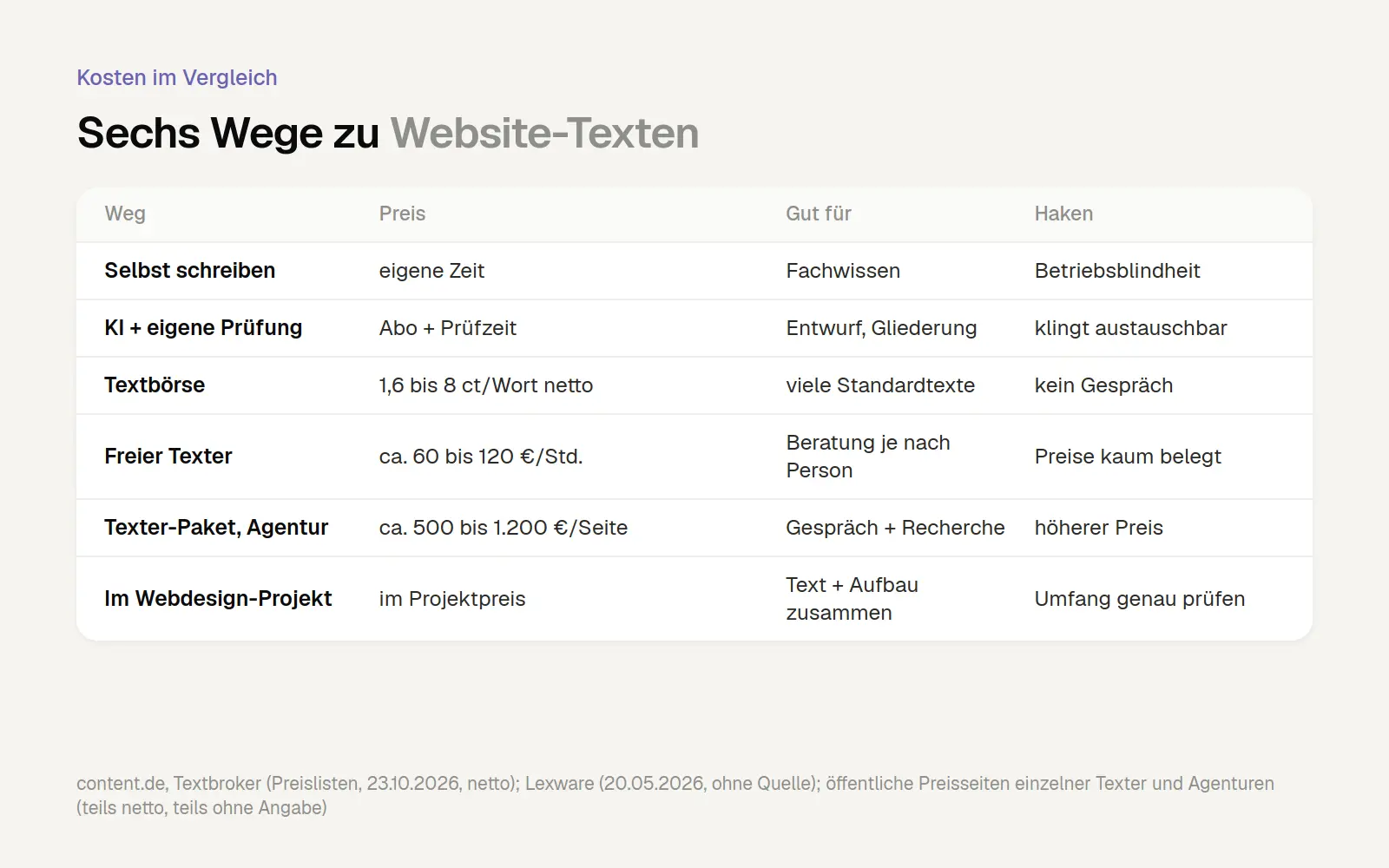
A Comparison of Six Ways to Source Website Content. Content marketplaces: net prices; other prices: some net, some not specified. Sources: Price lists from content.de and Textbroker (accessed on October 23, 2026), Lexware Guide (May 20, 2026, range not cited), and public pricing pages of individual copywriters and agencies.
Our sample calculation for a small website
We were unable to find a reliable figure for how many words a small business's website typically contains. The following calculation is therefore based on an assumption, not on actual data.
Our assumption: a homepage with 500 words, four service pages with 600 words each, and an “About Us” page with 400 words. That’s six pieces of content totaling 3,300 words. Here’s how that breaks down in the different scenarios:
Textbörse, content.de 4 stars (3.0 cents per word): 3, 300 words cost 99 euros. With six base fees of 0.80 euros each, the total comes to 103.80 euros net.
Textbörse, content.de 5 stars (8.0 cents per word): 264 euros plus 4.80 euros in fees, for a total of 268.80 euros net.
The copywriting package mentioned above—which includes a homepage plus five subpages—costs just under 3,000 euros (net), including a consultation and research.
Agency based on the example above: Ten pages cost between 3,500 and 7,000 euros there. Calculated proportionally for six pages, that would be roughly 2,100 to 4,200 euros, with no net price specified.
Hourly rate based on the Lexware range: The number of hours a copywriter needs depends on the amount of preparatory work required. Ten hours therefore cost between 600 and 1,200 euros.
The difference between a little over 100 and about 3,000 euros isn’t just a premium for nicer-sounding words. In the best-case scenario, you’ll get text that meets your specifications. In the more expensive scenario, you’re paying someone to work out those specifications with you. If you can do the groundwork yourself, a freelance writing platform is a good option. If you can’t, you’re cutting corners in the wrong place.
Why a 300-word text costs more than the sum of its words
In a post about pricing (as of April 2025), a copywriting service estimated the time required for a 300-word piece: about one hour for the briefing, 45 minutes for SEO research, 60 minutes for writing, 45 minutes for fine-tuning, and 30 minutes for about two rounds of proofreading. That adds up to about four hours, not including research on the topic itself.
This is a provider's estimate, not an actual measurement. However, it shows that the actual writing is the smaller part. Those who pay per word usually pay only for this part.
AI-Generated Text and Google: What's Allowed and What Isn't
The short answer: Google doesn't penalize content just because AI was involved in creating it. The problem lies with content that's created primarily to boost rankings and offers no value to readers. That's stated quite clearly in Google's own documentation.
What Google Says, Word for Word
In February 2023, Google published its stance on AI-generated content on the Search Central Blog. One subheading there reads, “Rewarding high-quality content, however it is produced”: High-quality content is rewarded, regardless of how it is created. It goes on to state: “Appropriate use of AI or automation is not against our guidelines.” Thus, the appropriate use of AI does not violate Google’s guidelines.
However, it is a violation of the spam guidelines to use AI “with the primary purpose of manipulating rankings in search results”—that is, primarily to manipulate search results. In the same post, Google recommends evaluating content based on “Who, How, and Why” (who created it, how, and why) and according to E-E-A-T, a quality metric that we’ll explain below.
The current page on the use of generative AI, last updated on October 1, 2026, provides more specific guidance: “Generative AI can be particularly useful when researching a topic and for adding structure to original content. However, using generative AI tools or other similar tools to generate many pages without adding value for users may violate Google’s spam policy on scaled content abuse.” In essence: AI can help with research and organizing your own content. However, generating many pages without adding value for users may violate the spam policy.
The basic rule is outlined in Google’s Guidelines for Helpful Content, last updated on October 5, 2026. Google’s automated systems are designed to prioritize information that is “created to benefit people”—that is, made for people. As part of its self-assessment, Google asks, among other things: “Does the content provide original information, reporting, research, or analysis?” Does the content offer original information or original analysis? And: “Is it self-evident to your visitors who authored your content?” Is it immediately clear to visitors who wrote the content?
Scaled content abuse: the real risk
“Scaled content abuse” roughly translates to: abuse through mass-generated content. Google introduced this spam rule on March 5, 2024. It explicitly applies “no matter whether content is produced through automation, human efforts, or some combination of human and automated processes.” In other words, it doesn’t matter whether the content is written by a machine, a human, or both.
The current spam guidelines, last updated on August 28, 2026, state: “Scaled content abuse is when many pages are generated for the primary purpose of manipulating search rankings rather than helping users.” Google specifically cites the following as an example: “Using generative AI tools or other similar tools to generate many pages without adding value for users.”
A typical example would be a business that creates 50 city pages where only the place name changes. It doesn't matter who wrote them: they're of no use to anyone. According to the Google Search Status Dashboard, there have been four spam updates so far in 2026, with no indication of which ones affected mass-generated content.
What this means for your business
Based on Google's statements, a few clear rules can be derived for a typical company website:
AI can help with writing: structuring, phrasing, shortening, and simplifying.
You need to provide the facts: prices, processes, areas of expertise, experience, and examples from actual projects.
Each page must have its own purpose. There should be no pages that differ only in the place name or a single word.
A person reads every sentence before it goes online and checks every number.
It must be clear who is behind the business and who is responsible for the content.
Do AI-generated texts need to be labeled as such?
Article 50 of the European AI Regulation, also known as the AI Act, sets forth transparency requirements. It distinguishes between providers who manufacture AI systems and operators. In this context, operators are defined as anyone who uses an AI tool in a professional capacity. As of August 2, 2026, the requirement set forth in Article 50, paragraph 4, applies to operators—including businesses that use AI.
For texts, paragraph 4, subparagraph 2, is decisive. According to this provision, operators of an AI system that generates or manipulates text “that is published to inform the public about matters of public interest” must disclose that the text was artificially generated or manipulated. However, this obligation does not apply “if the AI-generated content has undergone a process of human review or editorial control and if a natural or legal person bears editorial responsibility for the publication of the content.” The official text can be found on EUR-Lex (Regulation (EU) 2024/1689). We have quoted from the unofficial reading version at artificialintelligenceact.eu.
The Federal Network Agency, which is responsible for oversight in Germany, describes the same exception: The content is “reviewed by a person at a later stage or subjected to editorial review,” and a person or company assumes editorial responsibility.
According to our interpretation, this means that texts about your services, prices, or your team generally do not involve the public interest, and even if they do, the obligation is waived based on your review. However, exactly what “public interest” encompasses has not yet been definitively clarified. The labeling requirement for deepfakes—that is, deceptively realistic, AI-generated images, sounds, or videos—is set forth in the first subparagraph and does not apply to texts. Anyone publishing news or articles on political topics should have them reviewed more closely. This is a general assessment, not legal advice. For more information on images and chatbots, see our article “What the New AI Labeling Requirement Means for Your Website.”
How to Spot Website Content That Generates Leads
Only in practice will we see whether a text actually generates inquiries. We derive the characteristics from the studies and our measurements above. All examples come from a fictional plumbing company in Brühl, which we’ll call “Sanitär Muster.” It doesn’t actually exist. Replace placeholders like X and Y with your own values.
The service and location should be included in the first sentence
The first sentence on the home page should explain what you do and where. It doesn't need to say that you're happy to have visitors.
Before: “Welcome to Sanitär Muster. We’re glad you’re visiting our website.”
Afterward: “Bathroom renovations and furnace replacements in Brühl, Hürth, and Erftstadt. All under one roof, from the first appointment to the last tile.”
The second text answers the two questions that someone coming from Google has: Do they do what I need? Will they come to me? According to the F-pattern, the top of the page is the area that is read most frequently.
Answering Your Customers' Questions
Anyone looking for a small business, a medical practice, or a studio usually has similar questions: How much does it cost, roughly? How does the process work? Do you come to me? How long does it take? A text that answers these questions alleviates uncertainty. And a customer who feels confident is more likely to call.
Gather these questions before anyone writes a single line. You yourselves are the best source. What do customers ask on the phone? What comes up repeatedly in emails? What questions are asked during the first in-person appointment? Each of these questions can become a paragraph, a subheading, or an entry in the FAQ section.
Before: “We’re happy to advise you on any questions you may have about your bathroom.”
Afterward: “Here’s how it works: We’ll come to your home to take a look at your bathroom. You’ll receive a written quote within X business days. A complete bathroom renovation usually takes Y weeks with us. If you’d like, we can set up a temporary shower for you during that time.”
Concrete figures instead of empty phrases
Many businesses don’t list prices because every order is different. That’s understandable, but it doesn’t help the customer. In his 2006 article “Show Prices for Common Scenarios,” Jakob Nielsen called the absence of prices on websites for business customers “the #1 web design mistake of 2002.” His recommendation: “showing sample prices for a set of typical orders.” This text is also outdated. However, the idea still applies well to businesses that cannot quote fixed prices.
Previously: “Prices upon request.”
Afterward: “A bathroom measuring about 6 square meters usually costs between X and Y euros with us, including sales tax, materials, and installation. We’ll let you know the exact cost of your bathroom after the site visit.”
The same applies to other figures: years in business, team size, response time, and service area in kilometers. Numbers can be verified, but catchphrases like “fast and reliable” cannot. Anyone quoting prices to individual customers must provide total prices, including sales tax. For more on this, see the section on legal matters.
Prove trust rather than claim it
Google describes quality in its guidelines for human raters—the Search Quality Rater Guidelines—using the acronym E-E-A-T. It stands for Experience, Expertise, Authoritativeness, and Trustworthiness. The additional “E” for Experience was added in December 2022. The current version of the guidelines is dated September 2025.
It’s important to note a limitation that Google itself points out: These reviewers’ evaluations “don’t directly influence ranking,” meaning they don’t directly factor into the ranking. However, they do show what Google looks for in terms of quality.
In practical terms, this means: Show who you are. Real photos of the team and construction sites instead of stock images. Master craftsman’s certificate, certifications, memberships, years of experience. References that include the location and type of project. A legal notice that’s easy to find.
Previously: “Quality and experience for many years.”
Afterward: “A master craftsman’s business since X, with Y people on the team. For every job, one of the owners comes personally to inspect the site.”
Reviews are also part of the picture. According to BrightLocal’s 2026 Local Consumer Review Survey, 41 percent of respondents “always” read reviews when searching for local businesses. Last year, that figure was 29 percent. 85 percent are more likely to use a business based on positive reviews, and 74 percent pay attention to reviews from the past three months. However, the survey included 1,002 adults in the U.S. The study does not indicate whether the situation is the same in the DACH region.
A clear call to action
Every page needs an answer to the question: What should the visitor do next? The call to action—often referred to as a “CTA” in marketing—is the phrase or button that says exactly that. “Contact” is not a call to action; it’s a menu item.
Before: A button labeled “Contact” at the very bottom of the page.
Afterward: A “Request a Tour” button at the top and at the bottom of each service page. Below that, the phone number as a clickable link and the phrase: “We’ll get back to you within one business day.”
On a cell phone, a number you can't tap on means: memorize it, type it out, and hope you don't make a typo. Also, explain what happens after the request, and only make promises you can keep.
Headings You Can Skim
For many visitors, the headlines are the main content. According to the F-pattern, the eye tends to scan primarily the beginning of headlines and paragraphs. That’s why the most important word should come first. “Bathroom Renovation: Process and Duration” says more than “How We Work.” “Heating System Replacement in Hürth” says more than “Our Services.”
Technically, the order must be correct: one main heading (H1) per page, followed by second-level subheadings (H2), followed by third-level subheadings (H3), without skipping any levels.
Page Title and Meta Description
Both are often the first thing a customer reads about you, even before they visit your website. Google may display them differently in search results. However, writing them carefully provides the best foundation. Each page needs its own description.
Previously, page title: “Home.” Meta description: none.
Next, page title: “Bathroom Renovation in Brühl | Plumbing Samples.” Meta description: “Bathroom renovation and furnace replacement in Brühl and the surrounding area. Fixed-price quote after an on-site inspection; renovation typically takes Y weeks. Request an appointment now.”
What your customers say—including those in your local area
Customers search using their own words, not yours. They search for “bathroom renovation,” “heating system replacement,” or “plumber in Brühl”—and rarely for “plumbing installation.” Keyword research reveals exactly what these terms are and how often they’re searched. In our guide to keyword research, we’ve shown how to do this and which search terms can be misleading, using a bathroom renovation company as an example.
Local terms include: city, neighborhoods, neighboring towns, county, and—in Austria—the federal state, and in Switzerland, the canton. We haven’t found a reliable study on just how effective local terms are. However, the search queries themselves show that people include the location in their searches, such as in “web design Cologne.” Only list locations where you actually work, and for each location, include something that’s specific to that area: directions, local references, and unique features. Otherwise, you’ll end up with interchangeable pages—exactly the kind of content Google’s guidelines against mass-generated content are designed to prevent.
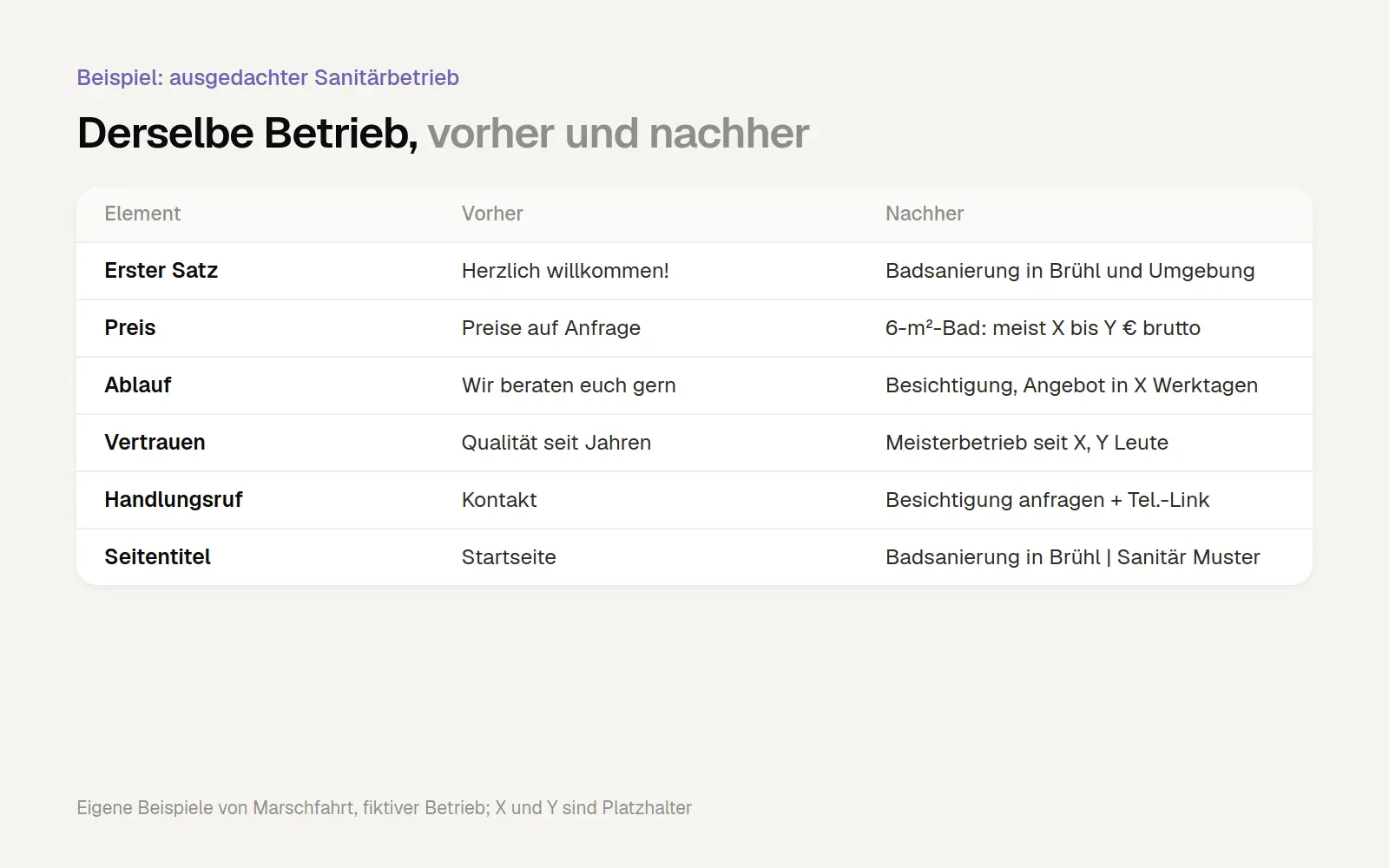
Before and after at a fictional plumbing company. X and Y stand for your own values. Source: examples from Marschfahrt.
Legal Considerations When Writing: Six Things You Should Know
The guides we’ve reviewed on this topic barely mention the law. Yet a single sentence in the contract determines whether you’ll be able to use your texts freely later on. The following points provide an overview for Germany; they do not constitute legal advice. Austria and Switzerland have their own laws.
1. Obtain contractual rights of use
Texts may be protected as literary works under Section 2 of the German Copyright Act (UrhG). The prerequisite is that they are a “personal intellectual creation.” The copyright itself remains with the writer. The writer grants you rights of use. Under Section 31 of the German Copyright Act (UrhG), a right of use may be granted “as a simple or exclusive right.” An exclusive right means that only you may use the text in this way; the author may not sell it again.
If the contract does not specify exactly how you may use the texts, the scope of use is determined by the purpose of the contract (Section 31(5) of the German Copyright Act (UrhG)). If the contract only specifies “website,” you may not be able to use the texts for flyers, advertisements, or social media without further authorization. Therefore, make sure to have the right of use granted to you in writing—exclusively, without any time or geographical restrictions—and explicitly including the right to edit the texts, use them on social media, and print them.
Also clarify whether the writer wishes to be credited. According to Section 13 of the German Copyright Act (UrhG), the author has “the right to recognition of his or her authorship of the work.” If you do not want to be credited, this must be specified in the contract.
A note on AI: According to prevailing opinion—that is, the view held by most courts and experts—AI-generated output alone, without human input, is not considered a “work” within the meaning of Section 2 of the German Copyright Act (UrhG). Even short, simple advertising slogans often fail to meet the required level of creativity—that is, the minimum degree of originality required for a text to be protected. This is a widely accepted classification, not the exact wording of the law.
2. Do not copy other people's texts
Anyone who copies text from a competitor’s website risks claims for removal and injunctive relief under Section 97 of the German Copyright Act (UrhG), as well as claims for damages in cases of willful misconduct or negligence. Just because a text is freely available online does not mean it can be used freely. Even if a service provider is the one who copied the text, claims may still be directed against you as the website operator. Therefore, make sure the contract includes a guarantee that the texts were created independently.
3. Advertising claims must be accurate
According to Section 5 of the Unfair Competition Act (UWG), it is unfair “for anyone to engage in a misleading commercial practice that is likely to induce a consumer or other market participant to make a commercial decision that they would not otherwise have made.” Section 5a of the UWG additionally prohibits withholding material information. In plain terms: don’t make promises you can’t keep, and don’t cite figures you can’t back up.
Be cautious with superlatives such as “market leader,” “the best plumber in Cologne,” or “No. 1.” According to the Frankfurt am Main Chamber of Industry and Commerce (IHK), such “unique selling point” advertising is “permissible only if this leading position can be proven based on objectively verifiable characteristics.” The lead over competitors must be clear and “demonstrate a certain consistency and duration.” Mere claims of superiority that no one would consider verifiable do not fall under this category. The Chamber of Industry and Commerce gives the example: “the most beautiful flower in the world.” A good copywriter recognizes such phrases and suggests a verifiable alternative.
4. Special Rules for Medical Practices
Healthcare practices are also subject to the Law on the Advertising of Medicines (HWG). According to Section 3 of the HWG, misleading advertising is prohibited. According to the law, this applies in particular when the false impression is given “that a) a successful outcome can be expected with certainty.” A statement such as “Pain-free after three sessions” may therefore be prohibited. Further restrictions are set forth in Section 11 of the HWG, in addition to the professional regulations of the respective professional association.
5. List prices including sales tax
If you quote prices to individual customers, the Price Indication Regulation applies. Anyone who advertises by stating prices “must indicate the total prices,” as stated in Section 3(1) of the Price Indication Regulation (PAngV). This refers to prices that include sales tax. A net price alone—even if accompanied by the note “plus sales tax”—is not sufficient when dealing with individual customers.
6. The legal notice is part of the text
The Digital Services Act (DDG) replaced the Telemedia Act in May 2024. According to Section 5 of the DDG, the required information in the legal notice must be “easily recognizable and directly accessible.” For a new website, the legal notice should therefore be included in the content plan from the very beginning.
Here's how collaboration with a copywriter or agency works
There is no set standard process. A typical process, as described publicly, is as follows: initial consultation, proposal with a timeline, briefing and re-briefing (the copywriter summarizes how they understand the assignment), copy, proofreading, and publication. Six steps can be derived from such processes.
1. Briefing
It all starts with the briefing: Who is the website for? What services are to be sold? What is the goal of each page—to get a call, book an appointment, or fill out a form? A good briefing saves time on revisions later on. Many providers use a questionnaire for this purpose.
2. Conversation
A conversation complements the questionnaire because it allows for follow-up questions. A good copywriter asks about things you take for granted. Why do your regular customers keep coming back? What do you do differently from the business two blocks down? What question do you hear so often that it’s starting to annoy you? It’s precisely these answers that give rise to sentences that no AI and no copywriting service can write without you.
3. Keyword Research
At the same time, the copywriter or agency will analyze what your customers are searching for and how often. This determines which pages to create and what to name them. It’s worth creating a dedicated page for bathroom renovations in Brühl if people are searching for that—not just because the name sounds good. Ask to see the results. If visibility on Google is a major priority for you, check out our SEO section to learn how we approach it.
4. Draft
The first draft should ideally be presented in the actual layout or at least in the actual page structure, not as a plain text document. That’s the only way you’ll be able to see if the headline fits on a cell phone and if the call to action is in the right place.
5. Correction
Review the draft for three things: Is everything factually correct? Does it sound like you? Would a customer call after reading this? Gather all feedback in a single round and from one person. Three people with three different wish lists rarely make a text better.
6. Approval and Installation
Approve the texts in writing. Written approval also serves as documentation that a person has reviewed them and that you bear responsibility for them. Afterward, the texts are incorporated into the site, complete with page titles, meta descriptions, well-formatted headings, and alt text. Alt text consists of short image descriptions that screen readers read aloud and search engines analyze. Determine in advance who will be responsible for incorporating the content.
What You Need to Provide
Even the best copywriter can only write as well as the information you provide. The publicly described processes outline what they need from you:
Target customers and catchment area: Who do you want to reach, and where?
Services with Price Ranges: What do you offer, and how much do they cost, roughly?
Common Customer Questions: What questions do customers ask over and over again on the phone?
Differentiation from the Competition: What do you do differently?
Supporting Documents: References, Certificates, Years of Experience, Team.
Photos: Team, Work, Offices.
One person to approve it. And time for a conversation.
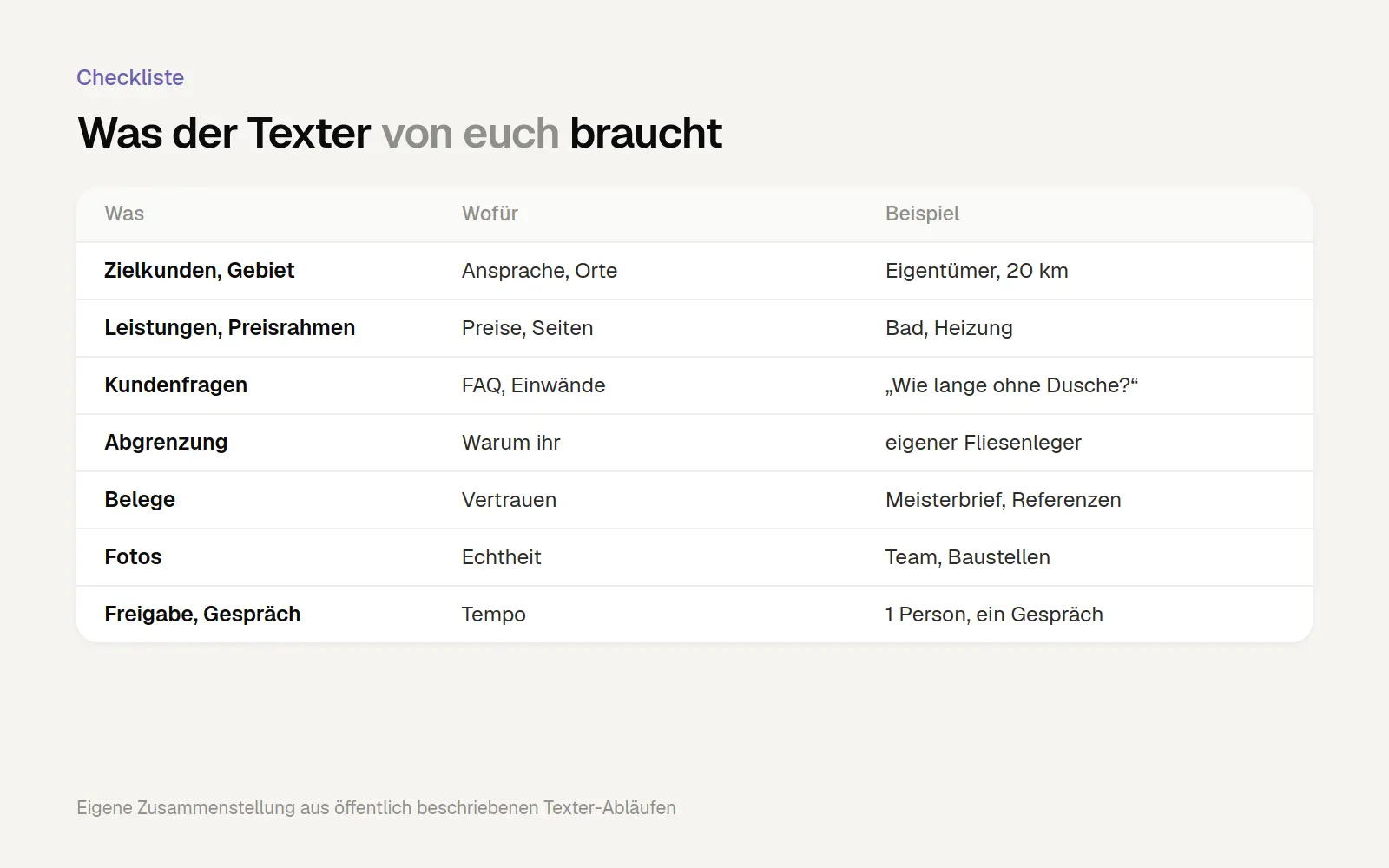
Checklist: What the copywriter needs from you. Source: Compiled by the author based on publicly described copywriting workflows. The examples refer to the fictional plumbing business.
How to Tell If an Offer Is a Good One
A price alone doesn't tell you much, as evidenced by the range for the same item reported by one agency. So, before placing an order, ask these questions:
If there are multiple service pages: Does this include a consultation with us, or do you just write based on the briefing or questionnaire?
Is keyword research included, and will we be able to see the results?
Do you include page titles and meta descriptions for each page?
How many rounds of proofreading are included in the price, and how much does each additional round cost?
What usage rights are you granting us? Exclusive, perpetual, and including use in print and on social media?
Do you use AI, and if so, for what? Who verifies the facts?
Who exactly is writing it: you, or someone you're assigning the task to?
Can you provide examples of website content, not just blog posts?
Do you also incorporate the text, or do you provide a document?
A sample text can be helpful if you're unsure. Pay a fair price for it instead of asking for it for free. A paid sample text shows you how someone really works.
There are also red flags. For a website with multiple service pages, a quote based solely on word count—without any consultation or research. Promises like “Guaranteed #1 on Google,” which no reputable provider can make. No mention of usage rights. And texts that are finished before anyone has even asked a single question about your business.
Frequently Asked Questions
How much does it cost to have SEO content written?
According to the price lists from content.de and Textbroker, you pay between 1.6 and 8.0 cents per word (net), plus small fees per text (as of October 23, 2026). Individual copywriters and agencies publicly quote around 500 to 1,200 euros for a subpage that includes an interview and research—some of these rates are net, while others do not specify. We were unable to find a recent, publicly available survey on copywriting rates in Germany.
What is the difference between SEO content and website content?
SEO content is optimized for specific keywords so that a page can be found on Google. Website content is meant to convince visitors. Good website content does both. Content written solely for Google may attract visitors, but it won’t generate inquiries. Content without the right keywords may be persuasive, but it’s unlikely to be found.
Does Google recognize AI-generated text, and is that a problem?
According to Google, it evaluates quality, not how content is created. A 2023 post states: “Our focus on the quality of content, rather than how content is produced, is a useful guide.” The problem lies with many pages that offer no added value, regardless of whether they are written by humans or AI. An AI-generated draft that you supplement with your own facts and carefully review is not a problem.
Do we have to label AI-generated text on the website?
Generally not, as long as a human reviews the texts and bears editorial responsibility for them. This is the exception outlined in Article 50(4), second subparagraph, of the AI Regulation, which the Federal Network Agency also refers to. For texts on topics of public interest, such as news, a more thorough review is warranted. Separate rules apply to AI-generated images and videos. This is not legal advice.
How long should a website text be?
Long enough to answer your customers’ questions—and no longer. We’re not aware of any evidence that Google prefers a specific word count. A services page that explains price ranges, the process, the service area, and duration can easily reach a few hundred words. A homepage that primarily directs visitors to the services section needs fewer words.
How long does it take to have website content written?
A single piece of copy can be completed quickly through a copywriting marketplace. However, when you factor in discussions, research, and proofreading, a few weeks is a realistic estimate; one copywriter estimates four to six weeks for a homepage plus five subpages. Much depends on how quickly you provide the necessary materials and approvals.
Does the website's structure have to be finished already?
No, it should be developed alongside the copy, based on your content and keyword research. If you finish the design first and then look for suitable copy, you’ll often have to tweak both.
Conclusion: How Much Website Content Costs and What Matters
For a small website like the one in our example calculation, having the content written costs anywhere from a little over 100 euros on a freelance writing platform to around 3,000 euros or more when hiring a copywriter or an agency. The difference rarely lies in the words themselves, but rather in the work that goes into them beforehand: listening, researching, and organizing. AI can help with this. Google has no problem with this, as long as a human reviews the content and each page serves a genuine purpose. More important than any specific labeling is that you secure the usage rights in writing and make only verifiable advertising claims.
You can check for yourselves whether a text is effective. Does the first sentence explain what you do and where? Can a customer find the price range, process, and duration? Are there facts rather than mere claims? Is there a clear call to action with a clickable phone number? Does each page have its own page title and meta description? If you answer “no” to several of these questions, it’s worth taking a closer look at your content before you start thinking about a new design.
If you'd like a second opinion, send us a link to your homepage via our contact form. We'll take a look at it for free and let you know which three sentences we'd change first. You can check the technical basics—such as page titles, meta descriptions, and headings—yourself beforehand using our SEO checker.
More Articles
© Marschfahrt Studio
Practical knowledge on web design, SEO, AI, and conversion optimization. Based on real projects, without any marketing spin.

